

On this page
Naming amines can seem tricky when you see italicised *N*s and a mix of common and systematic names. Whether you are prepping for board exams or JEE, mastering amine nomenclature is a high-yield skill. Here is a breakdown of the IUPAC rules for primary, secondary, and tertiary amines.
How are primary, secondary, and tertiary amines classified?
Unlike alcohols and alkyl halides—where classification depends on the carbon atom—amines are classed by how many carbon groups are directly attached to the nitrogen atom.
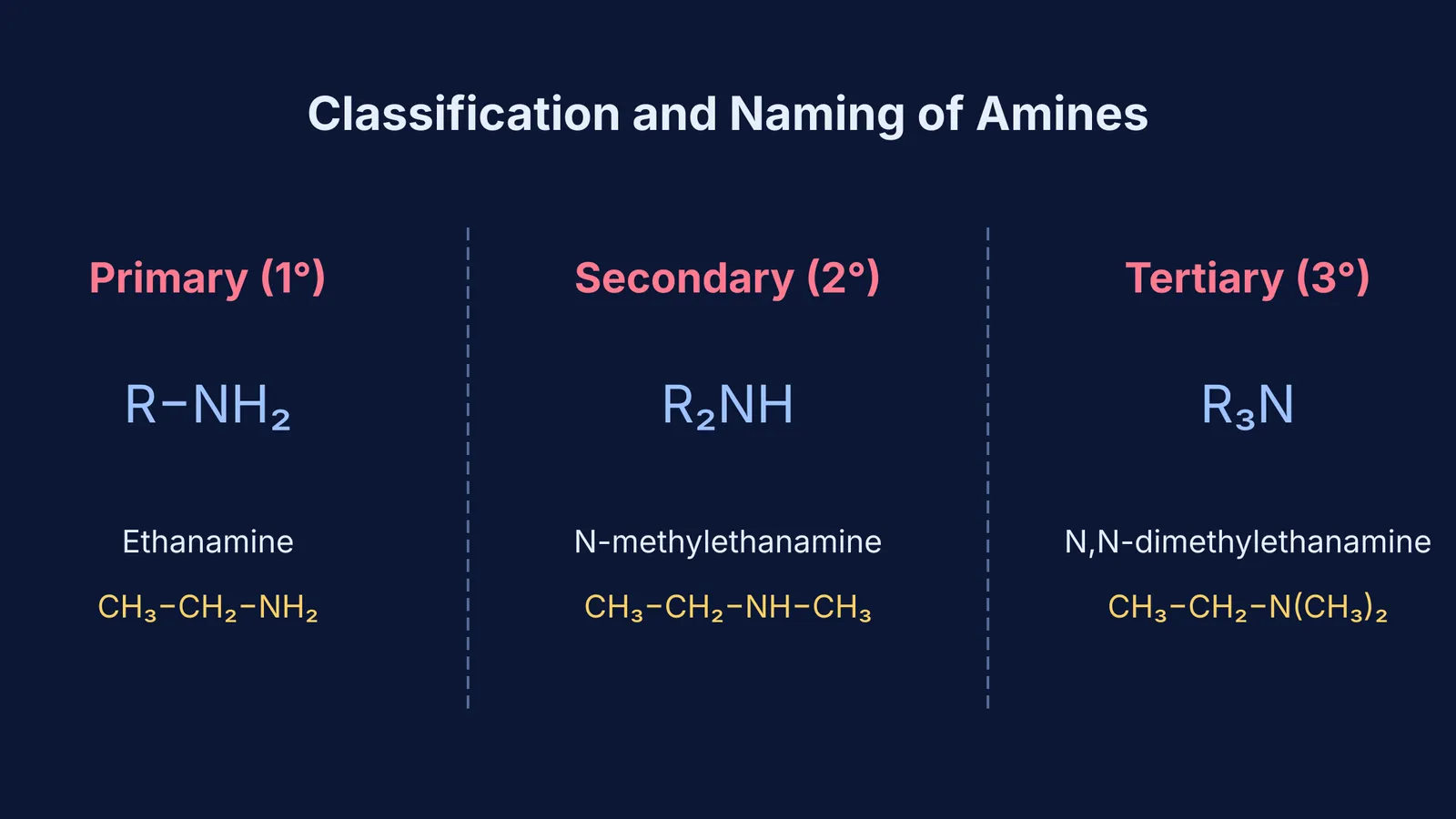
Primary (1°) amines have one carbon group attached to nitrogen (R−NH₂).
Secondary (2°) amines have two carbon groups attached to nitrogen (R₂NH).
Tertiary (3°) amines have three carbon groups attached to nitrogen (R₃N).
This means a molecule like *tert*-butylamine is actually a primary amine, because its nitrogen is only bonded to one carbon atom. For separating these classes in the lab, you might use Hinsberg's reagent.
What is the IUPAC rule for primary amines?
The *Nomenclature of Organic Chemistry* (often called the Blue Book) spans 1,612 pages and lays out the official rules for naming organic compounds. For a primary amine, the rule is straightforward:
Find the longest continuous carbon chain that is attached to the nitrogen atom.
Replace the "-e" ending of the parent alkane with the suffix "-amine".
Number the chain from the end closest to the amine group to give it the lowest possible locant.
For example, CH₃CH₂CH₂NH₂ is called propan-1-amine. Some syntheses, such as the Gabriel phthalimide synthesis, are specifically useful because they produce pure primary amines without secondary or tertiary by-products.
How do you name secondary and tertiary amines?
When nitrogen is bonded to more than one carbon group, the IUPAC rules treat the molecule as an N-substituted derivative of a primary amine.
Choose the parent chain: Select the longest or most complex alkyl group attached to the nitrogen. This forms the base alkanamine name.
Name the substituents: The other alkyl groups attached to the nitrogen are treated as substituents (like methyl or ethyl).
Use the "N-" prefix: Instead of a number locant, use an italicised *N-* to show that the group is attached to the nitrogen atom, not the carbon chain.
Worked example for a secondary amine: Look at CH₃−NH−CH₂CH₃.
The longest chain on the nitrogen is the ethyl group (two carbons), so the parent name is ethanamine.
The other group is a methyl group, attached to the nitrogen.
The IUPAC name is N-methylethanamine.
Worked example for a tertiary amine: Look at CH₃−N(CH₃)−CH₂CH₂CH₃.
The longest chain is the propyl group (three carbons), making the parent propan-1-amine.
There are two methyl groups attached to the nitrogen.
The IUPAC name is N,N-dimethylpropan-1-amine.
Notice that the locant *N* is repeated for each substituent, just as you would write 2,2-dimethyl. When substituents are different, list them in alphabetical order (e.g., *N*-ethyl-*N*-methylpropan-1-amine).
What about common names like aniline and benzylamine?
Many aromatic and simple amines have common names that are fully accepted by IUPAC.
Aniline: The simplest aromatic amine (C₆H₅NH₂) is widely called aniline, though benzenamine is the systematic name. If the nitrogen in aniline has substituents, they get the *N-* prefix. For example, C₆H₅N(CH₃)₂ is named N,N-dimethylaniline.
Benzylamine: This molecule (C₆H₅CH₂NH₂) features an amine group attached to a CH₂ group on a benzene ring. Its systematic name is phenylmethanamine, but benzylamine is very common.
If you suspect you have a primary amine—whether aliphatic or aromatic like aniline—you can confirm it in the lab using the carbylamine test, which produces a highly distinctive, foul-smelling isocyanide.
A quick checklist for naming amines
When faced with an amine structure in an exam, run through this checklist:
Count the carbon groups attached to nitrogen (1, 2, or 3) to classify it.
Identify the longest carbon chain attached to nitrogen. This is your parent "-amine".
Name any remaining groups on the nitrogen as alkyl substituents.
Put an *N-* in front of each substituent on the nitrogen.
Arrange the substituents alphabetically.
Practise these rules, and those intimidating *N*-prefixes will become the easiest part of organic nomenclature. To review these rules in detail, explore the Concept Library.


