

On this page
Naming a simple, unsubstituted ring like cyclopentane or cyclohexane is straightforward: you simply count the total number of carbon atoms in the closed loop and add the prefix *cyclo-* to the corresponding alkane name. But when you add alkyl groups, double bonds, halogens, or long carbon chains, the IUPAC rules demand a strict order of operations to ensure every chemist draws the exact same structure from a given name.
Here is how to choose the parent structure, number the ring carbons correctly, and break numbering ties with alphabetical order.
Is the ring or the chain the parent molecule?
The most common source of confusion in naming cycloalkanes is deciding whether the ring itself or an attached acyclic carbon chain serves as the parent molecule.
Historically, the rule was based purely on size: whichever part had more carbon atoms became the parent structure. Under this older rule, which is still taught in many standard textbooks, a three-carbon cyclopropyl group attached to a six-carbon chain is named 1-cyclopropylhexane.
However, the 2013 IUPAC Recommendations simplified this approach to reduce ambiguity. For hydrocarbons, a ring always has seniority over a chain, regardless of the number of carbon atoms. Under these modern Preferred IUPAC Name (PIN) rules, that exact same molecule is named hexylcyclopropane.
Before taking a major competitive exam like JEE or CBSE, it is always a good idea to check whether your specific syllabus follows the traditional carbon-counting rule or the updated 2013 IUPAC rule.
How do you number the ring for the lowest locants?
If the cycloalkane ring has only one attached substituent, no position number is needed. A cyclohexane ring with a single methyl group is simply called methylcyclohexane.
When there are two or more substituents, you must number the ring carbons to give those substituents the lowest possible set of locants (numbers) at the first point of difference.
For example, if a cyclohexane ring has methyl groups at positions 1, 2, and 4, it is named 1,2,4-trimethylcyclohexane. You would not number it as 1,3,4-trimethylcyclohexane, because the second locant (2) is lower than (3), giving the first set priority.
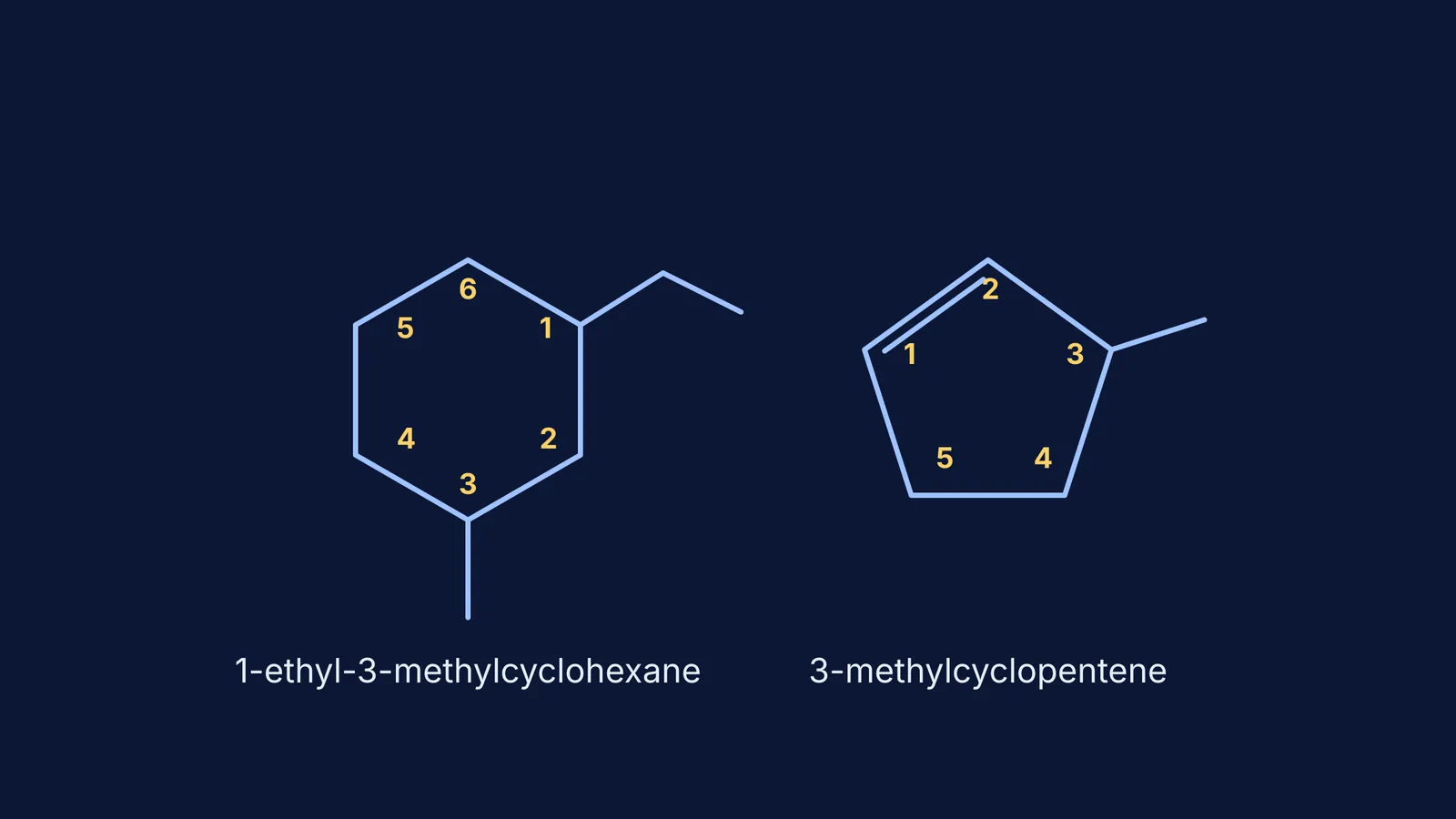
If the ring contains a double bond, such as in cyclopentene, the carbons of the double bond are automatically assigned positions 1 and 2. You then number through the double bond in the direction that gives the first attached substituent the lowest possible number.
When is alphabetical order used as a tie-breaker?
What happens when two different numbering paths give the exact same set of low locants? You break the tie using alphabetical order.
Imagine a cyclohexane ring with an ethyl group and a methyl group on adjacent carbons. You could assign C1 to the methyl-bearing carbon and C2 to the ethyl-bearing carbon, or vice versa. Because "ethyl" comes before "methyl" in the alphabet, the ethyl group gets the C1 position. The correct IUPAC name is 1-ethyl-2-methylcyclohexane.
Note that prefixes indicating how many identical groups are present (like *di-*, *tri-*, or *tetra-*) are ignored when alphabetising. For instance, an ethyl group takes alphabetical priority over a dimethyl group, because you compare the "e" in ethyl with the "m" in methyl, ignoring the "di" prefix entirely. This is a common trap in chemistry exams.
How do you name an unsaturated cycloalkane?
Let's apply these IUPAC nomenclature rules to a five-membered ring containing one double bond and one methyl group attached to the ring.
Find the parent: The basic five-membered carbon ring with a double bond is named cyclopentene.
Number the double bond: The two carbon atoms sharing the double bond must be assigned positions C1 and C2.
Find the lowest locant: We have two choices for numbering around the ring. We can number starting at the double bond carbon closest to the methyl group, which puts the methyl substituent at C3. Or, we can start at the other double bond carbon, which forces us to count further around the ring and puts the methyl at C5.
Final name: Since 3 is lower than 5, the correct numbering path is the one that gives us 3-methylcyclopentene.
If you find yourself stuck on priority rules or complex molecules, the Fermi Concept Library holds a lesson for every concept in chemistry to help you trace the exact logic. For specific examples, the Fermi Problem Library features a step-by-step solver that explains the reasoning rather than just printing the final name.
For further practice, try drawing structural isomers in Class 10 or reviewing the basics of naming carbon compounds in Class 10 before moving on to multi-substituted rings.


