On this page
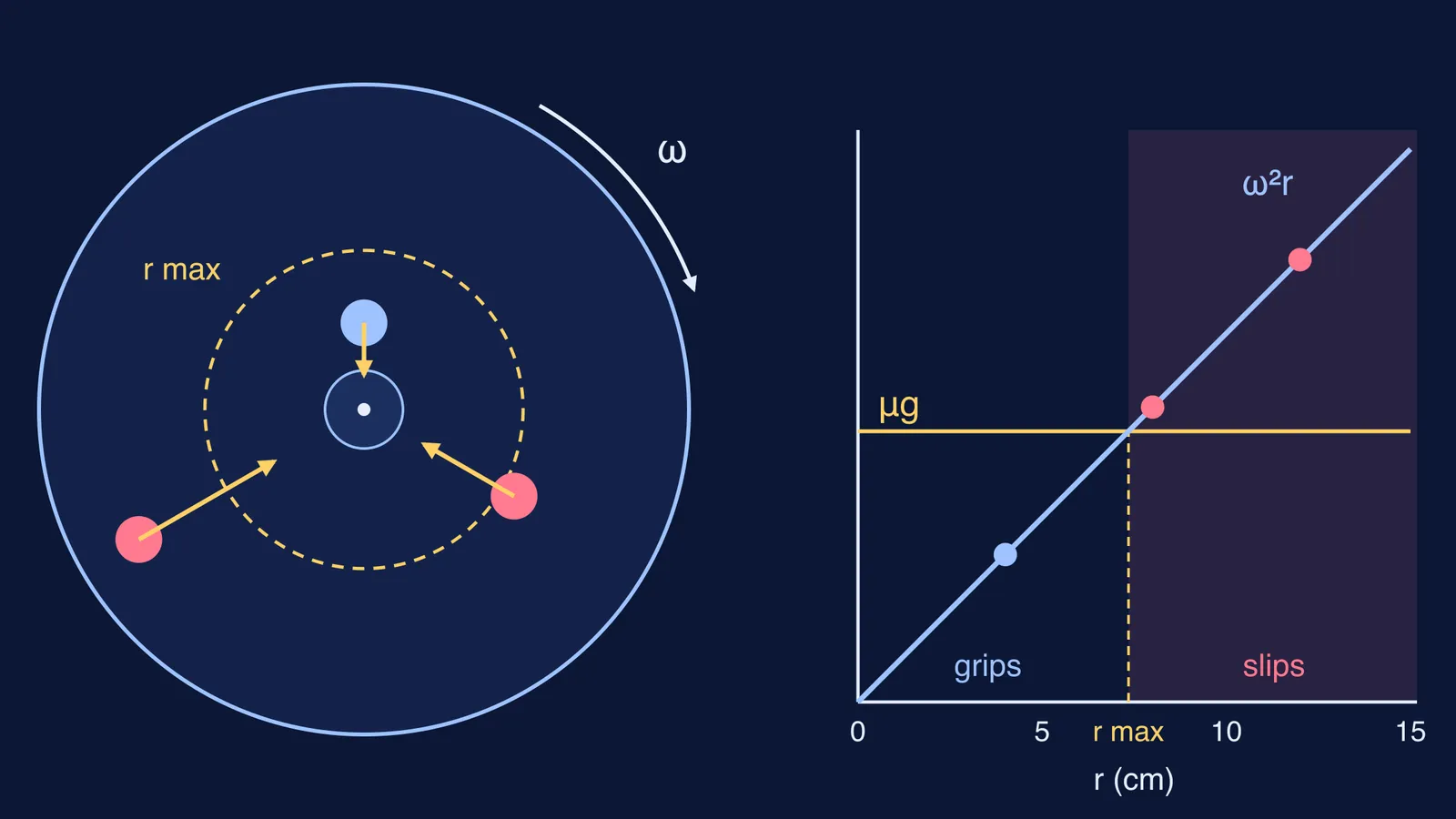
You put three identical coins on a record: one near the label, one halfway out, one near the rim. You switch the turntable on and turn up the speed. Which one slides off first? The usual guesses are the heaviest, or all at once. Neither is right, and the reason is one inequality.
Why does a coin on a rotating turntable slip at all?
To move in a circle, the coin needs a net force pointing at the centre. OpenStax's University Physics puts it plainly: "Any net force causing uniform circular motion is called a centripetal force" (OpenStax University Physics, Centripetal Force). Its size is F = mω²r, where ω is the angular speed in radians per second and r is the distance from the centre.
On a flat turntable, the only thing pulling the coin inward is friction from the disc. The ceiling on static friction is f(max) = μs·N, where μs is the coefficient of static friction (OpenStax University Physics, Friction). On a level disc N = mg, so the most friction can give is μs·mg.
The coin grips while mω²r ≤ μs·mg. Cancel m on both sides:
A coin on a turntable stays put while ω²r ≤ μs·g, so it slips beyond the radius r = μs·g/ω².
Three things fall out of that line:
Mass cancels. A heavy coin and a light coin of the same metal, at the same radius, slip together.
The friction needed grows with r; the friction available does not. At any speed, the outermost coin goes first.
Speed counts as a square. Doubling ω cuts the safe radius to a quarter.
OpenStax works the same idea for a car on a flat curve: 25 m/s on a 500 m radius needs μs of at least 0.13 (OpenStax, Centripetal Force). The coin is the same problem, shrunk.
At what radius does a coin slip on a record player?
Record players run at standard speeds: 33⅓ rpm for 12-inch LPs, 45 rpm for 7-inch singles, and 78 rpm for older shellac discs (Wikipedia, Phonograph record). For μs, take 0.5, the static coefficient OpenStax lists for metal on wood (OpenStax friction table). A coin on a rubber mat or on vinyl will differ, so treat this as a worked illustration. Use g = 9.8 m/s², so μs·g = 4.9 m/s².
Convert rpm to rad/s with ω = rpm × 2π/60:
At 33⅓ rpm, ω ≈ 3.49 rad/s and ω² ≈ 12.2 per s², so r ≈ 4.9/12.2 ≈ 0.40 m. A 12-inch LP's radius is about 15 cm, so every coin stays.
At 45 rpm, ω ≈ 4.71 rad/s and ω² ≈ 22.2 per s², so r ≈ 0.22 m. Still beyond the edge of an LP.
At 78 rpm, ω ≈ 8.17 rad/s and ω² ≈ 66.7 per s², so r ≈ 0.073 m. A coin more than about 7.3 cm from the spindle slips.
Now flip the question. Keep coins at 4 cm, 8 cm and 12 cm and raise the speed slowly. Each slips when ω = √(μs·g/r):
12 cm coin: ω ≈ 6.39 rad/s, about 61 rpm.
8 cm coin: ω ≈ 7.83 rad/s, about 75 rpm.
4 cm coin: ω ≈ 11.1 rad/s, about 106 rpm.
Halving the radius raises the slipping speed by a factor of √2, not 2.
How do you test it in a simulation?
Commit to a prediction before you press play:
Write down which coin slips first, and at roughly what rpm, using r = μs·g/ω².
Place coins at three radii and set μs.
Raise the speed slowly; note the rpm at which each coin slips.
Change only the mass. Your prediction: nothing moves.
Halve μs. Your prediction: at a given speed, every slip radius halves.
If a coin slips a little early, check the ramp: while the disc speeds up, friction must also supply a tangential push, mαr, on top of mω²r. Ramp slowly and the gap closes.
Try this predict-then-run test in the Fermi Simulation Lab, which has interactive simulations for ideas that are easier to see than to read. If you are stuck on why friction points inward, Fermi's AI tutor notices where you are stuck and decides whether to explain, ask or show.
Why does the coin slide outward if the force points inward?
From the ground, there is no outward force. Once friction cannot keep up, the coin carries on closer to a straight line while the disc turns beneath it, so it drifts towards the rim. The "flung outward" feeling belongs to the rotating frame. Related reads: how to make an AI name the real force behind centripetal force, static vs kinetic friction as you pull a block and Coulomb's laws of friction.