

On this page
A brick lying flat or standing on its edge takes about the same push to start sliding. Charles-Augustin de Coulomb, a French military engineer, turned that puzzle into measured physics. The rules he tested in 1781 are the friction laws in your Class 11 textbook.
Who was Coulomb, and what did he test in 1781?
Coulomb (1736 to 1806) spent twenty years and seven field posts as an officer in France's military engineering corps, including eight years in Martinique building Fort Bourbon, according to the Dictionary of Scientific Biography. Posted to Rochefort in 1779, he used the naval shipyards there as a laboratory for a long series of friction experiments, as the MacTutor biography from the University of St Andrews records.
The result, a memoir called *Théorie des machines simples* (Theory of simple machines), won the double first prize of the Paris Academy of Sciences in 1781 and got Coulomb elected to the Academy (Dictionary of Scientific Biography). He measured static friction (before sliding starts) and dynamic friction (during sliding), and summed up his data with two-term equations: a constant, plus a term that changed with normal force, velocity, time or other conditions (MacTutor).
What did Coulomb find about friction and contact area?
Coulomb confirmed Guillaume Amontons's work of 1699: friction has an approximately linear relationship with the normal force, the force pressing the surfaces together (Dictionary of Scientific Biography). He went further, measuring how friction changed with materials, lubrication, velocity and resting time. His work remained the standard on friction for about a century and a half; the same source quotes the friction historians Kragelsky and Schedrov: "Without exaggeration, one can say that he created this science."
A 2021 paper by Elena Popova and Valentin Popov of TU Berlin, rereading Coulomb's text, says he found the coefficient of friction depends only weakly on contact area, normal force and velocity. The dependencies are of "logarithmic character": a parameter had to change by several orders of magnitude to change the coefficient by a factor of two. Amontons' law held well for metal on metal, less well for wood on wood or wood on metal.
How do Coulomb's findings become the Class 11 laws of friction?
Section 4.9.1 of the NCERT Class 11 Physics chapter on Laws of Motion gives the version you need for CBSE and JEE Main:
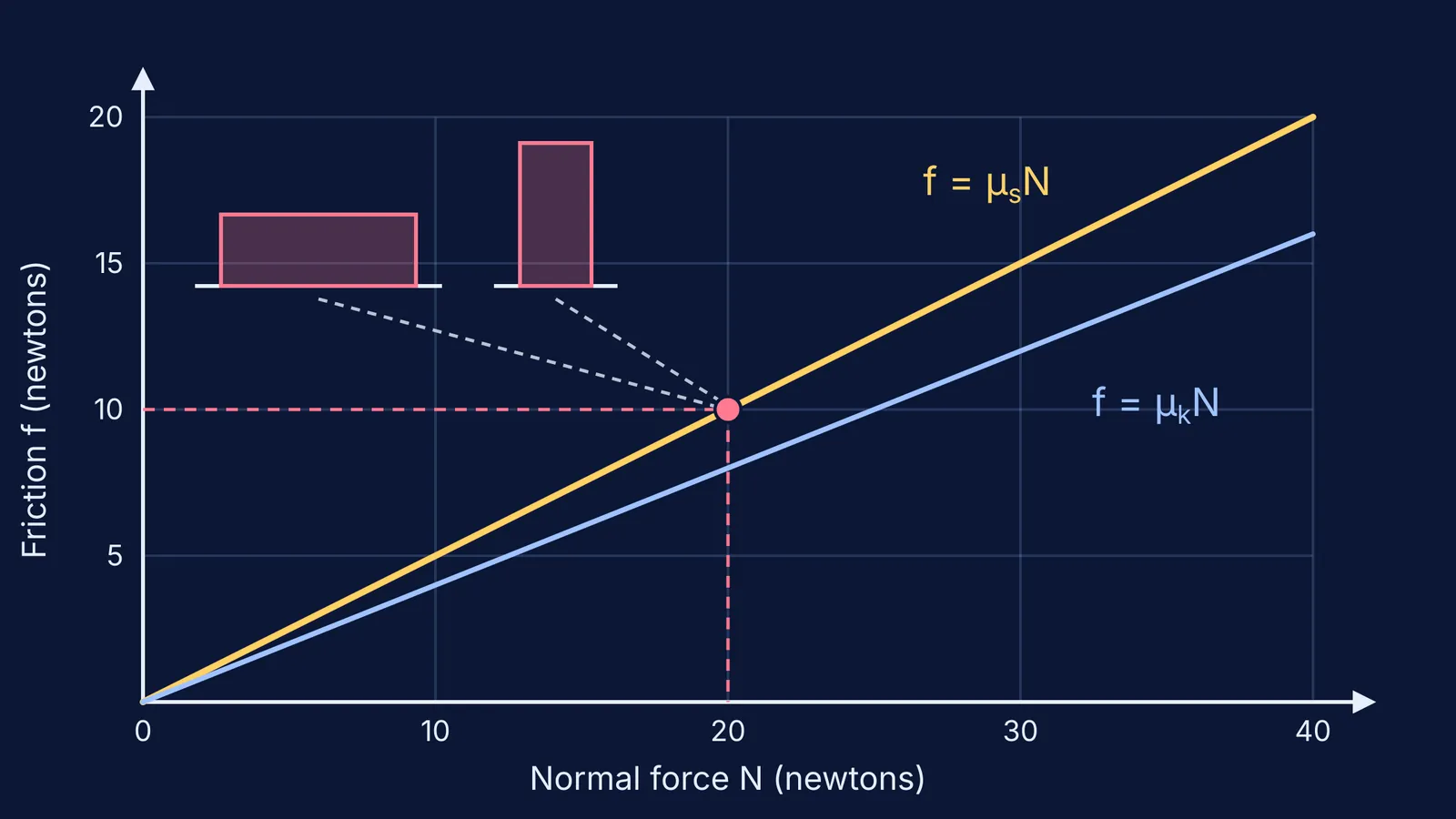
Limiting static friction is independent of the area of contact and varies with the normal force approximately as (fs)max = μsN, where μs depends only on the two surfaces.
Static friction adjusts itself: fs ≤ μsN. Below the limit, it equals the applied force.
Kinetic friction obeys fk = μkN, is independent of contact area, is nearly independent of velocity, and μk is less than μs.
NCERT adds a line Coulomb would have recognised: "The laws of friction given above do not have the status of fundamental laws like those for gravitational, electric and magnetic forces." More in our explainer on why friction does not depend on contact area.
Worked example: does a brick slide more easily on its edge?
Take a 2 kg brick on a floor with μs = 0.5, μk = 0.4 and g = 10 m/s².
Normal force: N = mg = 20 N, flat or on edge. Area never enters the formula.
Limiting friction: (fs)max = 0.5 × 20 = 10 N, either way.
Push with 6 N: the brick stays put, and friction is 6 N, not 10 N.
Push with 12 N: that beats 10 N, so it slides. Kinetic friction is 0.4 × 20 = 8 N, so a = (12 − 8) ÷ 2 = 2 m/s².
Press down with an extra 10 N: N = 30 N, so limiting friction is 15 N. Change the normal force and friction changes; change the face and it does not.
The mistakes that cost marks:
Writing f = μsN when the body is not sliding or about to slide.
Assuming N = mg on an incline, or when a force pulls at an angle.
Forgetting that the slipping angle on an incline satisfies tan θ = μs, whatever the mass. NCERT's Example 4.8 gets μs = tan 15° ≈ 0.27.
If you keep picking the wrong formula, the Fermi Problem Library has worked problems with a step-by-step solver that explains the reasoning rather than printing an answer. Step 3 is explained further in why static friction is often less than μN.
How can you test Coulomb's law yourself?
Pull a wooden block slowly with a spring balance; note the reading as it starts to slide.
Add weights in equal steps and repeat. Plot friction against normal force: the slope is μs.
Turn the block onto a narrower face at the same load. The readings should barely change.
Our limiting friction and normal reaction practical guide covers the lab version. To watch the forces change, the Fermi Simulation Lab has interactive simulations for ideas that are easier to see than to read.
Next time you write μN in an answer, remember Coulomb measured it in a shipyard at Rochefort.


