

On this page
Imagine you have a 10 kg box sitting on a floor. The coefficient of static friction (μₛ) is 0.5. You push it gently with a force of 20 Newtons. What is the force of static friction?
If you plug the numbers into fₛ = μₛN, you get fₛ = 0.5 × (10 × 9.8) = 49 N.
But wait. You are pushing forward with 20 N, and friction is pulling backwards with 49 N. Does the box accelerate backwards into you? No. The box stays perfectly still. The actual friction force is exactly 20 N.
This is a common trap in mechanics. Static friction is not a fixed number; it is a lazy force that only does exactly as much work as it needs to.
Why is static friction not always mu times normal force?
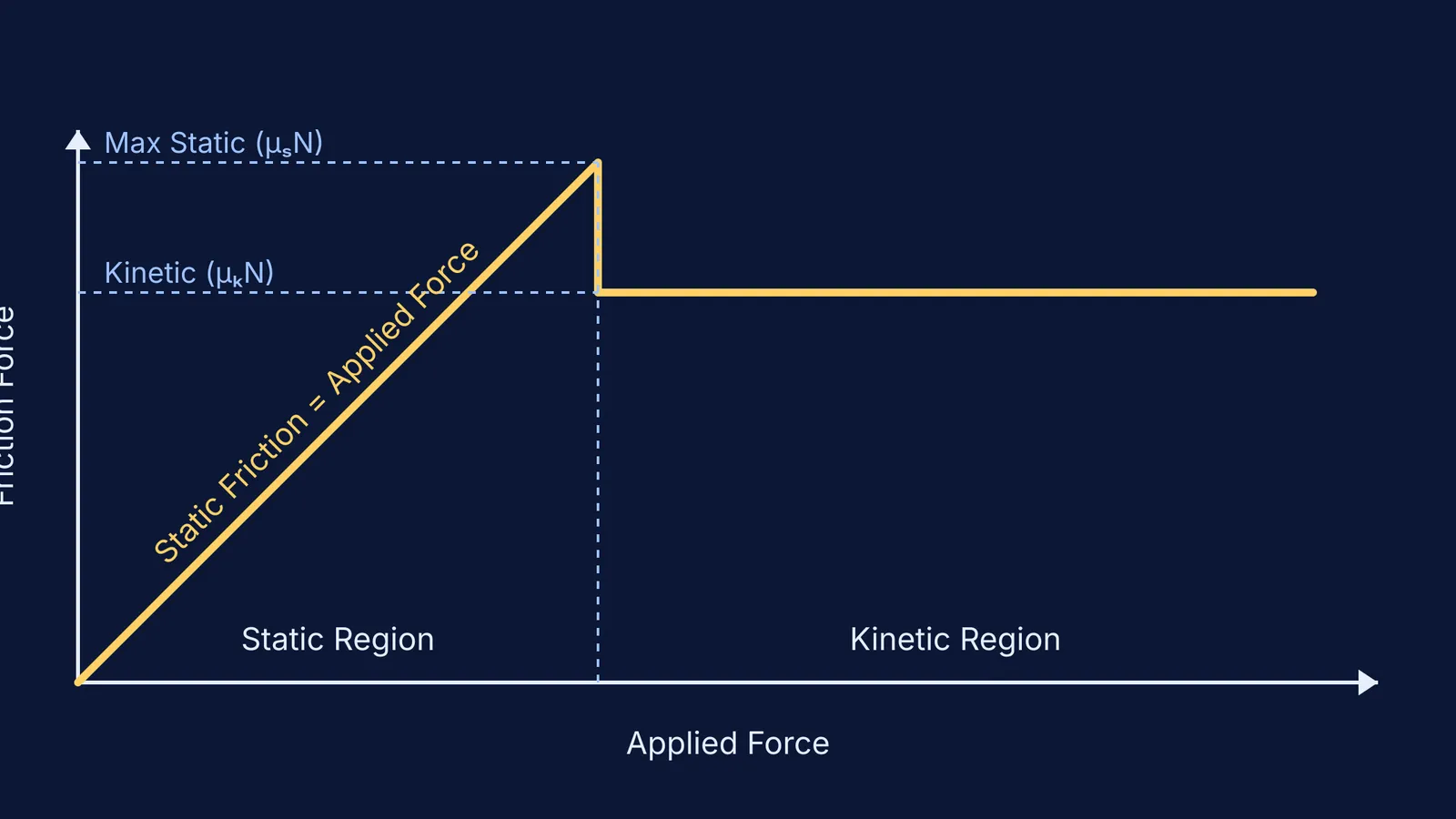
The formula fₛ = μₛN only tells you the maximum possible friction before the object breaks its grip and starts to slide. As OpenStax University Physics explains, the true relationship is an inequality: fₛ ≤ μₛN.
Think of μₛN as the breaking point. If you don't push the box at all, static friction is zero. If you push with 20 N, friction pushes back with 20 N. It will keep matching your push, newton for newton, right up until you hit 49 N. Only at that exact threshold of impending motion does fₛ = μₛN. If you push with 50 N, the grip breaks, the box slips, and kinetic friction takes over.
Why do so many students make this mistake?
If you have ever calculated a massive friction force for an object that isn't moving, you are not alone. A 2021 study in *Physical Review Physics Education Research* reviewed 42 primary papers to classify student difficulties with solid friction, finding persistent misconceptions across different countries and education systems.
The confusion usually starts because kinetic friction is taught as a simple equation (fₖ = μₖN). When students learn the static friction formula next, they naturally assume it works the same way. The subtle "less than or equal to" sign is easily forgotten during a timed exam like JEE Main.
When you make a wrong-method mistake like this in the Fermi Problem Library, the AI tutor does not just print the correct answer. It notices where you are stuck and holds a line of reasoning, asking you to compare your applied force to the μₛN limit before you move on to the next step.
How do you solve static friction problems correctly?
To avoid falling into the μₛN trap, never calculate friction in isolation. You can use this three-step framework for any static friction problem:
Assume it stays still: First, pretend friction is perfectly grippy. Use Newton's second law (Net Force = 0) to calculate exactly how much friction is *required* to keep the object from moving.
Find the breaking point: Now, calculate the maximum possible static friction (f_max = μₛN).
Compare the two:
If the required friction is less than or equal to f_max, the object stays at rest. The actual friction is simply the required force.
If the required friction is greater than f_max, the object slips. The static hold is broken, and you must use kinetic friction (fₖ = μₖN) to find the acceleration.
Let us apply this framework to our 10 kg box from earlier:
Step 1: We push with 20 N. For the box to stay at rest, the net force must be zero, meaning the required friction is exactly 20 N.
Step 2: The maximum static friction is μₛN, which we calculated as 0.5 × (10 × 9.8) = 49 N.
Step 3: Since our required friction (20 N) is strictly less than the maximum possible friction (49 N), the box does not slip. The actual friction force remains exactly 20 N.
This same logic applies to more complex setups, such as finding the angle of repose on an inclined plane or figuring out which way a spool pulled by a string will roll. In every case, μₛN is a boundary, not a guarantee.


