

On this page
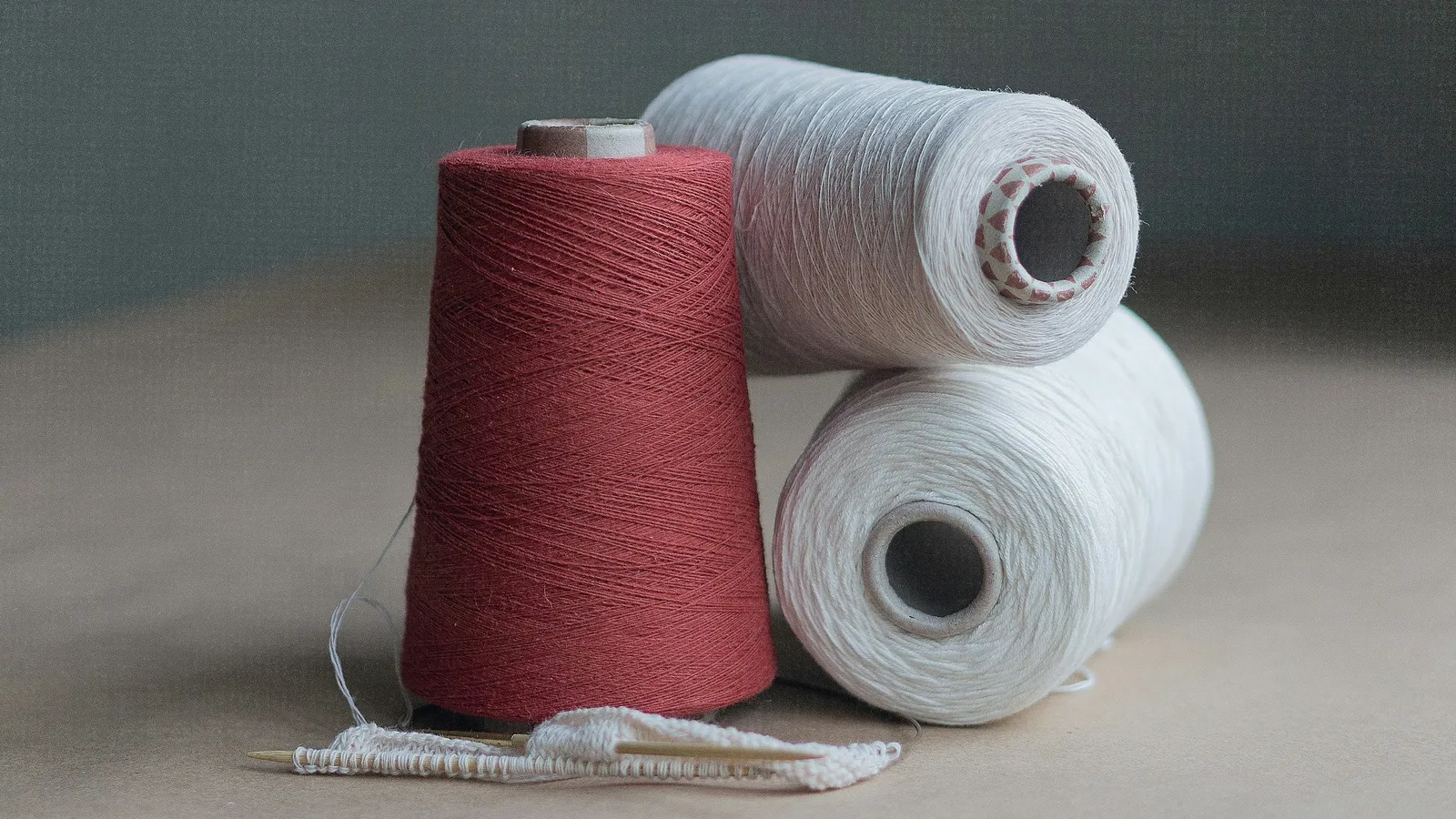
Lay a cotton reel on a table so the thread comes off the bottom of its axle, and pull the thread gently along the table. The reel rolls towards you. Now raise your hand until the thread is nearly vertical and pull again: the reel rolls away from you. This puzzle is a favourite in JEE-style rotation problems because it can be answered in one line if you choose the right point to take torques about. This post shows that choice, works the numbers and lists the traps.
Is this on the syllabus?
The JEE (Advanced) 2026 brochure lists "Rolling without slipping of rings, cylinders and spheres" and the dynamics of rigid bodies. The JEE (Main) 2026 syllabus lists rolling friction, torque, and "rigid body rotation and equations of rotational motion"; the NEET (UG) 2026 syllabus has the same lines. Neither names rolling without slipping.
The current NCERT chapter Systems of Particles and Rotational Motion (2026-27 reprint) no longer has a section on rolling motion. It mentions a cylinder rolling down an incline in its introduction, noting that the contact point is at rest if it rolls without slipping, and then studies rotation about a fixed axis. So spool problems are an extension beyond the textbook, aimed mainly at JEE Advanced. For the basics, read our post on rolling without slipping on inclines.
What is the one idea that solves it?
When a spool rolls without slipping, the point P where it touches the table is momentarily at rest. Take torques about P:
Friction and the normal force both act at P, so they have no torque about it.
Gravity acts through the centre, directly above P, so it has no torque either.
Only the thread's pull has a torque about P.
So the direction of rolling depends only on which side of P the thread's line of action passes. Extend the thread down towards the table. If it passes above P, or reaches the table beyond P (on the far side from you), the spool rolls towards you. If it reaches the table between P and you, the spool rolls away. If it passes exactly through P, it cannot start rolling at all.
Worked example 1: a horizontal pull
Sample numbers: a spool of mass m = 0.5 kg, outer radius R = 5.0 cm and axle radius r = 2.0 cm, treated as a uniform disc, so I = ½mR². The thread leaves the bottom of the axle horizontally with tension F = 2.0 N. Take g = 10 m/s².
I = ½ × 0.5 × 0.05² = 6.25 × 10⁻⁴ kg m². About P (parallel axes): I_P = I + mR² = 1.875 × 10⁻³ kg m².
The thread is a height R − r = 0.03 m above P, so the torque about P is 2.0 × 0.03 = 0.06 N m.
α = 0.06 ÷ 1.875 × 10⁻³ = 32 rad/s², and a = Rα = 1.6 m/s² towards you.
Check with the centre of mass. Along the table: F − f = ma. About the centre: fR − Fr = Iα. Solving gives f = 1.2 N acting away from you, and indeed 2.0 − 1.2 = 0.8 = 0.5 × 1.6. Friction here is static, so rolling needs μ ≥ 1.2 ÷ 5.0 = 0.24.
Using torques about P works here because P is the instantaneous axis and the centre stays at a fixed height above it. Checking with the centre-of-mass equations, as above, is a good habit.
Worked example 2: tilt the thread
If the thread leaves the underside of the axle at angle θ above the horizontal, its lever arm about P is R cos θ − r. So a = FR(R cos θ − r) ÷ I_P, with the same sample spool:
θ = 30°: a ≈ 1.24 m/s² towards you.
θ = 60°: a ≈ 0.27 m/s², still towards you.
θ = 80°: a ≈ −0.60 m/s², away from you.
The switch comes where cos θ = r/R = 0.4, so θ ≈ 66.4°. At that angle the pull has no torque about P. Friction must then hold the whole horizontal pull, F cos θ = 0.8 N, while the normal force has dropped to 5.0 − 2.0 sin 66.4° ≈ 3.17 N, so μ ≥ 0.25. Pull harder and the spool slides instead. Mungan (2001) analysed this "well-known pulling angle at which it cannot roll without slipping". Wagner and Vaterlaus (2014) went further and mapped pulling angles at which the spool never starts to slip whatever the force, depending on the friction coefficient and the moment of inertia.
Which mistakes cost marks?
Guessing friction's direction. With the thread from the top of the outer rim of the same disc, a = FR(2R) ÷ I_P ≈ 5.33 m/s², so ma ≈ 2.67 N is more than F and friction must act towards you, about 0.67 N. Always solve for it.
Writing f = μN while the spool rolls. Static friction is only as large as needed. Our post on friction in block problems covers the same idea.
Forgetting the parallel-axis term in I_P.
Taking torques about P when the spool slips. P is then not at rest, and the shortcut fails.
Keeping N = mg for a tilted thread. The upward pull reduces it.
A practice routine
Try the cotton-reel experiment at three angles and predict each result first.
Redo example 1 for a ring-like spool (I = mR²) with r = 3.0 cm. You should get a = 0.8 m/s² and friction 1.6 N away from you.
Find the critical angle for r/R = 0.5 and 0.8 (60° and about 36.9°).
For every case, find friction from the centre-of-mass equations, then confirm the direction of rolling with torques about P.
For balancing torques in static problems, see our guide to ladders and torque equilibrium. When your friction sign keeps coming out wrong, the Fermi Problem Library has worked problems with a step-by-step solver that explains the reasoning rather than printing an answer.
Tonight, pull a reel of thread at a shallow angle and then a steep one, and explain each result with torques about the contact point.


