

On this page
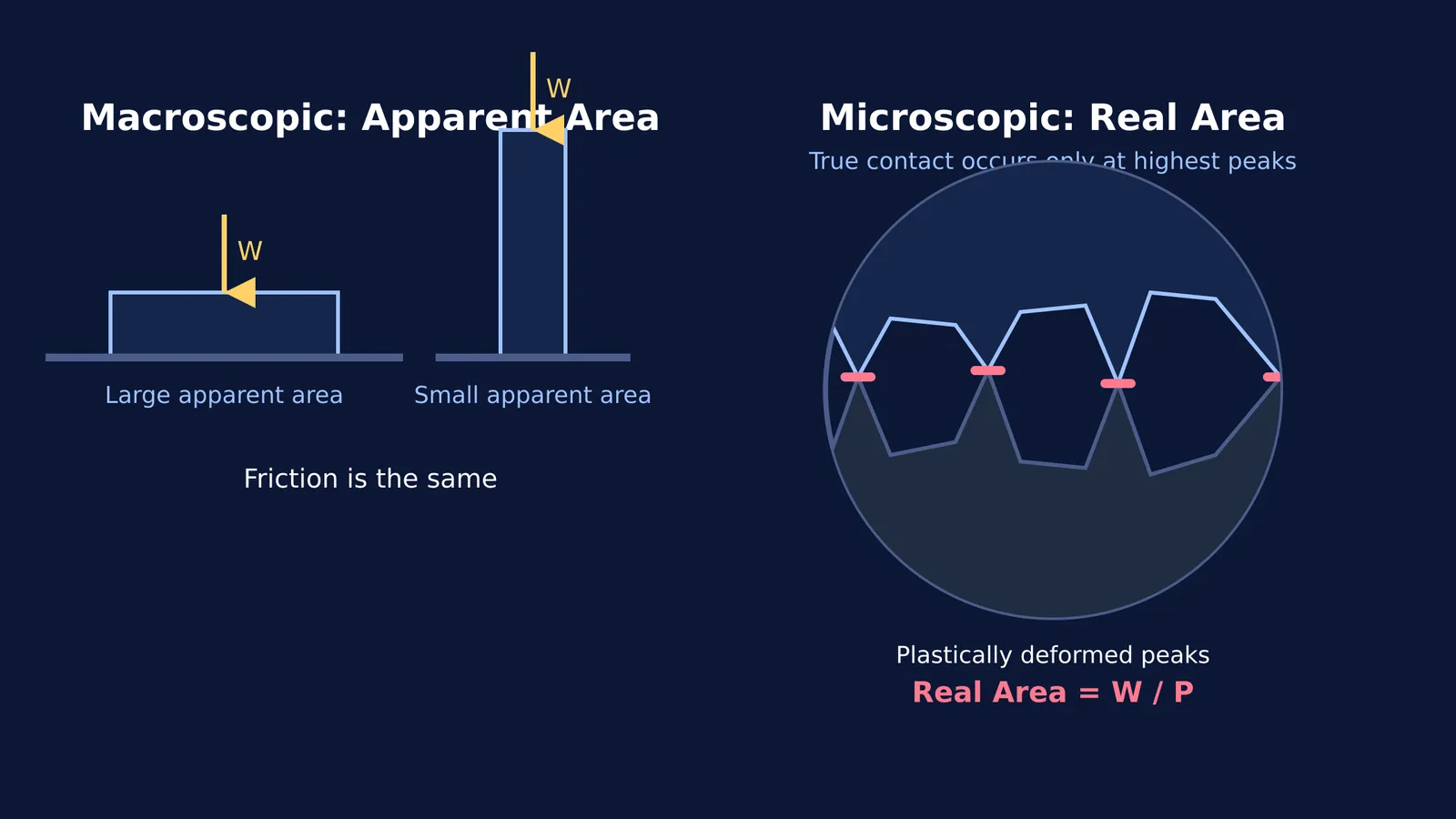
If you set a heavy textbook flat on a desk, its apparent area of contact is simply its length multiplied by its width. But if you stand the book up on its narrow edge, the area touching the desk shrinks dramatically. Yet, Amontons' laws of friction state that the force required to drag the book across the desk is exactly the same in both cases.
How can friction remain constant when the object has only a fraction of its surface in contact with the ground? The answer is that the apparent area you measure with a ruler is an optical illusion, and the real friction depends on microscopic forces you cannot see.
Does friction depend on surface area?
At the macroscopic level, friction is completely independent of the apparent surface area. As long as the mass of the object and the materials of the two surfaces remain the same, you can change the shape or orientation of the object without changing the friction force.
This counterintuitive rule is Amontons' Second Law. It is closely related to Amontons' First Law, which states that friction is proportional to the normal load. The standard equation you learn is f = μN, where N is the normal force and μ is the coefficient of friction. There is no area term in this equation. To understand why the area term is missing, we have to look through a microscope.
What is the real area of contact?
In 1939, Australian physicist Frank Philip Bowden and his colleague David Tabor published a seminal paper in the *Proceedings of the Royal Society of London* that redefined how we understand sliding objects. They proved that even highly polished metal or glass surfaces are not truly flat.
At the microscopic level, every surface is a jagged landscape of peaks and valleys called asperities. When you place two surfaces together, they do not touch everywhere. Bowden famously compared the situation to turning Switzerland upside down and resting it on top of Austria. The two surfaces only make intimate contact at the very tips of the highest microscopic mountains.
The sum of these tiny junction points is the real contact area. Because they only touch at the peaks, the real contact area is a tiny fraction of the apparent area.
How does the load change the real area?
Because the real contact area is so incredibly small, the pressure at those few points of contact is enormous. Even a light load (W) creates a local pressure that exceeds the yield strength of the material. This immense pressure causes the microscopic tips of the asperities to physically crush and deform like soft clay.
This process, known as plastic deformation, continues until the flattened peaks create just enough surface area to support the load without crushing further. Because of this, the real contact area (Ar) is governed by a simple equation:
Ar = W / P
Here, P is the yield pressure, which is a constant measure of the hardness of the softer material.
Notice that the apparent area is nowhere in this equation. If you stand the textbook on its narrow edge, there are fewer microscopic peaks making contact, but the entire weight of the book is concentrated on them. They crush much deeper, flattening out into wider individual spots. If you lay the book flat, there are thousands of contact points, but each one carries a tiny fraction of the weight, so they barely flatten at all.
In both cases, the total real contact area—and therefore the total friction force required to break those microscopic welds—remains exactly the same.
When does friction depend on area?
The Bowden-Tabor theory assumes that the surface peaks crush plastically. This holds true for rigid materials like metals, plastics, and wood. However, friction does depend on the contact area if the material deforms elastically instead of plastically.
Rubber tires are elastic. When you push rubber into the road, it springs back into shape rather than crushing permanently. Because of this, the real contact area for rubber is not strictly proportional to the load. A wider tire on a racing car actually generates more grip than a narrow one, which is why dragsters have massive rear wheels.
If you are practising mechanics and keep missing the subtle assumptions required for your equations, the Fermi Problem Library has worked problems with a step-by-step solver that explains the reasoning rather than printing an answer. For complex dynamic situations—such as determining whether pulling a spool by its string makes it roll forward or backward—you can explore the Fermi Concept Library, which has every concept in physics, chemistry, biology, mathematics and computing, each with its own lesson and its place in the map.


