

On this page
Class 11 students usually meet friction twice: as a formula in Laws of Motion, and on a lab bench with a block, a pulley and a weight box. This guide covers the set-up, a full set of sample readings, and how to get the coefficient of friction from the slope of your graph rather than one lucky trial.
What is the practical to study limiting friction and normal reaction?
It is Experiment 9 in Section A of the CBSE Physics (042) syllabus for 2025-26: "To study the relationship between force of limiting friction and normal reaction and to find the co-efficient of friction between a block and a horizontal surface." The same document gives the Class 11 practical exam 30 marks, of which 7 go to each of the two experiments you perform (one from each section) and 5 go to the viva on experiments, activities and project.
The physics comes from the NCERT Class 11 Physics chapter on Laws of Motion, which states that the limiting value of static friction is independent of the area of contact and varies with the normal force approximately as (fs)max = μs N. NCERT adds that μs depends only on the nature of the surfaces in contact, and that the laws of friction are empirical relations that are only approximately true. That matters when your points miss the line.
Unsure why friction can take any value up to μN? Read why static friction is often less than μN first.
How do you set up the block and pan?
The block rests on a horizontal table. A light string from its hook runs over a pulley at the table's edge to a small pan. Pan weights pull the block; weights on top press it harder into the surface.
Level the surface and clean it. Note the masses of the block and the empty pan.
Check the string is parallel to the table. A sloping string adds a vertical pull and changes N.
Add small weights to the pan, one at a time, until the block just starts to slide. Record the total pan mass, including the pan itself.
Put a slotted weight on the block and repeat. Take five or six sets with increasing mass on the block.
For each set, calculate N = (block mass) × g and F = (pan mass) × g, each mass including its weights.
How do you find μ from the F vs N graph?
Here is a worked example with sample readings, taking g = 9.8 m/s² and a 100 g block. Each mass includes the weights added to it.
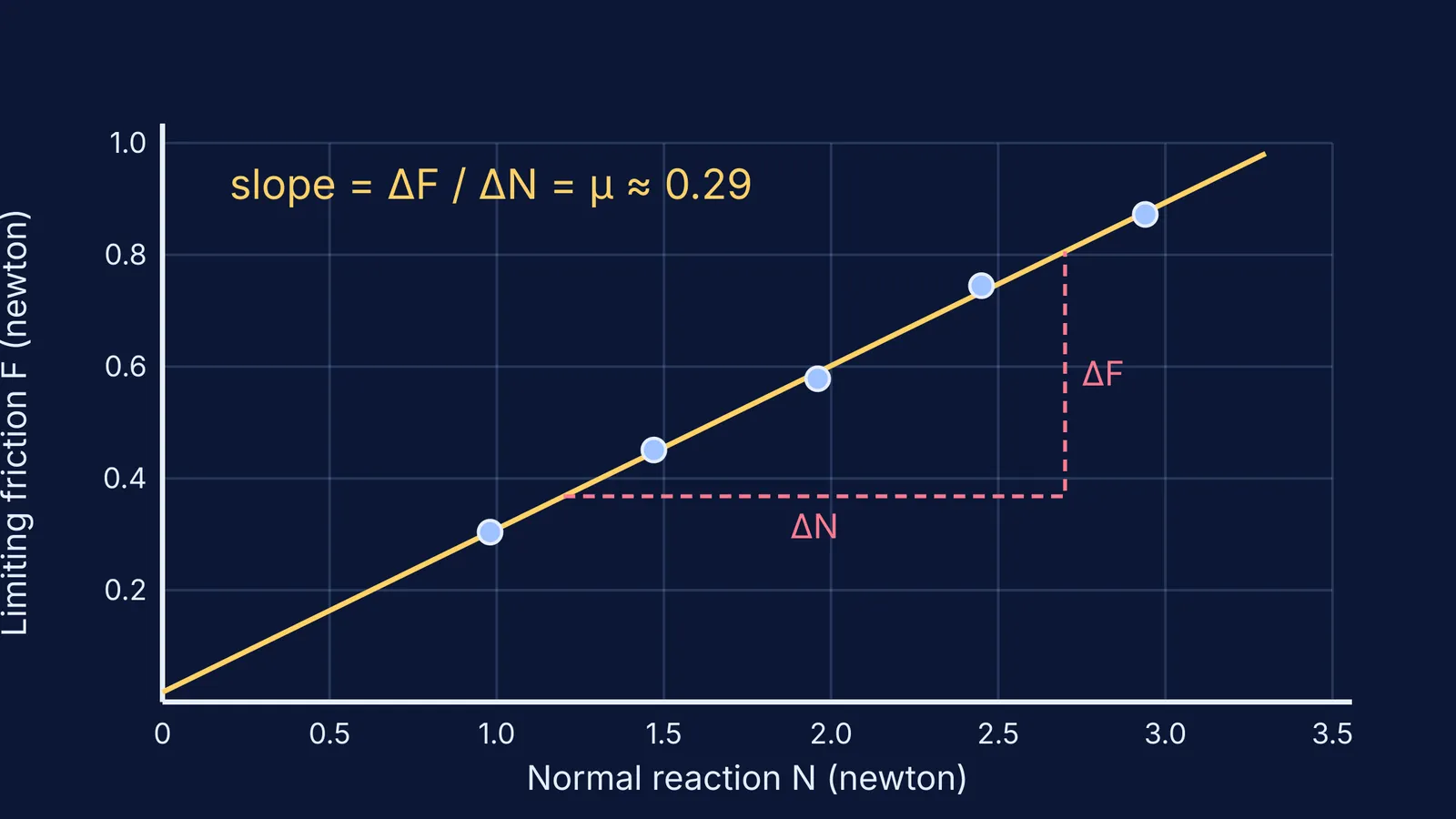
Block 100 g, pan 31 g: N = 0.98 N, F = 0.304 N
Block 150 g, pan 46 g: N = 1.47 N, F = 0.451 N
Block 200 g, pan 59 g: N = 1.96 N, F = 0.578 N
Block 250 g, pan 76 g: N = 2.45 N, F = 0.745 N
Block 300 g, pan 89 g: N = 2.94 N, F = 0.872 N
The single-reading ratios F/N range from 0.295 to 0.310. Plot N on the x-axis and F on the y-axis, then draw one best straight line rather than joining the dots. Pick two points on that line far apart, not two of your readings. Using N = 0.98 N (F = 0.304 N) and N = 2.94 N (F = 0.876 N) from the line, the slope is (0.876 − 0.304) ÷ (2.94 − 0.98) = 0.572 ÷ 1.96 ≈ 0.29. That slope is μ for this block on this surface.
The slope averages out small errors in judging the moment of slipping. A least-squares fit of the same five readings gives the same 0.29, with a line that crosses the F-axis at about 0.02 N, close enough to zero for an empirical law. For scales and labels, see our guide to plotting graphs in physics practicals.
What mistakes cost marks in this practical?
Adding weights in big jumps near the limit, so the block slides well past it.
Pushing or tapping the block to start it, which mixes in kinetic friction.
A dusty or wet patch on the table, which changes μ between readings.
Reporting μ with units. It is a ratio of two forces, so it has none.
Three viva questions to rehearse aloud: Why does the graph pass close to the origin? What would happen to μ if you turned the block onto a smaller face? (NCERT's answer above, and our post on why friction does not depend on contact area, will help.) Why is kinetic friction measured differently?
If the gap is the idea itself, the Fermi Concept Library gives every concept in physics its own lesson and its place in the map. When it is the numericals that go wrong, the Fermi Problem Library has worked problems with a step-by-step solver that explains the reasoning rather than printing an answer.
Before lab day, rule a five-row table in your notebook with columns for both masses, N and F, and fill it in live.


