

On this page
Most CBSE physics practicals end in a graph, and the graph is where careful readings either become a clean result or lose marks. The CBSE physics curriculum for 2026-27 lists graph-based experiments in both years, from the V–I graph for resistivity and the prism i–d graph in Class 12 to the simple pendulum and P–V graphs in Class 11.
How many marks does the graph carry in a CBSE physics practical?
The CBSE 2026-27 physics curriculum sets the practical exam at 30 marks over 3 hours in both Class 11 and Class 12. Two experiments carry 7 marks each, the practical record 5, one activity 3, the investigatory project 3 and the viva 5.
The curriculum does not split the 7 marks, so the graph's share depends on your examiner. Your graphs also appear in your practical record (at least 8 experiments, 4 from each section) and can come up in the viva. Class 11 even lists an activity "to plot a graph for a given set of data, with proper choice of scales and error bars".
How do you choose the scale for a physics practical graph?
The University of Minnesota's physics lab guide to graphing says to choose scales "so that the data occupies most of the space of your graph". It adds that you do not need to include zero unless it matters for reading the graph.
Divide each quantity's range (largest minus smallest reading) by the large squares on that axis.
Round up to an easy step: 1, 2 or 5 units (times a power of ten) per square. Steps like 3 turn every point into a calculation.
Keep one step along each axis; the two axes may differ.
Write the scale in a corner, for example "x-axis: 1 cm = 0.05 A; y-axis: 1 cm = 0.1 V".
How do you label the axes and plot the points?
Write the quantity and its unit on each axis, such as "Current I (A)" and "Potential difference V (V)". The Minnesota guide asks for labels so a reader knows "what quantity was being measured and in what units", and for a title on every graph, such as "V versus I for wire 1". Put the quantity you set yourself on the x-axis.
Mark each point as a circled dot or a cross so it stays visible under the line, and check it against your observation table.
How do you draw a best-fit line and find its slope?
Do not join the dots. With a clear ruler, draw one straight line that has, in the Minnesota guide's words, "as many principal values beneath it as above it". The line does not need to touch any data point. Let it run a little beyond your first and last readings.
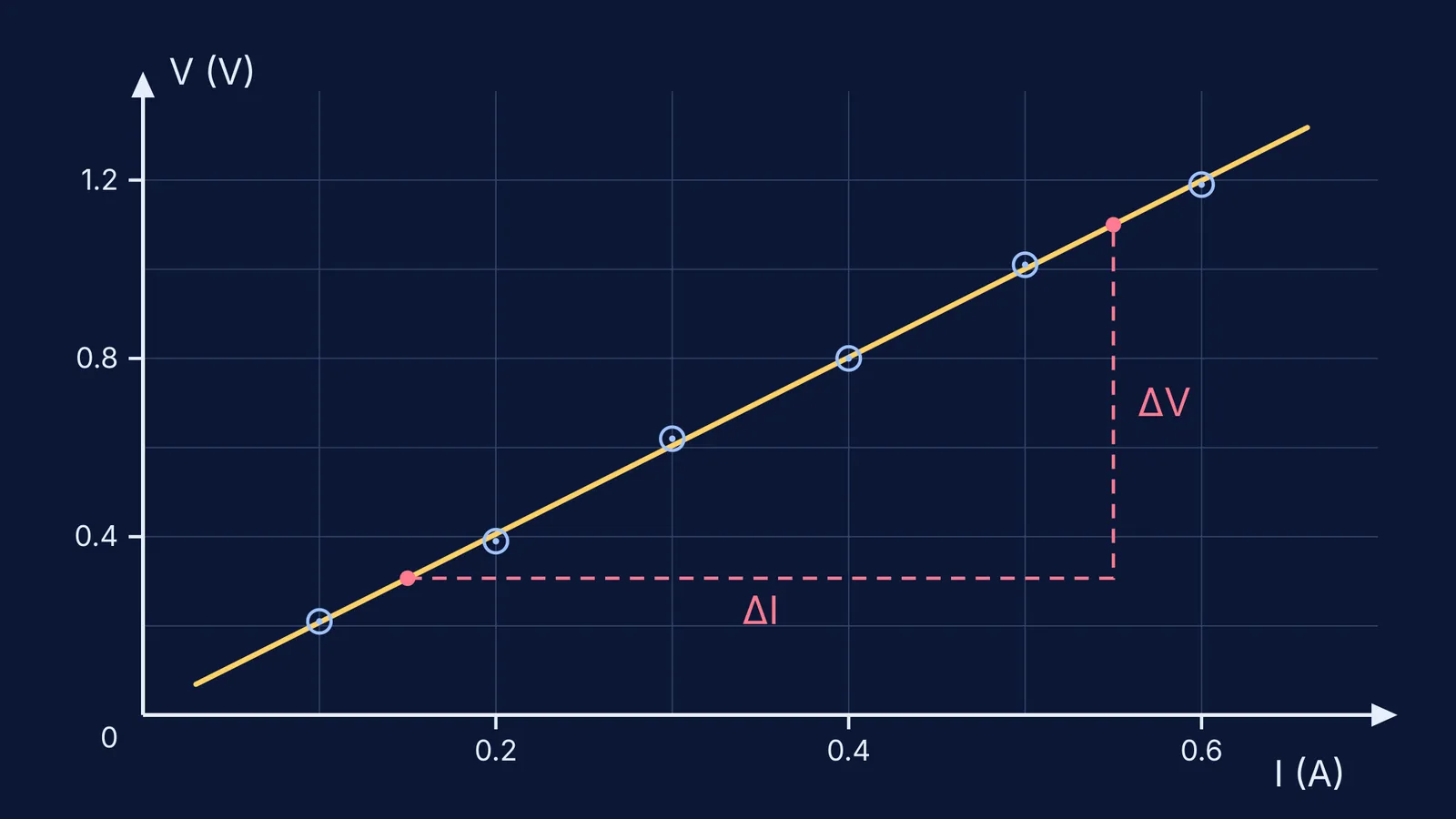
For the slope, pick two far-apart points on your line, not your readings, because your line "might not pass through them exactly". Draw a dashed right-angled triangle between them, read Δy and Δx, and write slope = Δy/Δx with its unit.
Worked example: the V–I graph for a wire
Suppose your readings are I = 0.10, 0.20, 0.30, 0.40, 0.50 and 0.60 A, with V = 0.21, 0.39, 0.62, 0.80, 1.01 and 1.19 V.
Scale: 1 cm = 0.05 A and 1 cm = 0.1 V put the largest readings about 12 cm from the origin; use a smaller step if your sheet has room.
Line: drawn through the scatter, it passes close to the origin, as Ohm's law predicts.
Slope points: (0.15 A, 0.31 V) and (0.55 A, 1.10 V), both read off the line.
Slope: (1.10 − 0.31) ÷ (0.55 − 0.15) = 0.79 ÷ 0.40, about 1.98 Ω. That slope is the resistance R.
From R you get resistivity with ρ = RA/l; our guide to finding the resistivity of a wire from a V–I graph walks through that step. The same method gives g from the L–T² graph of a simple pendulum.
If the step from slope to final answer is where you go wrong, the Fermi Problem Library has worked problems with a step-by-step solver that explains the reasoning rather than printing an answer. If the gap is the idea itself, such as why a V–I slope is resistance, the Fermi Concept Library gives every concept in physics its own lesson.
What should you check before submitting the practical file?
A title, and the scale in a corner
Axes labelled with quantity and unit
Uniform steps of 1, 2 or 5
Visible point marks
One best-fit line, extended past the end points
A slope triangle from two line points, with the unit
For the rest of exam day, read our guide on how to prepare for CBSE Class 12 physics practicals and the viva.


