On this page
If you sit JEE Main on a different day from your friend, you answer a different question paper. The National Testing Agency (NTA) says plainly in its JEE (Main) 2027 Information Bulletin that "in spite of all efforts to maintain equivalence among various question papers, the difficulty level of these question papers administered in different Shifts may not be exactly the same." Normalisation is how NTA deals with that: you are ranked against the people who took your paper, not against raw marks from an easier or harder one.
Why does JEE Main normalise marks across shifts?
According to Appendix IV of the NTA Information Bulletin, candidates who get a tougher set are likely to score lower, so NTA uses a "Normalization procedure based on Percentile Score" so that candidates are "neither benefitted nor disadvantaged" by the difficulty of their paper.
The bulletin says candidates are spread across shifts randomly, in roughly equal numbers, and that with so many candidates from across the country the chance of bias in who sits which shift becomes remote. That is the assumption behind the method: each shift holds a similar mix of students, so a given percentile means much the same in any shift.
How is the JEE Main percentile calculated?
NTA's formula, from the bulletin's normalisation appendix, is:
Percentile = 100 × (candidates in your shift with a raw score equal to or less than yours) ÷ (total candidates who appeared in your shift)
Four rules from the same document matter for you:
The highest scorer in every shift gets a percentile of exactly 100, whatever their raw marks.
Percentiles are calculated to 7 decimal places to reduce ties.
Your total percentile is not an average of your Physics, Chemistry and Maths percentiles.
If you write both sessions, the better of your two total NTA scores is used, not the best subject from each.
NTA's own worked example is a shift in which 41,326 candidates appeared. One candidate scored 121 raw marks, and 37,244 candidates in that shift scored 121 or less. So the percentile is 100 × 37,244 ÷ 41,326 = 90.1224411. Put the other way, 41,326 − 37,244 = 4,082 candidates in that shift scored more than 121.
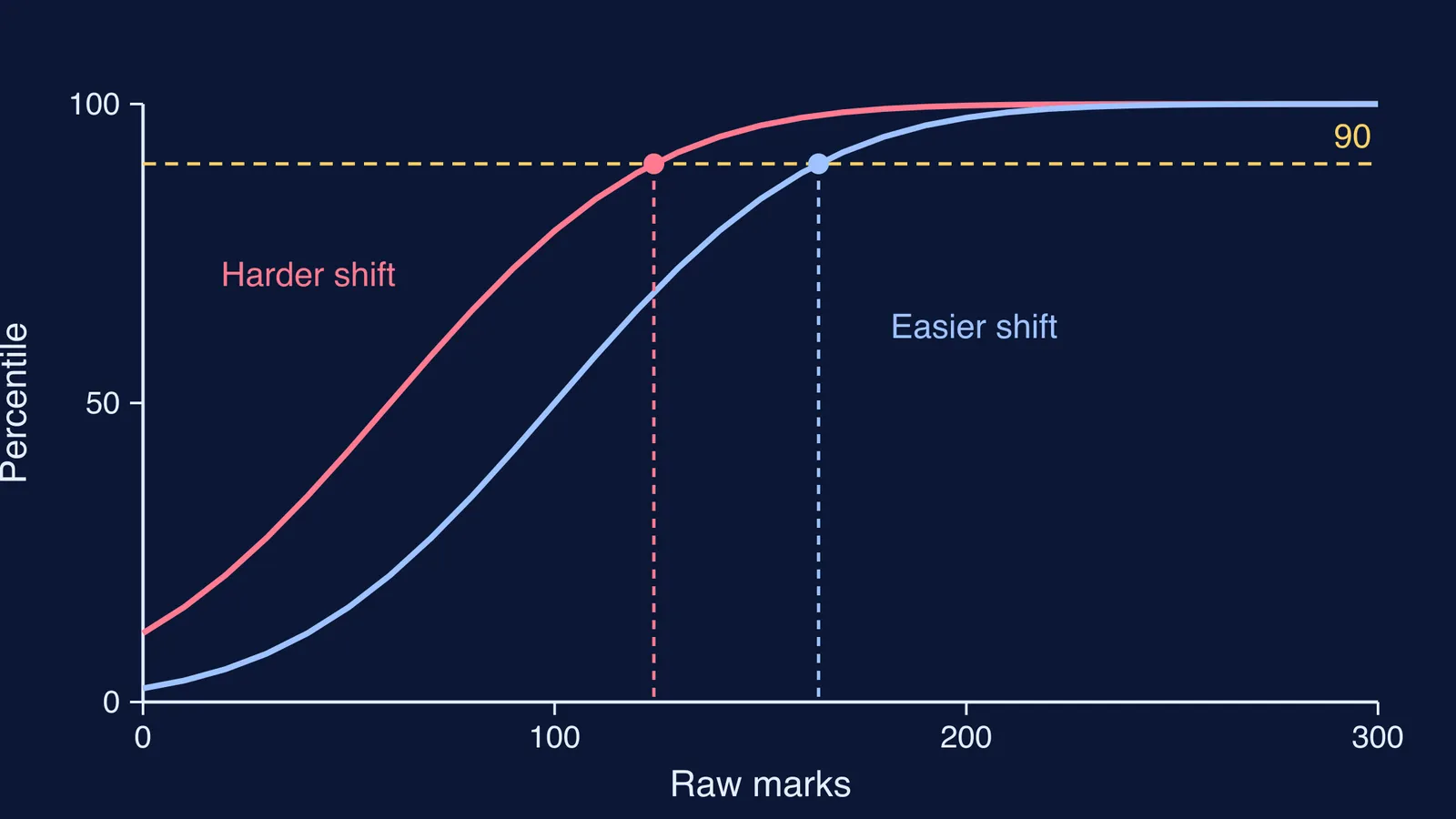
Now the same percentile with different marks. The diagram at the top uses two made-up shifts. In the harder one, about 124 raw marks already puts you at the 90th percentile. In the easier shift, you need about 164 for the same 90. Suppose Ananya scores 124 in the hard shift and Rohan scores 164 in the easy one. Both are at the 90th percentile and stand level. The 40-mark gap was the paper, not the students.
What percentile do you need for your target?
By the bulletin's definition, 100 minus your percentile is roughly the share of your shift ahead of you. To turn a rank goal into a percentile goal:
Target percentile ≈ 100 × (1 − target rank ÷ number of candidates)
Say, purely as an illustration, that 10,00,000 candidates write the paper and you want a rank inside 20,000. Then 100 × (1 − 20,000 ÷ 10,00,000) = 98. It is only a rough guide, since final ranks merge all shifts and include ties and categories.
Two official rules from the bulletin help here. To be eligible for JEE Advanced 2027, you need to be among the top 2,50,000 successful candidates (all categories together) in the B.E./B.Tech paper. And when a qualifying cut-off lands on slightly different percentiles in different shifts, the lowest of them applies to everyone: the bulletin's example is a cut-off at 78 in one shift and 79 in another, so 78 counts for both.
The raw mark that reaches your target depends on your shift's paper, so set your raw-mark goal as a range from mocks and aim for its top.
How should you use this while preparing?
Write down a rank goal and turn it into a percentile with the formula above.
In mocks, note where you stand among the people who took that mock, not only your raw marks.
If your paper feels hard, remember it is hard for your whole shift; the percentile already accounts for that.
If session 1 goes badly, session 2 still counts: only your better total is used.
After the exam, download your response sheet and check the provisional answer key while NTA displays them; the bulletin rules out re-checking the result later.
What you control is your raw score. If you lose marks to wrong methods, the Fermi Problem Library has worked problems with a step-by-step solver that explains the reasoning rather than printing an answer. If you do not know where to start, Fermi's AI tutor can work out what you already know and build a plan for the session.
Before your exam, check the current bulletin on the official JEE Main website.