On this page
If your textbook or worksheet asks you to find A⁻¹ "using elementary row operations", it wants the Gauss-Jordan method: put the identity matrix beside A and row-reduce. It never asks you for nine cofactors, and every line can be checked. Below are the order of operations, one 3×3 example worked in full, and the slips that cost marks.
How does the [A | I] method find an inverse?
A square matrix A is invertible if there is a matrix B of the same order with AB = BA = I; that B is written A⁻¹, as defined in section 3.7 of NCERT's Class 12 Mathematics Part I, Chapter 3. The same chapter proves that an inverse, if it exists, is unique.
Every elementary row operation (swap two rows, multiply a row by a non-zero number, add a multiple of one row to another) is the same as multiplying on the left by an elementary matrix. MIT's 18.06 lecture notes on inverse matrices put the whole method in one line: if E is the product of those matrices, then E[A | I] = [I | E], and because EA = I, E is A⁻¹. Whatever turns A into I, applied to I, builds A⁻¹.
The same notes say a singular matrix has determinant zero and no inverse. So if a row of zeros appears in the left half, stop: A has no inverse.
A note for CBSE students: the current NCERT chapter (reprint 2026-27) defines invertible matrices but has no section on elementary operations, so ask your teacher which method your board paper expects. JEE aspirants should check the current syllabus on the official NTA site before deciding how much time to give this method.
In what order should you do the row operations?
Work one column at a time, left to right, and never disturb a column you have finished.
Column 1: get a non-zero pivot in row 1 (swap rows if the top entry is 0), make it 1, then clear everything below it.
Column 2: make the row 2 pivot 1 and clear below it. Then make the row 3 pivot 1.
The left half is now upper triangular with 1s on the diagonal. Clear upwards, starting from the bottom: use row 3 to clear column 3 in rows 2 and 1, then row 2 to clear column 2 in row 1.
Read A⁻¹ from the right half.
Clearing upward from the bottom keeps your zeros safe: row 3 has zeros in columns 1 and 2, so subtracting multiples of it cannot spoil work already done.
Rows only. A column operation multiplies on the right, not the left, so mixing one in breaks the E[A | I] = [I | E] argument.
Worked example: how do you invert a 3×3 matrix by row operations?
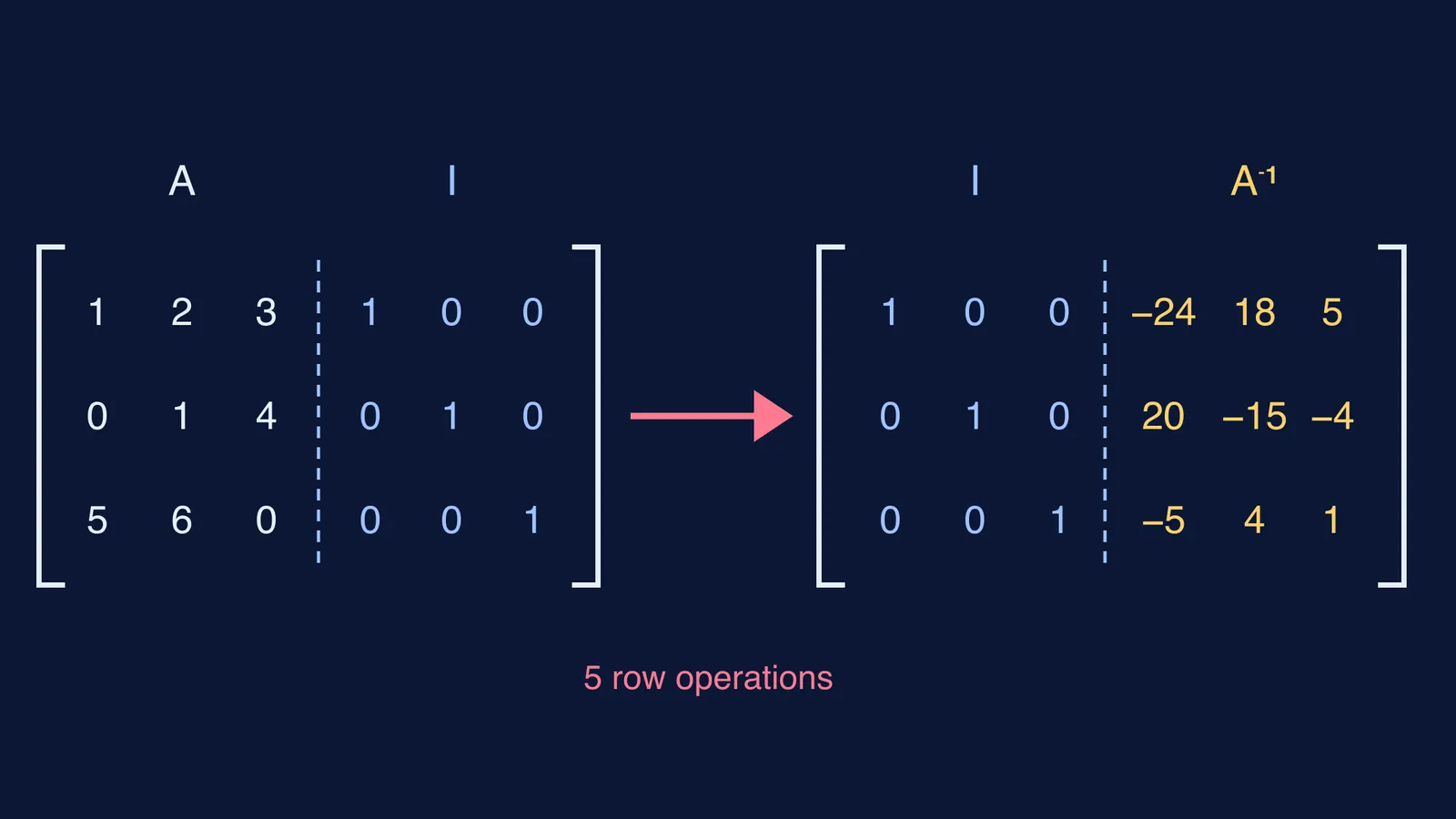
Take A with rows (1, 2, 3), (0, 1, 4) and (5, 6, 0). Its determinant is 1(0 − 24) − 2(0 − 20) + 3(0 − 5) = 1, so the inverse exists and will have whole-number entries. Start with [A | I]:
R1: [1 2 3 | 1 0 0]
R2: [0 1 4 | 0 1 0]
R3: [5 6 0 | 0 0 1]
Column 1 already has pivot 1 and a zero in row 2, so only row 3 needs work.
R3 → R3 − 5R1 gives [0 −4 −15 | −5 0 1]. Note the right half: 0 − 5(1) = −5.
R3 → R3 + 4R2 gives [0 0 1 | −5 4 1]. The left half is now upper triangular.
R2 → R2 − 4R3 gives [0 1 0 | 20 −15 −4].
R1 → R1 − 3R3 gives [1 2 0 | 16 −12 −3].
R1 → R1 − 2R2 gives [1 0 0 | −24 18 5].
So A⁻¹ has rows (−24, 18, 5), (20, −15, −4) and (−5, 4, 1). Check one product: row 1 of A times column 1 of A⁻¹ is 1(−24) + 2(20) + 3(−5) = 1, as it should be.
Which slips ruin the answer?
Forgetting the right half. Every operation acts on all six entries of the row. Students clear the left half carefully and copy the right half unchanged.
Subtracting a negative. In step 3, the first right-hand entry is 0 − 4(−5) = +20, not −20. Write the bracket out every time.
Reading an old row. Do one operation per line and rewrite the full matrix, so the next step uses the row as it is now.
Clearing with an unfinished row. Only subtract a row whose entries left of its pivot are already 0. Otherwise it refills zeros you made in earlier columns.
Slipping in a column operation to save a step. It breaks the method, and the wrong answer can still look plausible.
To compare routes, our post on finding a 3×3 inverse by the adjoint method works the cofactor way, and what a singular matrix means explains why some matrices have no inverse at all. The same row moves also evaluate determinants quickly.
If your answer keeps failing the check and you cannot see which line went wrong, the Fermi Problem Library has worked problems with a step-by-step solver that explains the reasoning rather than printing an answer. If the gap is the idea itself, why a row operation is a matrix multiplication, the Fermi Concept Library gives each mathematics concept its own lesson.
Tomorrow, take a fresh 3×3 matrix, run the four-stage order without looking, and finish with the multiply-back check.