

On this page
When you study linear algebra for the JEE or university maths, you are quickly taught a hard rule: if a matrix is singular, you cannot invert it. But what exactly makes a matrix "singular", and why does the maths break down when you try to find its inverse?
Mathematically, a singular matrix is simply a square matrix that does not have a matrix inverse according to MathWorld. You can test for this algebraically: a square matrix is singular if and only if its determinant is zero. While the calculation is straightforward, the real insight comes from looking at what a singular matrix does to space.
What does a singular matrix mean geometrically?
To understand a singular matrix, you have to think of a matrix as an active transformation. When you multiply a vector by a matrix, the matrix stretches, rotates or shears the space that the vector lives in.
The determinant of a matrix measures how much that transformation scales area (in 2D) or volume (in 3D). If you have a 2 × 2 matrix with a determinant of 3, any shape transformed by that matrix will end up with three times its original area.
If the determinant is exactly zero, the scaling factor is zero (Wikipedia). This means the transformation completely collapses the space into a lower dimension. For example, a 2D plane might be flattened into a single 1D line, or a 3D cube might be squashed flat into a 2D plane. Because the resulting shape is entirely flat, its area or volume is exactly zero.
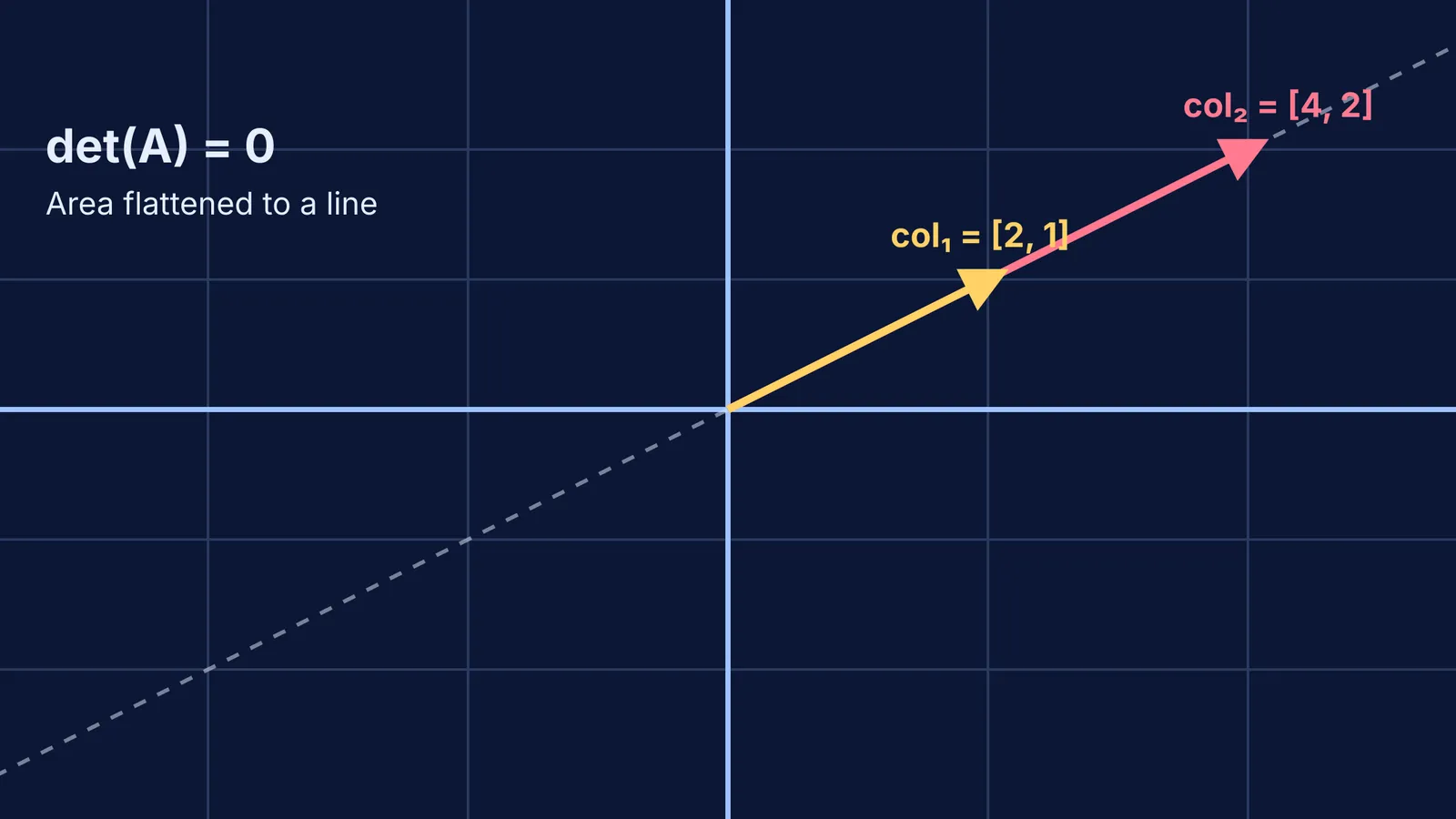
This geometric collapse happens because the columns of a singular matrix are linearly dependent. In a 2 × 2 matrix, this means one column vector lies on the exact same line as the other. Instead of spanning a full 2D parallelogram, they just stretch along a single line.
Why does a singular matrix have no inverse?
The geometric collapse explains exactly why singular matrices are non-invertible. An inverse matrix is supposed to reverse the original transformation. If a matrix scaled an area by 2, its inverse scales it by 1/2, returning every point to where it started.
But when a singular matrix flattens a 2D plane onto a 1D line, multiple different points from the original plane are squashed onto the exact same spot on the line.
Once the points overlap, you lose the information about where they originally came from. Because there is no way to know which overlapping point should go where, you cannot "un-squash" the space. The transformation is irreversible, meaning the inverse matrix cannot exist.
This is also why the formula for a matrix inverse (which divides by the determinant) breaks down for singular matrices. You cannot divide by zero, just as you cannot recover lost dimensions.
If linear algebra feels like an endless list of abstract rules, linking the algebra to the geometry makes it much easier to remember. The Fermi Concept Library connects matrix equations to their visual meaning, helping you see why rules like det(A) = 0 work. If you get stuck on a homework problem involving linear dependence or inverses, the Fermi Problem Library will take you through it step by step, showing you the geometric reasons behind the calculation.
How to test if a matrix is singular?
Consider a 2 × 2 matrix A with rows [2, 4] and [1, 2].
If you calculate the determinant (ad - bc):
det(A) = (2 × 2) - (4 × 1) = 4 - 4 = 0
Because the determinant is zero, the matrix is singular.
You can also spot it by looking at the columns. The first column is the vector (2, 1). The second column is the vector (4, 2), which is exactly twice the first column. Because the second vector just stretches along the same line as the first, they cannot span a 2D area. The area of the parallelogram they form is zero, confirming that this matrix will collapse any 2D shape onto a 1D line.
For more applications of the determinant, you can use it to find the area of a triangle using determinants, or solve systems of linear equations using Gabriel Cramer and the determinant rule of 1750. When working with regular, non-singular matrices, you might also explore shortcuts like finding Aⁿ for a matrix by spotting the pattern.


