On this page
An iron nail is full of tiny magnets, yet it does not pick up a pin until a strong magnet is brought near. Heat it red hot and even the magnet loses its grip. One idea explains both: magnetic domains.
What are magnetic domains in a ferromagnetic material?
Each atom in a ferromagnet such as iron, cobalt or nickel has its own magnetic dipole moment. In a ferromagnet, neighbouring atoms interact so that they line up with each other on their own, over a region called a domain, as NCERT's Class 12 Physics textbook explains (NCERT Physics Part 1, Chapter 5, Magnetism and Matter, section 5.5.3).
A magnetic domain is a region of a ferromagnet in which the atomic magnetic moments all point the same way, so the region is strongly magnetised by itself.
NCERT gives a typical domain size of 1 mm, with about 10¹¹ atoms in each domain (NCERT, section 5.5.3). HyperPhysics, from Georgia State University, puts domain sizes between 0.1 mm and a few mm (HyperPhysics: Ferromagnetism).
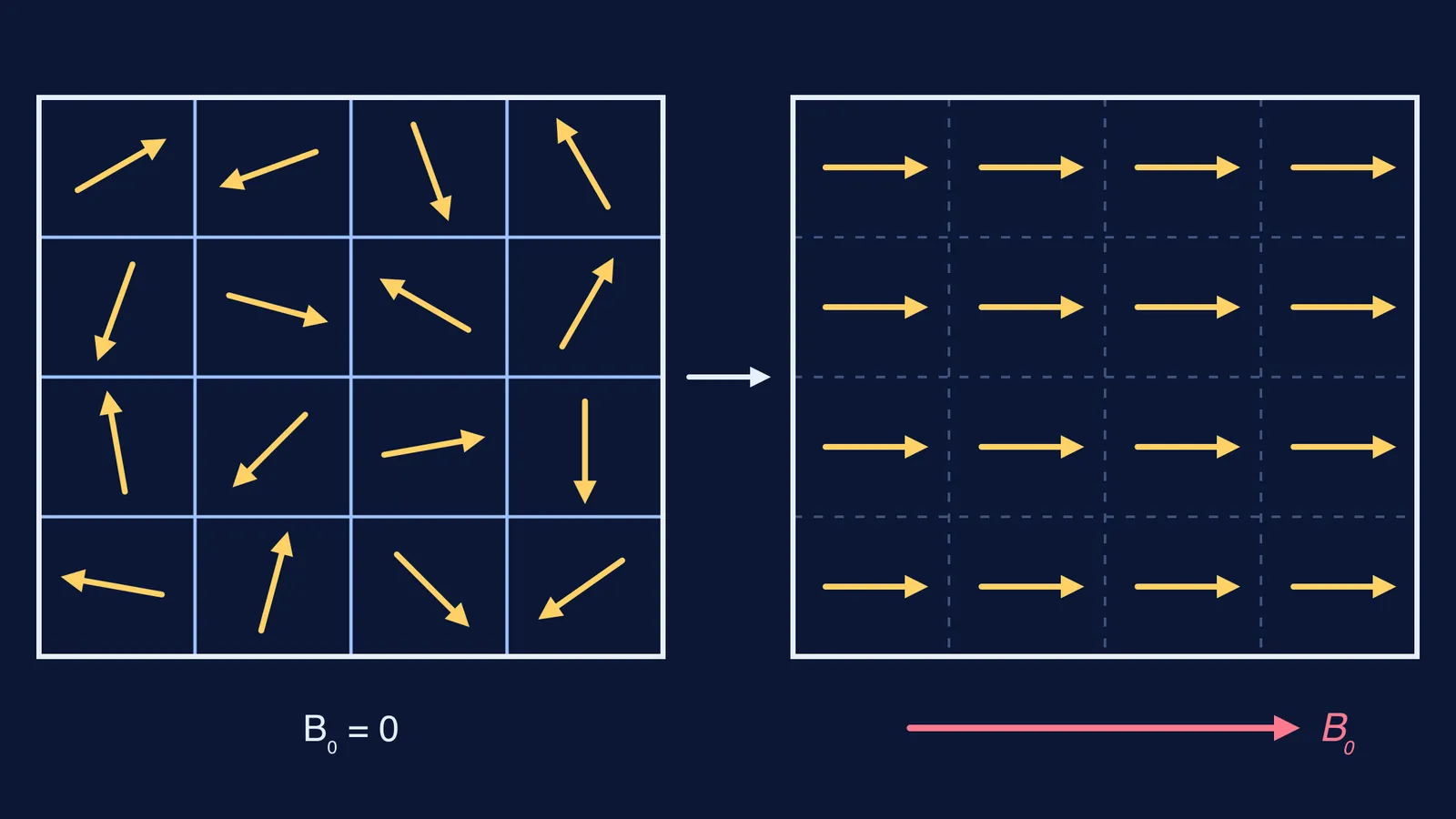
So why is the nail not a magnet? NCERT's answer: the magnetisation varies randomly from domain to domain, so there is no bulk magnetisation. For the history of the idea, read how Pierre Weiss explained ferromagnetism with magnetic domains.
How do domains align in an external magnetic field?
Apply a field B₀ and two things happen, NCERT says: domains turn towards B₀, and the domains already pointing along B₀ grow in size. With enough field they join into what the textbook calls a single giant domain (NCERT, section 5.5.3). NCERT adds that domain motion can be watched under a microscope using a liquid suspension of ferromagnetic powder.
Because every domain is already strongly magnetised, a modest applied field produces a very large magnetisation. HyperPhysics describes this as a large multiplication of the applied field (HyperPhysics: Ferromagnetism). NCERT puts the relative permeability of ferromagnetic elements at more than 1000 (NCERT, section 5.5.3).
If domain walls are hard to picture, the Fermi Simulation Lab has interactive simulations for the ideas that are easier to see than to read.
Why does heating above the Curie point destroy magnetism?
NCERT explains that at a high enough temperature a ferromagnet becomes a paramagnet: the domain structure breaks up, and the magnetisation fades gradually as the temperature rises (NCERT, section 5.5.3). The atoms still carry their moments; what is lost is the line-up between neighbours. HyperPhysics calls the temperature at which this long-range order disappears the Curie temperature (HyperPhysics: Ferromagnetism).
The Curie temperature of iron is 1043 K, about 770 °C (HyperPhysics: table of Curie temperatures).
Worked example: what the numbers tell you
The same HyperPhysics table lists cobalt at 1388 K, nickel at 627 K and gadolinium at 293 K (HyperPhysics: table of Curie temperatures). Subtract 273 to get °C:
Iron: 1043 − 273 = 770 °C, so it loses ferromagnetism only when red hot.
Cobalt: 1388 − 273 = 1115 °C, the highest of the four.
Nickel: 627 − 273 = 354 °C.
Gadolinium: 293 − 273 = 20 °C, so it is ferromagnetic on a cool Shimla morning and paramagnetic on a hot Chennai afternoon.
When the metal cools again with no field around, the domains re-form pointing in random directions, so a magnet heated past its Curie point does not get its magnetism back on its own; it has to be magnetised again. Try the prediction in does heating a magnet destroy its magnetism? Predict, then test.
What is the difference between soft and hard magnetic materials?
The difference is what happens when the applied field is removed.
Hard ferromagnets keep their magnetisation. NCERT names alnico, an alloy of iron, aluminium, nickel, cobalt and copper, and natural lodestone, and says such materials make permanent magnets, among other things compass needles (NCERT, section 5.5.3).
Soft ferromagnets lose their magnetisation when the field goes. NCERT's example is soft iron. HyperPhysics says soft materials are used for transformer and motor cores because they reduce the energy loss and heating when an AC field keeps reversing (HyperPhysics: Hysteresis).
Soft iron still magnetises strongly in a field; it just lets go easily. The loops behind this are drawn in dia-, para- and ferromagnetism explained, with hysteresis loops.
A three-question check for exam questions
To pick a material for a job, ask:
Must it stay magnetised after the field or current is gone? Then it needs a hard material: a permanent magnet or a compass needle.
Is the field switched on and off, or reversed many times a second? Then it needs a soft material: a transformer core, a motor core or an electromagnet you can switch off.
Will it run hotter than its Curie temperature? Then neither works, because above that point the material is no longer ferromagnetic.
To revise diamagnetism, paramagnetism and ferromagnetism together, the Fermi Concept Library gives each concept its own lesson and its place in the map.