On this page
Many students learn "friction always opposes motion, so it always does negative work" and lose marks for it. Static friction opposes slipping between two surfaces, not motion itself, and its work depends on the frame and on how the point where it acts moves.
Can static friction do positive work on a body?
Yes. Work is the dot product of force and the displacement of the point where the force acts, dW = F·dr, as defined in OpenStax University Physics, section 7.1.
The same section states that static friction does no work between the two surfaces, because they never move relative to each other, but that as an external force static friction can do work, for example keeping someone on a moving sled and doing positive work on them (OpenStax, 7.1).
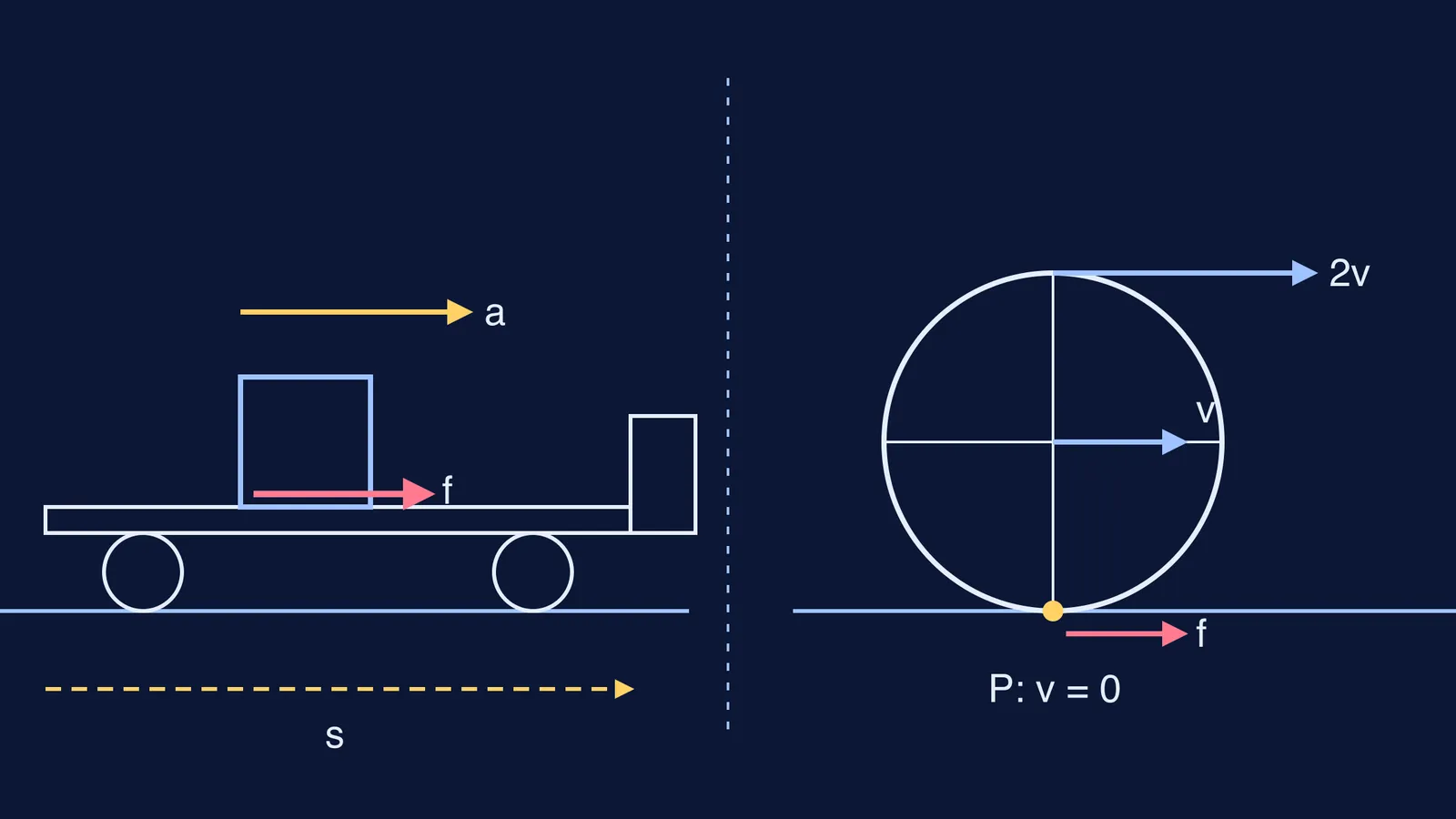
Seen from the ground, the box and the truck bed move together. The friction force on the box points forward and the box moves forward, so the work is positive.
Worked example: a box on an accelerating truck
We use the definition of work from OpenStax section 7.1 and take g = 9.8 m/s².
A 40 kg box sits on the flat bed of a truck. The truck starts from rest and accelerates at 2 m/s² for 5 s. The box does not slip.
Force: the only horizontal force on the box is static friction, so f = ma = 40 × 2 = 80 N, pointing forward.
No-slip check: friction can supply at most μs·mg, so the box stays put only if μs ≥ a/g = 2/9.8, about 0.2.
Displacement in the ground frame: s = ½at² = ½ × 2 × 25 = 25 m.
Work by friction on the box: W = f × s = 80 × 25 = 2000 J, positive.
Check with energy: the box ends at v = at = 10 m/s, so its kinetic energy is ½ × 40 × 10² = 2000 J. Friction supplied every joule.
Now look at the truck. The box pushes back on the bed with 80 N (Newton's third law), and the bed also moves 25 m, so friction does −2000 J on the truck. The two works add to zero. That is the sign that static friction only passed energy from the truck's engine to the box; no heat was made.
If the truck pulls away hard enough that a/g is larger than μs, the box slides back on the bed. Kinetic friction then acts, the surfaces rub, and the total work by the friction pair turns negative as heat. The graph of that switch from static to kinetic friction is in our post on what happens to friction as you pull a block.
Why does static friction do no work in pure rolling?
In rolling without slipping, the point of the wheel touching the ground is at rest relative to the ground, so its displacement is zero and the work done by static friction is zero (OpenStax University Physics, section 11.1).
The velocity of any point on a rolling wheel is the centre's velocity v plus the rotation's velocity. At the bottom these are v forward and ωR backward, and pure rolling means v = ωR, so the contact point has speed zero. The top of the wheel moves at 2v.
This is why, the same OpenStax section says, a body rolling without slipping keeps its mechanical energy constant when no non-conservative forces take energy away (OpenStax, 11.1).
Friction still does a job here. For a ball rolling down a slope, friction acts up the slope: its work on the translation is −f·s and the work through its torque is +fR·θ = +f·s, because s = Rθ. They cancel. So friction moves energy from translation into rotation without making any heat. Our post on how much of a rolling body's kinetic energy is rotational puts numbers on that split.
How do you decide the sign in an exam question?
Use this four-step check before you write any sign:
Name the frame. Ground frame unless the question says otherwise.
Find the friction force on the body you care about, from Newton's laws, not from a slogan.
Ask how the point where friction acts moves in that frame. At rest: zero work. Moving with the force: positive. Against it: negative.
Add the work on both surfaces. Zero total means static friction; a negative total means sliding and heat.
The same check sorts out many sign errors in energy questions; we list three more in work-energy mistakes that quietly cost marks.
To practise, try a few friction and rolling questions in the Fermi Problem Library, where the step-by-step solver explains the reasoning rather than printing an answer, so you can check your signs step by step. If the rolling picture still feels slippery, the Fermi Simulation Lab has interactive simulations for ideas that are easier to see than to read.