On this page
Put two polaroids at right angles and the light is cut off completely. Slide a third polaroid between them, its axis at 45°, and light comes back: one-eighth of what you started with. A version of this problem appears in NCERT Class 12 Physics, Chapter 10 (Wave Optics) as Example 10.2. Here is how to get the number by applying Malus' law twice, and why adding a filter can let more light through.
What is Malus' law?
Malus' law says that when polarised light of intensity I₀ meets a polaroid whose pass axis makes an angle θ with the light's polarisation, the transmitted intensity is I = I₀ cos²θ (NCERT Class 12 Physics, Section 10.7). Only the component of the electric field along the pass axis, E cos θ, gets through, and intensity goes as the square of the field.
A polaroid is a sheet of long-chain molecules aligned in one direction; it absorbs the electric field along the molecules and passes the field at right angles to them, the pass axis (same NCERT section). Unpolarised light passing a single polaroid comes out at half its intensity, and rotating that polaroid does not change it. OpenStax University Physics states the same: the first filter polarises the light along its axis and decreases its intensity by a factor of 2.
So every polaroid question runs on two rules:
Unpolarised light in: halve it.
Polarised light in: multiply by cos²θ, where θ is the angle between the light's polarisation and the new pass axis.
To see the cos²θ curve first, try a Malus's law polariser simulation at 0, 45 and 90 degrees.
Why do two crossed polaroids block all light?
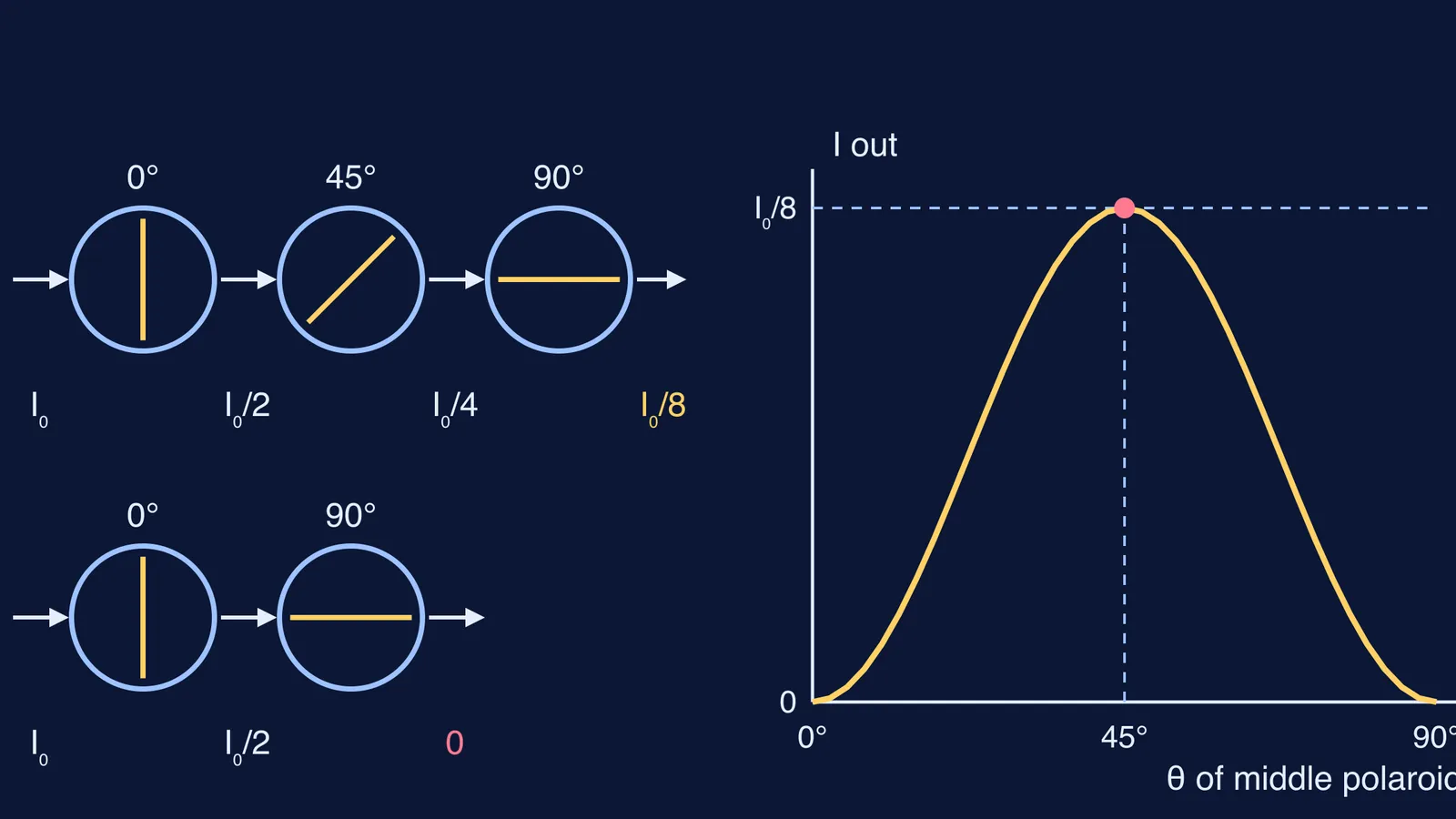
After the first polaroid, the light is polarised along its axis. The second polaroid is at 90° to that, and cos²90° = 0, so nothing gets through. NCERT notes that with two polaroids the intensity can be controlled from 50% down to zero of the incident intensity by adjusting the angle between their pass axes (NCERT Class 12 Physics, Chapter 10). Crossed is the zero end of that range.
What is the intensity through three polaroids at 45°?
Call the polaroids P1 (axis at 0°), P2 (at 45°) and P3 (at 90°), the set-up of NCERT's Example 10.2. Say a light meter reads 80 units before P1.
P1 meets unpolarised light, so halve it: 80 becomes 40. The light is now polarised at 0°.
P2 is 45° from that polarisation: 40 × cos²45° = 40 × 1/2 = 20. The light is now polarised at 45°.
P3 is 45° from the new polarisation, not 90°: 20 × 1/2 = 10.
Ten units out of 80 is one-eighth, so the answer is I₀/8, or 12.5% of the unpolarised light.
For any angle θ of the middle sheet, the same steps give I = (I₀/2) cos²θ sin²θ = (I₀/8) sin²2θ. NCERT's Example 10.2 finds the same dependence on θ and concludes that the transmitted intensity is greatest at θ = π/4, that is 45°. At 0° or 90° the middle sheet lines up with one of the outer ones, and the output falls back to zero.
Why does adding a polaroid let light through?
A polaroid passes the component parallel to its axis, and the light that leaves is polarised along that axis, as the caption of NCERT's Figure 10.18 states (NCERT Class 12 Physics, Chapter 10).
Light leaving P1 has no component at all along P3's axis. The middle sheet changes that. It projects the field onto the 45° direction, and that new field does have a component along P3. You turn the polarisation through 90° in two smaller steps instead of one impossible step. Each step costs intensity, which is why you get I₀/8 and not I₀/2.
Order matters. Put the 45° sheet before P1 or after P3 and the crossed pair still sits together, so the output stays zero.
If the projection picture won't settle, the Fermi Simulation Lab has interactive simulations for the ideas that are easier to see than to read.
Common mistakes in polaroid questions
Before you write the final answer, run this check:
Did you use 1/2, not cos²θ, for unpolarised light at the first sheet?
Is each θ measured from the sheet just before, not from the first one?
Did you square the cosine?
Does I₀ mean the unpolarised light or the light after the first polaroid?
Is the middle sheet actually between the crossed pair?
If you keep landing on a different answer from the key, the Fermi Problem Library has worked problems with a step-by-step solver that explains the reasoning rather than printing an answer. And if phase and path difference are next on your list, read how an AI tutor walks through path difference and phase in wave optics.