On this page
Every JEE aspirant learns that a diatomic gas has Cv = 5R/2. Then a question says "non-rigid" or "very high temperature", and the answer becomes 7R/2. These are not rival formulas: they are the same gas at two temperatures, and the change between them needs a little quantum mechanics.
What are Cv = 5R/2 and 7R/2 for a diatomic gas?
Both come from the law of equipartition of energy, set out in NCERT Class 11 Physics, Chapter 12: Kinetic Theory. Each translational and rotational degree of freedom carries an average energy of ½kBT per molecule. A vibrational mode carries kBT, because it has two squared terms: kinetic energy and potential energy of the spring-like bond.
A rigid diatomic molecule, like a dumbbell, has 3 translational and 2 rotational degrees of freedom. NCERT gives U = 5/2 RT per mole, so Cv = 5R/2, Cp = 7R/2 and γ = 7/5.
If the molecule also vibrates, NCERT adds kBT per molecule: U = 7/2 RT, so Cv = 7R/2, Cp = 9R/2 and γ = 9/7. In both cases Cp − Cv = R, as for any ideal gas.
If molar heat capacity itself feels blurry, start with specific heat vs heat capacity.
Why does Cv of a diatomic gas increase at high temperature?
Classical equipartition assumes every mode can take any amount of energy. A vibrating bond cannot. Its energy comes in steps of hν, and physicists describe the step by a characteristic vibrational temperature, θv = hν/k, as in these Georgia Tech lecture notes on diatomic molecules.
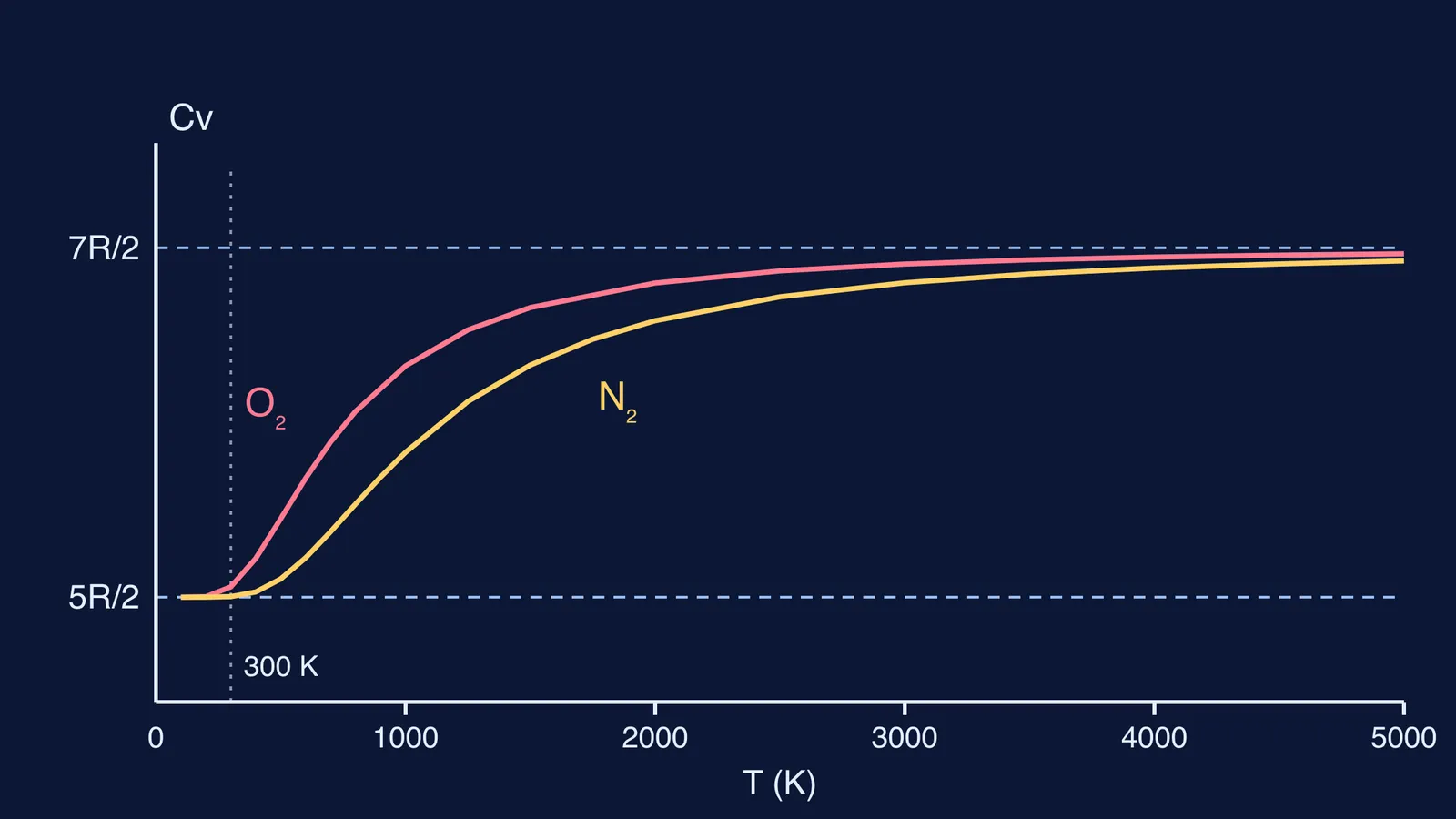
The same notes list θv as 6300 K for hydrogen, 3390 K for nitrogen and 2270 K for oxygen. At room temperature, about 300 K, T is far below θv. Almost no collision delivers a full quantum, so the bond stays in its lowest level and absorbs almost no heat. Vibration is "frozen".
The measured values in NCERT's Table 12.2 give nitrogen Cv = 20.8 J mol⁻¹ K⁻¹ and γ = 1.40, the rigid prediction of 5R/2. NCERT also notes that gases such as Cl₂ have measured specific heats above the rigid prediction, and suggests the agreement improves when vibration is included.
As T climbs towards θv, more molecules reach higher vibrational levels. The Georgia Tech notes give the vibrational share of the molar heat capacity for a harmonic oscillator as R(θv/T)² e^(θv/T) / (e^(θv/T) − 1)². For nitrogen it gives about 0.05R at 500 K, 0.4R at 1000 K and 0.9R at 3000 K. So Cv does not jump; it slides from 5R/2 to 7R/2.
How do you calculate γ for both cases?
Use R = 8.31 J mol⁻¹ K⁻¹, the value NCERT uses in its kinetic theory examples, and θv = 3390 K for nitrogen from the Georgia Tech table.
Rigid (room temperature): Cv = 5R/2 = 20.8 J mol⁻¹ K⁻¹; Cp = 7R/2 = 29.1 J mol⁻¹ K⁻¹; γ = 7/5 = 1.40.
Fully vibrating (the "non-rigid" textbook case): Cv = 7R/2 = 29.1 J mol⁻¹ K⁻¹; Cp = 9R/2 = 37.4 J mol⁻¹ K⁻¹; γ = 9/7 ≈ 1.29.
In between, nitrogen at 1000 K: x = θv/T = 3.39, so the vibrational share is x²eˣ/(eˣ − 1)² × R ≈ 0.415R.
Add it to the rigid part: Cv ≈ 2.915R ≈ 24.2 J mol⁻¹ K⁻¹, and Cp = Cv + R ≈ 3.915R.
Divide: γ ≈ 3.915/2.915 ≈ 1.34, between 1.40 and 1.29.
Notice that Cp in the rigid case equals Cv in the vibrating case. That is the most common slip: writing 7R/2 for Cv of an ordinary room-temperature diatomic gas.
γ matters whenever a gas expands too fast to exchange heat, as in why air from a burst tyre feels cold.
Which value should you use in a JEE or board problem?
"Diatomic", "rigid diatomic" or no temperature hint: Cv = 5R/2, γ = 7/5.
"Non-rigid", "vibrational mode active" or "very high temperature": Cv = 7R/2, γ = 9/7.
A polyatomic gas with 3 rotational degrees of freedom and f active vibrational modes: NCERT gives Cv = (3 + f)R and γ = (4 + f)/(3 + f).
A mixture: add n × Cv for each gas, then divide by total moles; find Cp by adding R.
Counting energy: ½kBT per translation or rotation, but kBT per vibrational mode, never ½kBT.
When the idea is clear but the arithmetic in a mixed-gas question keeps going wrong, the Fermi Problem Library has worked problems with a step-by-step solver that explains the reasoning rather than printing an answer. If equipartition itself is the gap, the Fermi Concept Library gives each physics concept its own lesson and its place in the map.
For another kinetic theory result that hinges on one ratio, see why hydrogen's rms speed is four times oxygen's.