

On this page
Press the valve on a scooter tyre, or stand near a tyre that bursts, and the rush of air on your skin feels cold. Nothing cold was stored inside the tyre. The air cools itself on the way out, and the reason is a core idea in Class 11 and JEE thermodynamics: adiabatic expansion.
Why does air from a burst tyre feel cold?
An adiabatic process is one in which no heat is gained or lost by the system (HyperPhysics, Georgia State University). A burst is far too fast for the escaping air to take in heat from the rubber, the road or the room. OpenStax makes the same argument for car engines, where compression happens so quickly that the gas has no time to exchange heat with its surroundings (OpenStax University Physics, Volume 2, section 3.6).
Now apply the first law. With Q = 0, the change in internal energy equals minus the work done by the gas. The escaping air has to shove the outside atmosphere out of its way, so it does work. That work is paid for from its own internal energy, and for an ideal gas, lower internal energy means lower temperature.
This is the mirror image of a pump. When you squash air quickly, work goes in and the air heats up, which is why a bicycle tyre gets warm when you pump it.
What does T V^(γ−1) = constant mean?
For an ideal gas in a reversible adiabatic process, T V^(γ−1) stays constant (OpenStax, section 3.6). Here γ is the ratio of specific heats, Cp/Cv.
For air, γ = 1.4 at standard conditions (NASA Glenn Research Center).
So the exponent is γ − 1 = 0.4. If the volume goes up, the temperature has to come down to keep the product the same. The same law can be written as pV^γ = constant or p^(1−γ)T^γ = constant; our explainer on switching between the TV and PT forms of the adiabatic relation shows how to move between them.
How cold can the air get? A worked example
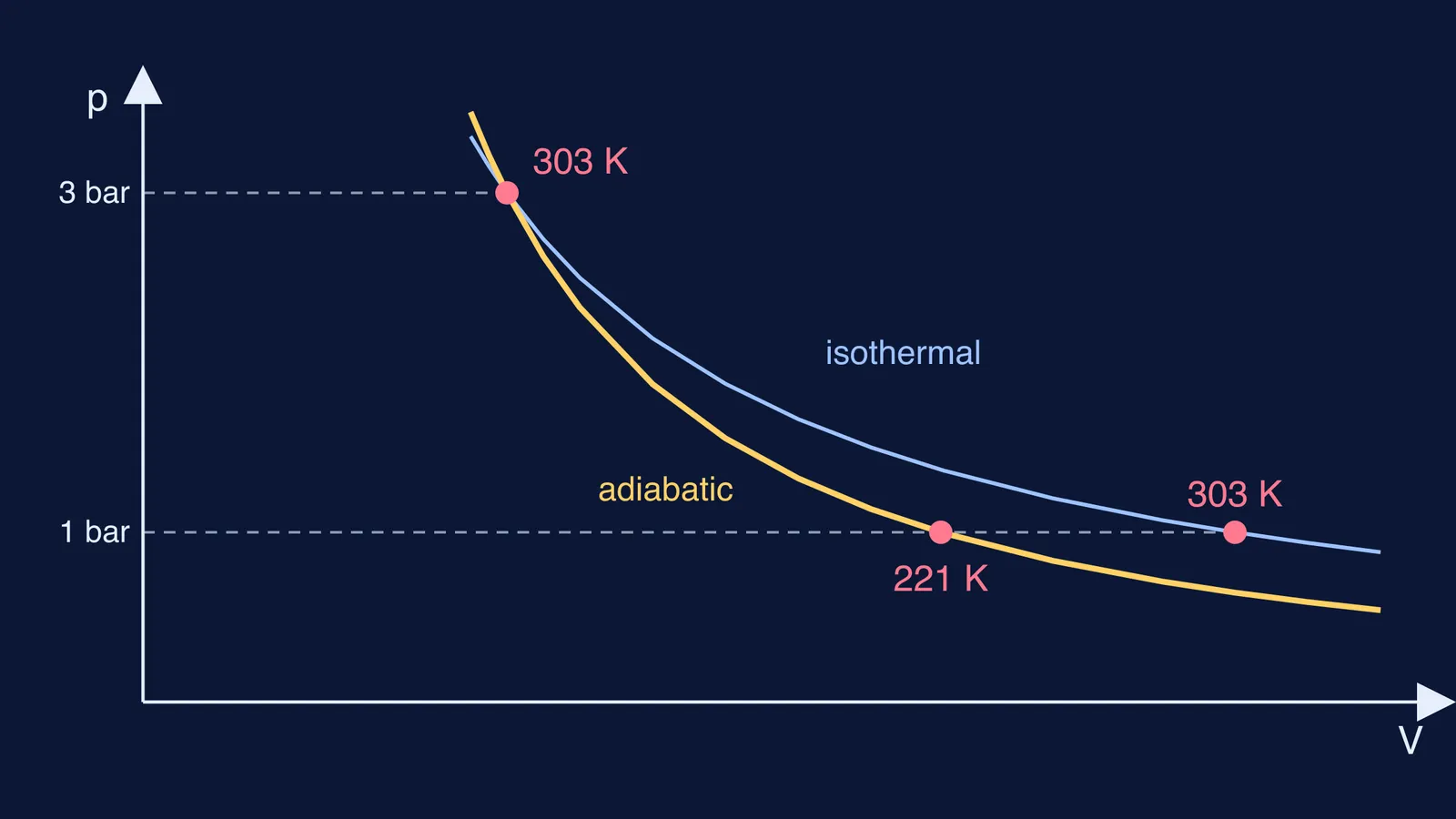
The recommended pressure for many passenger cars is 30 to 36 psi, or about 2.1 to 2.5 bar (The Motor Ombudsman). A gauge reads pressure above the atmosphere, and one standard atmosphere is 1.01325 bar (Standard atmosphere, Wikipedia). Take a round gauge reading of 2 bar, just under that range, so the air inside is at about 3 bar absolute.
Start: p1 = 3 bar, T1 = 303 K (a 30 °C afternoon), V1 = 1 in any unit.
Find the new volume at 1 bar from pV^γ = constant: V2/V1 = 3^(1/1.4) ≈ 2.19.
Use T V^(γ−1) = constant: T2 = T1 × (V1/V2)^0.4 = 303 × (1/2.19)^0.4 ≈ 303 × 0.731 ≈ 221 K.
That is about −52 °C, a drop of roughly 82 K.
Check with the PT form: T2 = T1 × (p2/p1)^((γ−1)/γ) = 303 × (1/3)^0.286 ≈ 221 K. Same answer.
Why doesn't your hand freeze, then?
The −52 °C figure is the ideal, reversible limit, the most cooling the gas can get. A real burst is turbulent and irreversible. A rougher model treats it as one sudden push against a constant 1 bar outside. Then the work done is only p2(V2 − V1), and with Cv = (5/2)R for air (which follows from γ = 1.4) the energy balance gives T2 = T1 × (2.5 + 1/3)/3.5 ≈ 245 K, about −28 °C. Our post on work done in an irreversible expansion explains why the one-step push does less work.
That jet mixes with warm room air within moments, and your skin warms it further. So you feel a sharp chill, not frostbite. Please do not burst tyres to test this: a tyre failing at pressure can injure you. Letting air out slowly through the valve shows the chill safely.
A checklist for adiabatic numericals
Convert to kelvin before you touch any power.
Convert gauge pressure to absolute pressure.
Pick γ from the gas: 1.4 for air and other diatomic gases, 5/3 for monatomic gases.
Choose the form that links the two quantities you know: TV, pV or pT.
Ask whether the process is reversible. If the gas expands against a fixed outside pressure in one step, use W = p(ΔV) and the first law instead.
Do not confuse this with free expansion into a vacuum, where the gas pushes on nothing and does no work.
Sanity-check the sign: expansion cools, compression heats.
To practise these steps, the Fermi Problem Library has worked problems with a step-by-step solver that explains the reasoning rather than printing an answer. If the idea of internal energy still feels shaky, the Fermi Concept Library gives each concept in physics its own lesson and its place in the map.
Next time you let air out of a tyre, feel the chill and run the numbers: 3 bar to 1 bar, γ = 1.4.


