

On this page
If you have ever inflated a bicycle tyre before cycling to class, you probably noticed the pump cylinder growing warm in your hands. By the time the tyre reaches riding pressure, the base of the barrel and the valve connector feel hot. Most cyclists assume that friction between the rubber piston seal and the metal cylinder barrel generates this heat.
Thermodynamics reveals that friction plays only a secondary role. The primary driver of the warmth is rapid mechanical compression of the air, which directly converts muscular work into thermal energy.
Why does a bicycle pump get hot when filling a tyre?
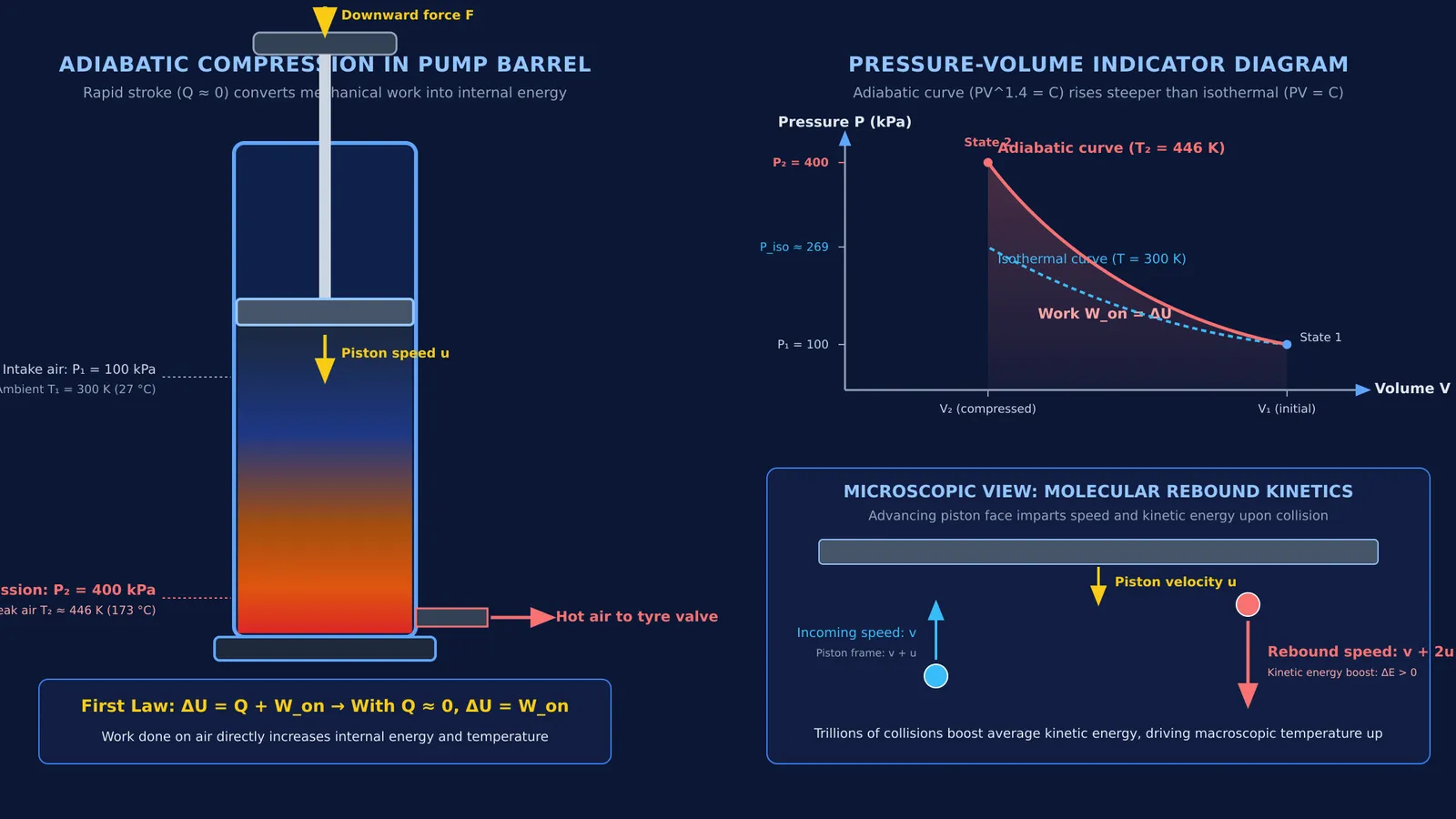
When you depress the pump handle, your arm exerts a downward force over a distance, doing mechanical work on the trapped air column. According to the OpenStax University Physics guide to adiabatic processes, an adiabatic process occurs when a gas undergoes compression or expansion so rapidly that negligible heat transfers into or out of the system.
The first law of thermodynamics defines this energy balance: ΔU = Q + W_on. Here, ΔU represents the change in internal energy, Q is heat exchanged with the surroundings, and W_on is work done on the gas. Because each downward stroke takes a fraction of a second, heat conduction through the barrel is too slow to dissipate energy during compression. Setting Q ≈ 0 simplifies the relationship to ΔU = W_on.
For an ideal gas, internal energy depends solely on temperature. Because work done on the gas is positive, internal energy must increase, driving the absolute temperature of the air upward. Once this hot, compressed gas reaches the cylinder base, it conducts thermal energy into the metal barrel and the tyre valve.
Is the heat caused by friction or air compression?
In the American Journal of Physics, researchers Michael Loverude, Christian Kautz, and Paula Heron studied student understanding of the first law of thermodynamics during rapid compression. While 75% of interviewed students correctly predicted that air temperature would rise, only about 15% applied the first law to explain it. Most students wrongly attributed the heat to friction or misapplied the ideal gas law.
In The Physics Teacher, Shelley Yeo and Marjan Zadnik surveyed 478 students using the Thermal Concept Evaluation, finding that learners routinely confuse heat with temperature, overlooking how mechanical work transfers energy into a thermodynamic system.
A simple test isolates friction from compression:
Disconnect the hose and pump freely; the cylinder stays barely lukewarm because seal friction generates very little heat.
Reconnect the hose and pump against backpressure; the base of the cylinder quickly becomes hot.
Mechanical friction occurs uniformly along the full stroke of the piston. In contrast, heating in a bicycle pump concentrates sharply at the base, precisely where pressure reaches its peak before opening the check valve.
How much does air temperature rise during adiabatic compression?
We can calculate the theoretical temperature rise using the adiabatic ideal gas relation from OpenStax University Physics: T₂ / T₁ = (P₂ / P₁)^((γ − 1) / γ).
Air consists predominantly of diatomic nitrogen and oxygen molecules, giving an adiabatic index of γ ≈ 1.4 (or 7/5). The exponent evaluates to (γ − 1) / γ = 0.4 / 1.4 = 2/7 ≈ 0.286.
Suppose atmospheric air enters the pump at initial pressure P₁ = 100 kPa and ambient temperature T₁ = 300 K (about 27 °C). Pumping against tyre backpressure to a total absolute pressure of P₂ = 400 kPa yields:
The pressure ratio is P₂ / P₁ = 400 / 100 = 4.
Raising 4 to the power of 0.286 yields 4^0.286 ≈ 1.486.
The peak compressed air temperature is T₂ = 300 × 1.486 = 446 K.
Converting to Celsius gives 446 − 273 = 173 °C.
In practice, the barrel does not reach 173 °C because hot air discharges into the tyre within milliseconds, and the metal dissipates heat between strokes. However, this calculation shows why air exiting the valve heats the pump rapidly. This distinction between slow heat dissipation and rapid pressure change is central when comparing isothermal and adiabatic processes, where adiabatic curves rise far more steeply on pressure-volume graphs.
What happens at the molecular level inside the pump?
Macroscopic pumping work connects directly to the kinetic theory of gases, where temperature reflects the average translational kinetic energy of molecules.
When an air molecule strikes a stationary wall, it rebounds with unchanged speed. But when a molecule collides with a piston advancing downward at speed u:
A molecule moving upward with speed v meets the piston at relative speed v + u.
Upon elastic reflection in the piston's reference frame, the molecule rebounds at relative speed v + u.
In the stationary frame of the cylinder, the molecule rebounds downward at speed (v + u) + u = v + 2u.
Each collision transfers momentum and kinetic energy from your muscles into the gas. This microscopic boost across trillions of collisions is the mechanical work measured historically in James Joule's mechanical equivalent of heat, proving that work and heat are interchangeable modes of energy transfer.
How can you solve compression problems in JEE and NEET physics?
Thermodynamic compression questions regularly appear in Class 11 physics, JEE Main, and NEET-UG. When approaching these problems:
Identify the process timescale: Rapid strokes are adiabatic (Q = 0), while slow compressions through conducting walls are isothermal (ΔT = 0).
Check the sign of work: Work done on a gas increases internal energy (ΔU > 0), whereas work done by expanding gas reduces internal energy and cools the system, explaining why a punctured tyre releases cold air.
Track molecular energy: Remember that pressure increases during compression both because volume shrinks and because molecules rebound with greater average speed.
To build intuition for how pressure, volume, and temperature interact across different stroke speeds, explore the interactive models in the Fermi Simulation Lab, which provides interactive simulations for ideas that are easier to see than to read. When working through numerical problems on thermodynamic cycles and adiabatic equations, the Fermi Problem Library offers worked problems with a step-by-step solver that explains the reasoning rather than printing an answer.


