

On this page
An adiabatic process is one where no heat enters or leaves the system. For an ideal gas undergoing a reversible adiabatic change, the relationship between its pressure (P) and volume (V) depends on the adiabatic index, γ (the ratio of specific heat at constant pressure to specific heat at constant volume, Cp/Cv).
But physics and chemistry exam questions do not always give you pressure and volume. You often need to find the final temperature after a sudden compression, or relate pressure directly to temperature to find the final state of an engine cylinder. To do this without wasting time in an exam, you must know how to convert the standard P-V relation into its T-V or P-T forms.
The foundational P-V relation
Every adiabatic calculation for an ideal gas starts from Poisson's law: P V^γ = constant
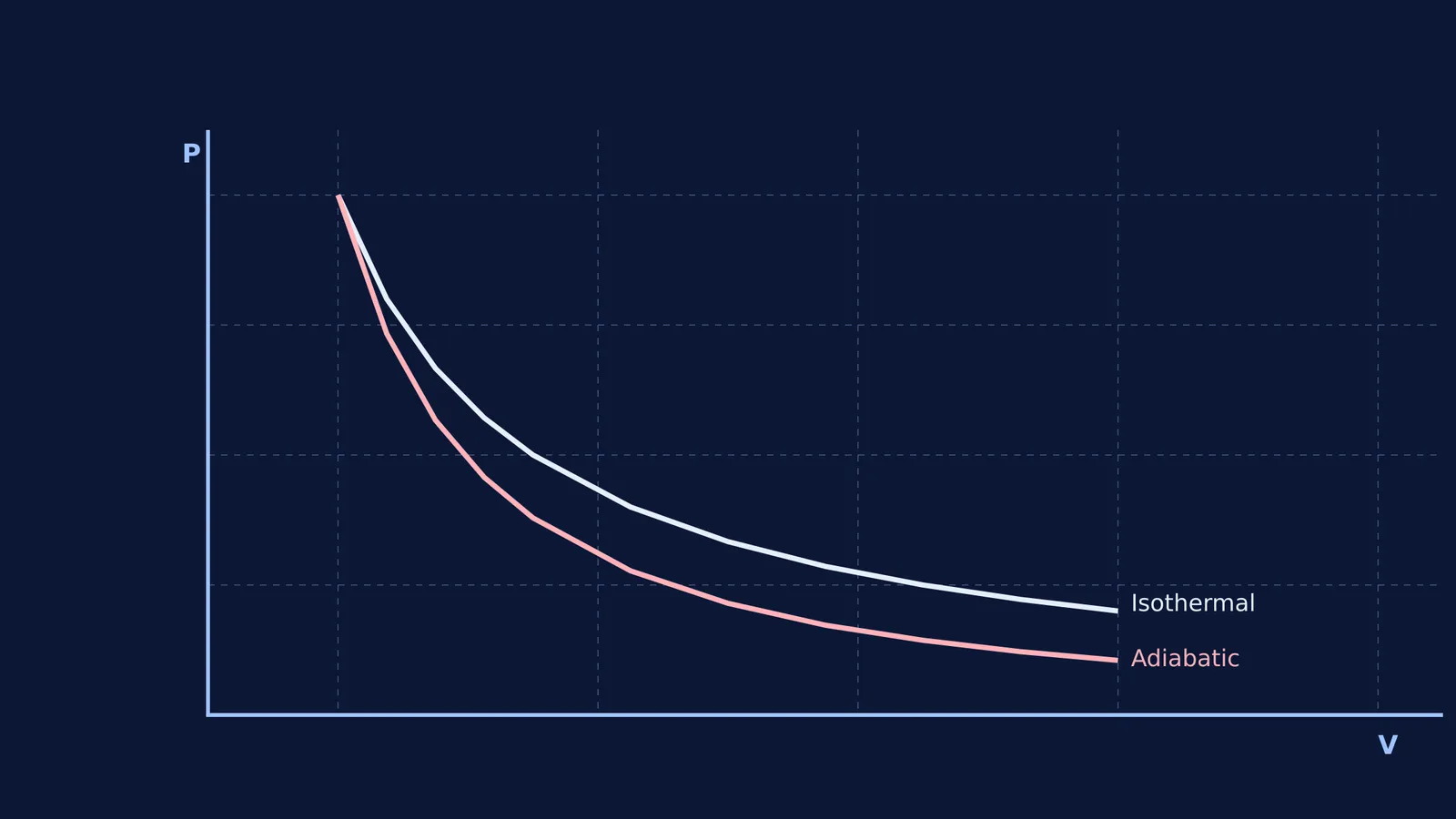
Because there is no heat exchange (Q = 0), the first law of thermodynamics states that any work done by the gas must come at the expense of its internal energy. According to University Physics/University_Physics_II_-_Thermodynamics_Electricity_and_Magnetism_(OpenStax)/03%3A_The_First_Law_of_Thermodynamics/3.07%3A_Adiabatic_Processes_for_an_Ideal_Gas), when a gas expands adiabatically, its pressure drops much faster than it would in an isothermal expansion. This is because the volume increases while the temperature simultaneously falls. On a standard indicator diagram, this makes the adiabatic curve noticeably steeper than an isothermal one.
Before you can use any form of the adiabatic equation, you must know the value of γ. For a monatomic gas (like helium), γ is approximately 1.67. For a diatomic gas (like oxygen or nitrogen at room temperature), γ is 1.4. If you are dealing with a mixture, you must calculate the effective γ of a gas mixture first.
How to derive the T-V adiabatic relation?
To find the relationship between temperature and volume, you need to eliminate pressure from the starting equation. You can do this using the ideal gas law, P V = n R T.
Rearrange the ideal gas law to make pressure the subject:
P = n R T / V
Substitute this expression for P into the foundational adiabatic equation (P V^γ = constant):
(n R T / V) × V^γ = constant
Use the laws of indices to combine the volume terms. V^γ divided by V is V^(γ−1):
n R T × V^(γ−1) = constant
Since n (the number of moles) and R (the universal gas constant) are themselves constants, you can divide the entire right side by n R to form a new constant:
T V^(γ−1) = constant
This gives you the T-V form. If a gas expands (V increases), its temperature must drop to keep the product constant. This is the mathematics behind why a suddenly opened bicycle tyre valve feels cold, or why rising air in the atmosphere cools to form clouds.
What is the P-T relation for an adiabatic process?
Sometimes, a problem gives you a sudden pressure change and asks for the new temperature, skipping volume entirely. Again, start with the ideal gas law, but this time rearrange it to eliminate V: V = n R T / P
Substitute this into P V^γ = constant:
P × (n R T / P)^γ = constant
Separate the terms inside the bracket:
P × (n R)^γ × (T^γ / P^γ) = constant
Since (n R)^γ is just another constant, divide the right side by it to absorb it into the constant term:
P × (T^γ / P^γ) = constant
Combine the P terms using the rules of indices (P divided by P^γ):
P^(1−γ) T^γ = constant
This P-T form is particularly useful for questions involving rapid pressure changes. For example, the rapid compression stroke in a diesel engine happens so fast that it is effectively adiabatic, and the P-T relation tells you exactly how hot the fuel-air mixture will get before it ignites.
Working through an example
Consider a diatomic gas (γ = 1.4) at an initial temperature of 300 K and a pressure of 1 atmosphere, a classic problem setup found in texts like University Physics/University_Physics_II_-_Thermodynamics_Electricity_and_Magnetism_(OpenStax)/03%3A_The_First_Law_of_Thermodynamics/3.07%3A_Adiabatic_Processes_for_an_Ideal_Gas). If it is suddenly compressed to 10 atmospheres, what is its final temperature?
Because the question involves pressure and temperature, use the P-T relation: P₁^(1−γ) T₁^γ = P₂^(1−γ) T₂^γ
Rearrange to solve for the final temperature (T₂): T₂^γ = T₁^γ × (P₁ / P₂)^(1−γ)
Take the γ-th root of both sides: T₂ = T₁ × (P₁ / P₂)^((1−γ)/γ)
Substitute the known values (T₁ = 300 K, P₁/P₂ = 1/10, γ = 1.4): T₂ = 300 × (0.1)^((1 − 1.4) / 1.4) T₂ = 300 × (0.1)^(−0.4 / 1.4) T₂ = 300 × (0.1)^(−0.285) T₂ = 300 × 1.93 = 579 K
The gas almost doubles in temperature simply from being compressed quickly.
Seeing the mathematical connections
It can be difficult to memorise these derivations, especially when you need to recall them under time pressure. If you find yourself forgetting whether the exponent is γ−1 or 1−γ, the Concept Library puts these thermodynamic processes in their mathematical context, showing you how each equation flows from the ideal gas law rather than asking you to memorise them in isolation.
If a question asks you to trace these changes visually, converting PV, PT and VT graphs requires knowing exactly whether a curve is an isotherm or an adiabat. Keep in mind that these specific relations only hold for a reversible adiabatic process involving an ideal gas. For irreversible sudden changes (like expanding into a vacuum), you must rely on the first law of thermodynamics directly.


