On this page
Three quantities in your thermal physics chapter sound almost the same, and exam questions exploit that. To keep them apart, ask: per what? Per object, per kilogram, or per mole.
What is the difference between heat capacity and specific heat?
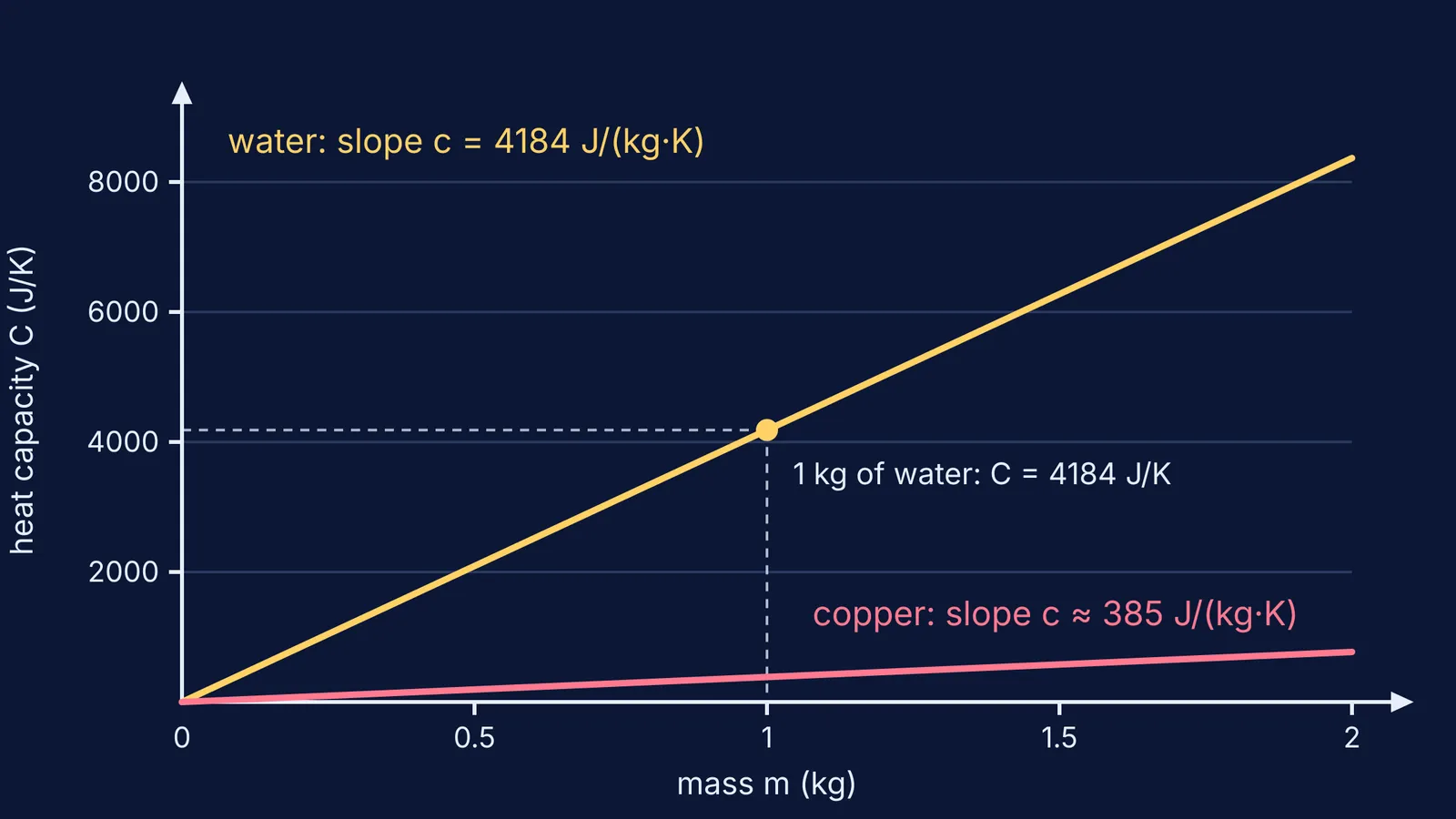
Heat capacity is the heat needed to raise the temperature of a whole object by one kelvin: C = Q/ΔT. It depends on how much material there is. A full bucket of water has a far larger heat capacity than a cup of water, even though both are water.
Specific heat capacity is heat capacity divided by mass: c = C/m = Q/(mΔT). It belongs to the material, not to any one object. The US Geological Survey states that one kilogram of water must absorb 4,184 joules to warm by 1 °C, so water's specific heat is 4184 J/(kg·K).
Molar heat capacity divides by the amount of substance instead: C_m = C/n = Q/(nΔT). Chemistry and gas problems prefer it because a mole is a fixed number of particles, whatever the substance.
Heat capacity C: one object, unit J/K
Specific heat capacity c: one material, per kilogram, unit J/(kg·K)
Molar heat capacity C_m: one material, per mole, unit J/(mol·K)
What are the SI units of heat capacity, specific heat and molar heat capacity?
The BIPM SI Brochure lists heat capacity in joule per kelvin (J K⁻¹), specific heat capacity in joule per kilogram kelvin (J kg⁻¹ K⁻¹) and molar heat capacity in joule per mole kelvin (J mol⁻¹ K⁻¹). The same brochure points out that entropy also uses J/K, so a unit alone does not tell you which quantity you are holding.
Why is water's specific heat so much bigger than copper's?
Per kilogram, the gap looks huge. Using the NIST Chemistry WebBook's fitted equation for solid copper at 25 °C, copper's molar heat capacity works out to about 24.5 J/(mol·K); divided by its molar mass of 63.546 g/mol, that is about 385 J/(kg·K). The same database's equation for liquid water gives about 75.4 J/(mol·K), and with a molar mass of 18.0153 g/mol, about 4184 J/(kg·K), matching the USGS figure.
So per kilogram, water needs roughly 11 times as much heat as copper for the same temperature rise. Per mole, it is only about 3 times. The rest of the difference is counting: a kilogram of water holds about 55.5 mol of molecules, while a kilogram of copper holds about 15.7 mol of atoms. The same idea explains why sand heats faster than water on a sunny beach.
How do you use all three in one problem?
Take a copper vessel of mass 0.5 kg holding 2 kg of water at 25 °C. How much heat takes both to 75 °C? Use the NIST-based values above: 385 J/(kg·K) for copper, 4184 J/(kg·K) and 75.4 J/(mol·K) for water.
Find each object's heat capacity. Vessel: C = 0.5 × 385 = 192.5 J/K. Water: C = 2 × 4184 = 8368 J/K.
Add the heat capacities, because the two objects warm together: 192.5 + 8368 = 8560.5 J/K.
Multiply by the temperature change, ΔT = 50 K: Q = 8560.5 × 50 ≈ 428,000 J, or about 428 kJ.
Check with moles. 2 kg of water is 2000 ÷ 18.015 ≈ 111 mol, and 111 × 75.4 ≈ 8370 J/K, the same heat capacity as step 1.
The classic wrong move is adding or averaging the specific heats (385 + 4184). Specific heats only add after each is multiplied by its own mass, which turns them into heat capacities. The vessel's water equivalent, 192.5 ÷ 4184 ≈ 0.046 kg, is the same idea. You will meet it again in the method of mixtures practical for specific heat.
If you keep reaching for the wrong formula, the Fermi Problem Library has worked problems with a step-by-step solver that explains the reasoning rather than printing an answer, so you can see where your method went off.
A 30-second check before you answer
Does the question name a thing: a vessel, a block, a calorimeter? It wants heat capacity, in J/K.
Does it name a material: the specific heat of aluminium or of water? It wants J/(kg·K), or J/(g·K) in many chemistry books.
Does it give n moles of gas, or talk about Cp and Cv? It wants molar heat capacity, in J/(mol·K). Gases add one more twist, covered in why Cp is greater than Cv for a gas.
Does your final unit match? If kg appears, you have a specific heat; if mol appears, a molar one; if neither, the whole object.
If the gap is in the idea itself rather than the arithmetic, the Fermi Concept Library gives every concept in physics and chemistry its own lesson and its place in the map, so you can see how heat capacity connects to calorimetry and gases.