

On this page
If you visit the coast on a bright afternoon, you will quickly notice a stark contrast. The dry sand burns your bare feet, forcing you to run toward the ocean. Yet, when you step into the water, it feels refreshingly cool. Both the shore and the sea have been sitting under the exact same sunlight for the same number of hours. Why do they reach such drastically different temperatures?
The answer lies in an invisible property of matter called specific heat capacity. This physical constant governs how materials respond to thermal energy, and understanding it can make sense of everything from coastal breezes to climate patterns.
What is specific heat capacity?
Specific heat capacity (often written as *c*) is the amount of heat energy required to raise the temperature of one kilogram of a substance by one degree Kelvin (or one degree Celsius). Every material has its own unique value, reflecting how easily its atoms or molecules can store thermal energy.
When thermal energy enters a substance, it causes the microscopic particles to move and vibrate faster, which we measure as a rise in temperature. In liquids like water, the molecules are bound together by strong intermolecular forces—specifically hydrogen bonds. Much of the incoming solar energy is spent stretching and breaking these bonds before the molecules can begin moving faster. In solid minerals like sand (which is mostly silicon dioxide), the incoming heat goes almost entirely into making the rigid atomic lattice vibrate, translating immediately into a temperature spike.
As listed in standard reference tables on Wikipedia, liquid water has a specific heat capacity of approximately 4,184 J⋅kg⁻¹⋅K⁻¹. In contrast, common dry sand has a specific heat capacity of just 830 J⋅kg⁻¹⋅K⁻¹.
This means water requires roughly five times more energy than sand to achieve the same change in temperature.
Why does sand warm faster?
Because sand has a lower specific heat capacity, its temperature responds sharply to even modest amounts of energy. We can see this mathematically using the heat equation:
Q = m × c × ΔT
Where:
Q is the heat energy absorbed (in joules).
m is the mass of the substance (in kilograms).
c is the specific heat capacity.
ΔT is the change in temperature.
If we rearrange this to solve for the temperature rise, we get:
ΔT = Q / (m × c)
Notice that the temperature rise (ΔT) is inversely proportional to the specific heat capacity (c). A smaller denominator means a larger result. Since the specific heat of sand (830) is about one-fifth the specific heat of water (4,184), the same amount of heat will cause sand's temperature to jump nearly five times higher than water's.
How much does 10 kJ of heat raise the temperature?
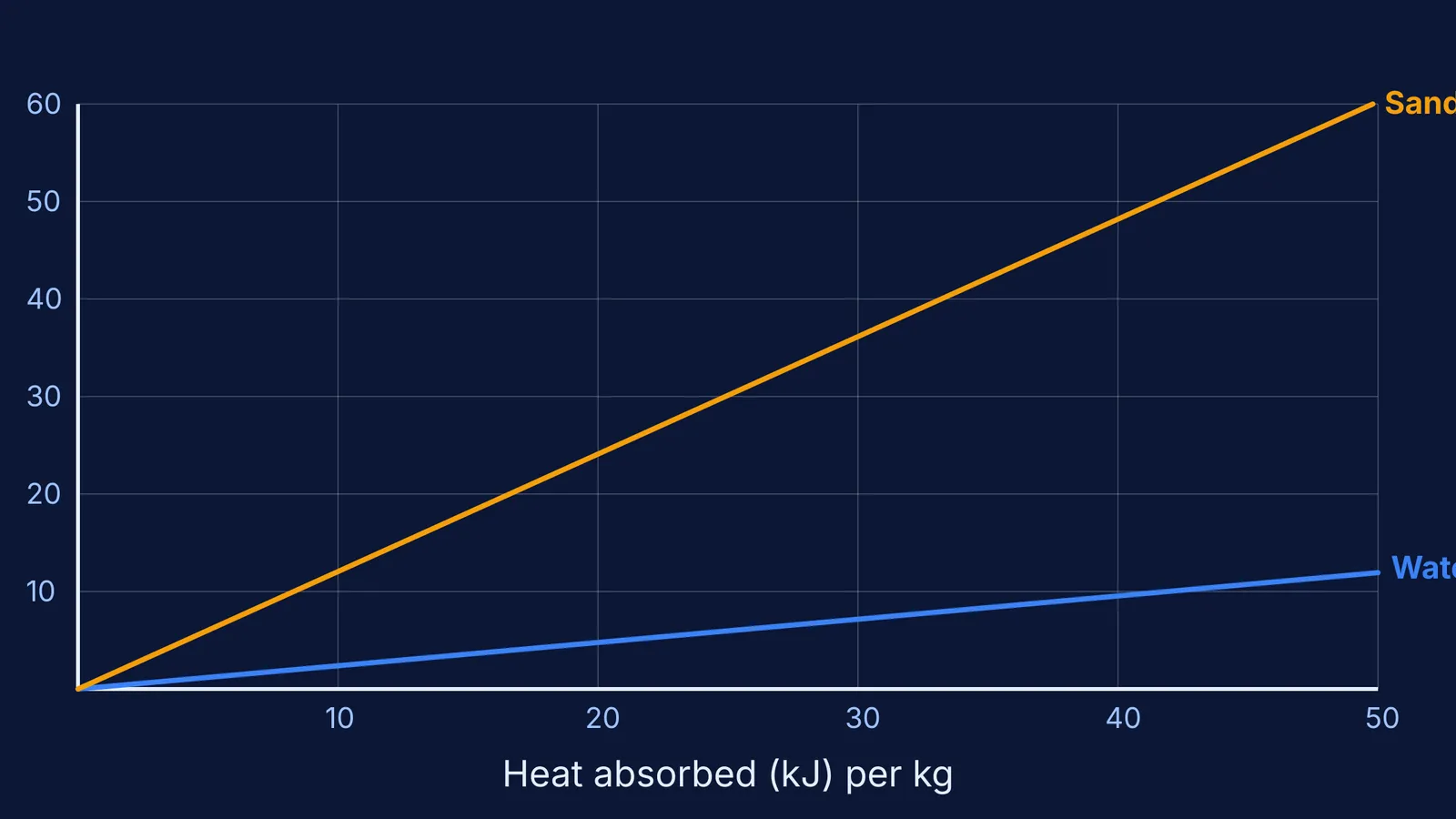
Let us apply these values to a practical scenario. Imagine a small patch of beach holding exactly one kilogram of dry sand, sitting directly beside a container holding one kilogram of seawater. The noon Sun beats down, delivering 10,000 joules (10 kJ) of heat energy to each.
We can calculate the exact temperature rise for the sand: ΔT = 10,000 J / (1 kg × 830 J⋅kg⁻¹⋅K⁻¹) = 12.0 °C
Now, we calculate the temperature rise for the water: ΔT = 10,000 J / (1 kg × 4,184 J⋅kg⁻¹⋅K⁻¹) = 2.4 °C
Under the exact same heating conditions, the sand's temperature increased by a massive 12 °C, while the water barely warmed by 2.4 °C. This calculation perfectly mirrors your experience at the beach.
How can you explore thermodynamics?
If you are studying for your physics or chemistry exams, you will find that specific heat shows up everywhere, from simple calorimetry experiments to complex gas laws. Reading about these thermal processes is one thing, but seeing them happen can make the equations much clearer. You can visualise how energy transfers between different substances in the Fermi Simulation Lab, which provides interactive simulations for the ideas that are easier to see than to read.
If you are looking to dig deeper into how heat and matter interact, reviewing how historical scientists measured these values can be helpful. You might explore Dulong, Petit and the law that weighed atoms with heat to see how early physicists linked heat capacity to atomic mass. Alternatively, for a rigorous look at how gases handle heat differently than liquids and solids, review Heat in isobaric and isochoric processes: using nCpΔT and nCvΔT. Understanding these core principles will ensure that the next time you step onto a hot beach, you will know exactly what the numbers are doing beneath your feet.


