On this page
Three identities do most of the work in Class 8 algebra: (a + b)² = a² + 2ab + b², (a − b)² = a² − 2ab + b², and (a + b)(a − b) = a² − b². The NCERT Grade 8 textbook Ganita Prakash builds all three from the distributive property in its chapter We Distribute, Yet Things Multiply, then asks you to use them on numbers such as 104², 99² and 98 × 102. Here is each one worked through, with a picture and a way to choose.
What are the (a + b)² and related identities?
The NCERT chapter defines an identity as a statement that two algebraic expressions are equal, whatever numbers the letters stand for. It names the three you need here:
Identity 1A: (a + b)² = a² + 2ab + b²
Identity 1B: (a − b)² = a² − 2ab + b²
Identity 1C: (a + b)(a − b) = a² − b²
In the textbook's picture for 1A, a square of side 65 splits into a 60 by 60 square, a 5 by 5 square and two 60 by 5 rectangles, so 65² = 3,600 + 25 + 600 = 4,225 (NCERT Ganita Prakash, section 6.2). The 2ab term is those two rectangles. If you leave it out, you are missing two whole pieces of the square.
How do you find 103² using (a + b)²?
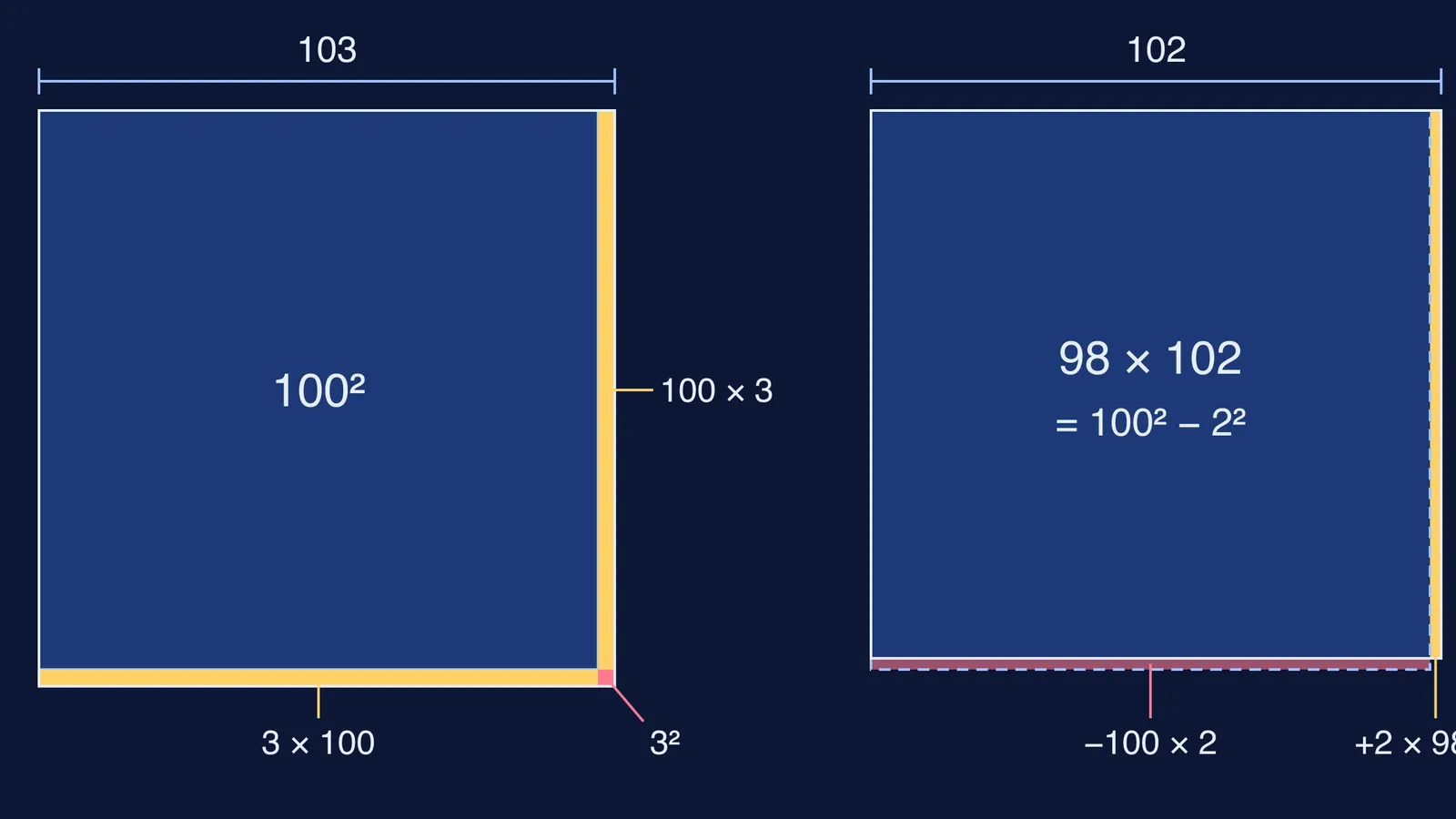
Split the number so that a² is easy to work out. For 103, take a = 100 and b = 3.
Write 103 = 100 + 3.
a² = 100² = 10,000.
2ab = 2 × 100 × 3 = 600.
b² = 3² = 9.
Add them: 10,000 + 600 + 9 = 10,609.
For a number just below a round number, use (a − b)² instead. 99² = (100 − 1)² = 10,000 − 200 + 1 = 9,801. 58² = (60 − 2)² = 3,600 − 240 + 4 = 3,364.
How do you calculate 98 × 102 quickly?
98 and 102 are each 2 away from 100, one below and one above. That is exactly the shape of (a − b)(a + b), so 98 × 102 = 100² − 2² = 10,000 − 4 = 9,996.
The NCERT chapter sets 98 × 102 and 45 × 55 as practice for Identity 1C. For the second one, 45 × 55 = (50 − 5)(50 + 5) = 2,500 − 25 = 2,475.
The same chapter shows a method it credits to Sridharacharya (750 CE): rewrite 1C as a² = (a + b)(a − b) + b². To find 197², take b = 3, so 197² = 200 × 194 + 9 = 38,809.
How do you simplify expressions with these identities?
Same method, with letters. Treat each whole term, coefficient included, as a or b.
(3x + 4)² = 9x² + 24x + 16, with a = 3x and b = 4
(2y − 7)² = 4y² − 28y + 49
(2x + 7)(2x − 7) = 4x² − 49
(2x + 3y)² − (2x − 3y)² = 24xy, because the squares cancel and 12xy − (−12xy) = 24xy
(a + b)² + (a − b)² = 2(a² + b²), which the textbook uses to explain why 2(5² + 6²) = 11² + 1²
Check any answer by putting in a small number. With x = 1, (3x + 4)² is 7² = 49, and 9 + 24 + 16 is also 49.
Which mistakes cost marks on identity questions?
The chapter's "Mind the Mistake" exercise shows (5m + 6n)² written as 25m² + 36n² (NCERT, section 6.3). The missing middle term, 60mn, is the classic slip. Watch for these:
Dropping 2ab. Remember the two rectangles.
Getting the sign of b² wrong in (a − b)². It is always +b², because (−b)² = b².
Squaring only the letter: (3x)² is 9x², not 3x².
Trying to factorise a² + b² with 1C. Only a difference of two squares splits into (a + b)(a − b).
For the whole chapter, including how to check an expansion, read algebraic identities in Class 8: expand, check and calculate faster. To use the identities in reverse, see how to factorise x² + 6x + 9 and spot a perfect square. When cubes come up, try evaluating 104 cubed with algebraic identities.
If you get a simplification wrong and can't see where, the Fermi Problem Library has worked problems with a step-by-step solver that explains the reasoning instead of just printing the answer. If the idea itself is the gap, the Fermi Concept Library gives each mathematics concept its own lesson.
Do the practice box tonight, then check each answer once by ordinary long multiplication.