

On this page
According to the National Achievement Survey 2021, the national average score for Class 10 mathematics was just 32%, highlighting the need for a strong foundation in middle school algebra. Algebraic identities are more than just formulae to memorise for exams; they are powerful mental tools that simplify otherwise tedious arithmetic. Multiplying 104 × 104 × 104 by hand requires multiple lines of carrying over and addition, making it easy to make a small error that ruins the final answer. By rewriting the numbers to use algebraic identities, you turn complex multiplication into simple addition and subtraction involving powers of ten.
This technique is introduced in Class 9 polynomials and forms the backbone of advanced algebra in Class 10 polynomials. These same algebraic rules are essential for factorising quadratic equations and working through calculus later in your studies. It teaches you to break problems down strategically rather than powering through them by brute force.
How do you evaluate 104 cube using an algebraic identity?
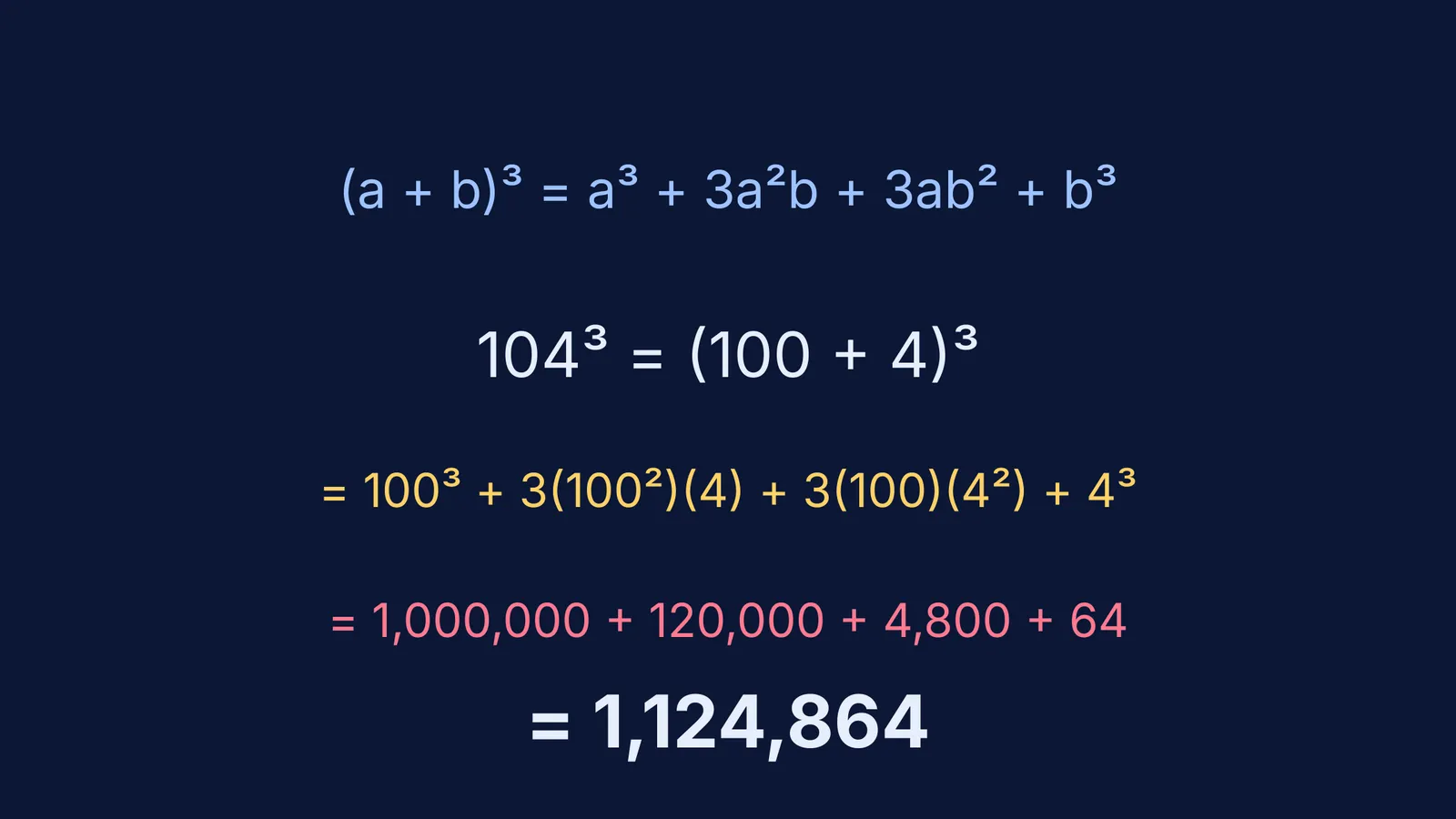
To evaluate 104³ without a calculator, we use the standard identity for the cube of a sum:
(a + b)³ = a³ + b³ + 3ab(a + b)
Alternatively, expanding the brackets gives the form most useful for mental calculation:
(a + b)³ = a³ + 3a²b + 3ab² + b³
The trick is to split the number into a round figure (like 10, 100 or 1000) and a small remainder. For 104, the obvious choice is 100 and 4. Let a = 100 and b = 4.
Substituting these into the identity gives: (100 + 4)³ = 100³ + 3(100²)(4) + 3(100)(4²) + 4³
Now, evaluate each term individually. Working with powers of 10 is straightforward because you simply count the zeros:
a³ = 100³ = 1,000,000
3a²b = 3 × 10,000 × 4 = 120,000
3ab² = 3 × 100 × 16 = 4,800
b³ = 4³ = 64
Finally, add the results together: 1,000,000 + 120,000 + 4,800 + 64 = 1,124,864.
How do you evaluate 998 cube with (a − b)³?
The cube of a difference works exactly the same way, but with alternating signs. The identity is:
(a − b)³ = a³ − 3a²b + 3ab² − b³
To find the cube of a number just below a power of 10, such as 998, we write it as (1000 − 2). This means a = 1000 and b = 2.
Substituting into our formula: (1000 − 2)³ = 1000³ − 3(1000²)(2) + 3(1000)(2²) − 2³
Evaluating each term:
1000³ = 1,000,000,000 (one billion)
3(1000²)(2) = 3 × 1,000,000 × 2 = 6,000,000
3(1000)(2²) = 3 × 1000 × 4 = 12,000
2³ = 8
Now, carefully combine the positive and negative terms: (1,000,000,000 + 12,000) − (6,000,000 + 8) = 1,000,012,000 − 6,000,008 = 994,011,992.
While writing out nine zeros might seem lengthy, performing 998 × 998 × 998 on paper without this identity takes far longer and requires tracking up to ten lines of working out.
Can you use a² − b² to compute 98 × 102 mentally?
The difference of two squares identity is arguably the most satisfying shortcut in arithmetic:
a² − b² = (a − b)(a + b)
You can run this identity in reverse to multiply two numbers that sit equally spaced above and below a round number. Consider the product 98 × 102. Both numbers are exactly 2 units away from 100.
Write the expression as: (100 − 2)(100 + 2)
According to the identity, this is equal to: 100² − 2²
This turns a two-digit multiplication into a simple subtraction: 10,000 − 4 = 9,996.
This pattern appears frequently in competitive exams and school assessments. Once you start looking for numbers equidistant from a base of 10, you can multiply 47 × 53 (which is 50² − 3²) or 105 × 95 (which is 100² − 5²) in seconds.
Common mistakes when applying (a + b)³
A common pitfall is forgetting the coefficients of 3 in the middle terms, wrongly expanding (a + b)³ as just a³ + b³. This error stems from treating the exponent as something that can be distributed across terms, ignoring the cross-multiplication.
When you multiply out (a + b)(a + b)(a + b), you are summing every possible combination of a and b. The 3a²b term appears because there are exactly three ways to pick two a terms and one b from the three sets of brackets. Understanding this combinatorics principle is why the formula takes the shape it does, and why it is not simply a³ + b³.
Another frequent error is mishandling the negative sign in (a − b)³. Students often write −3ab² instead of +3ab². The key rule is that when you square the negative b, the result becomes positive. Whenever you evaluate an identity with a minus sign, double-check your alternating positive and negative signs before you tally the final arithmetic.
Building algebraic intuition
Mastering these identities requires moving past rote memorisation and understanding the logic behind the numbers. When students stumble, it is often because they cannot link the abstract letters to real quantities.
If you want to master the full map of identities, the Fermi Concept Library contains every concept in mathematics, each with its own lesson and its place in the map. Furthermore, Fermi's AI tutor teaches through the problem—writing on a board and drawing the figure to check your understanding as it goes.
To make these calculations second nature, try applying the checklist below whenever you face a bulky calculation.
Mental math checklist for algebraic identities
Spot the base: Is the number close to 10, 50, 100, or 1000?
Choose the operator:
If the number is above the base (e.g., 103), use a sum (a + b).
If below (e.g., 97), use a difference (a − b).
Check for symmetry: If multiplying two numbers (e.g., 92 × 108), find their exact midpoint. If the midpoint is a clean power of 10, use (a − b)(a + b).
Mind the signs: When expanding (a − b)³, remember that the squared b term is positive (+3ab²) and the cubed b term is negative (−b³).


