On this page
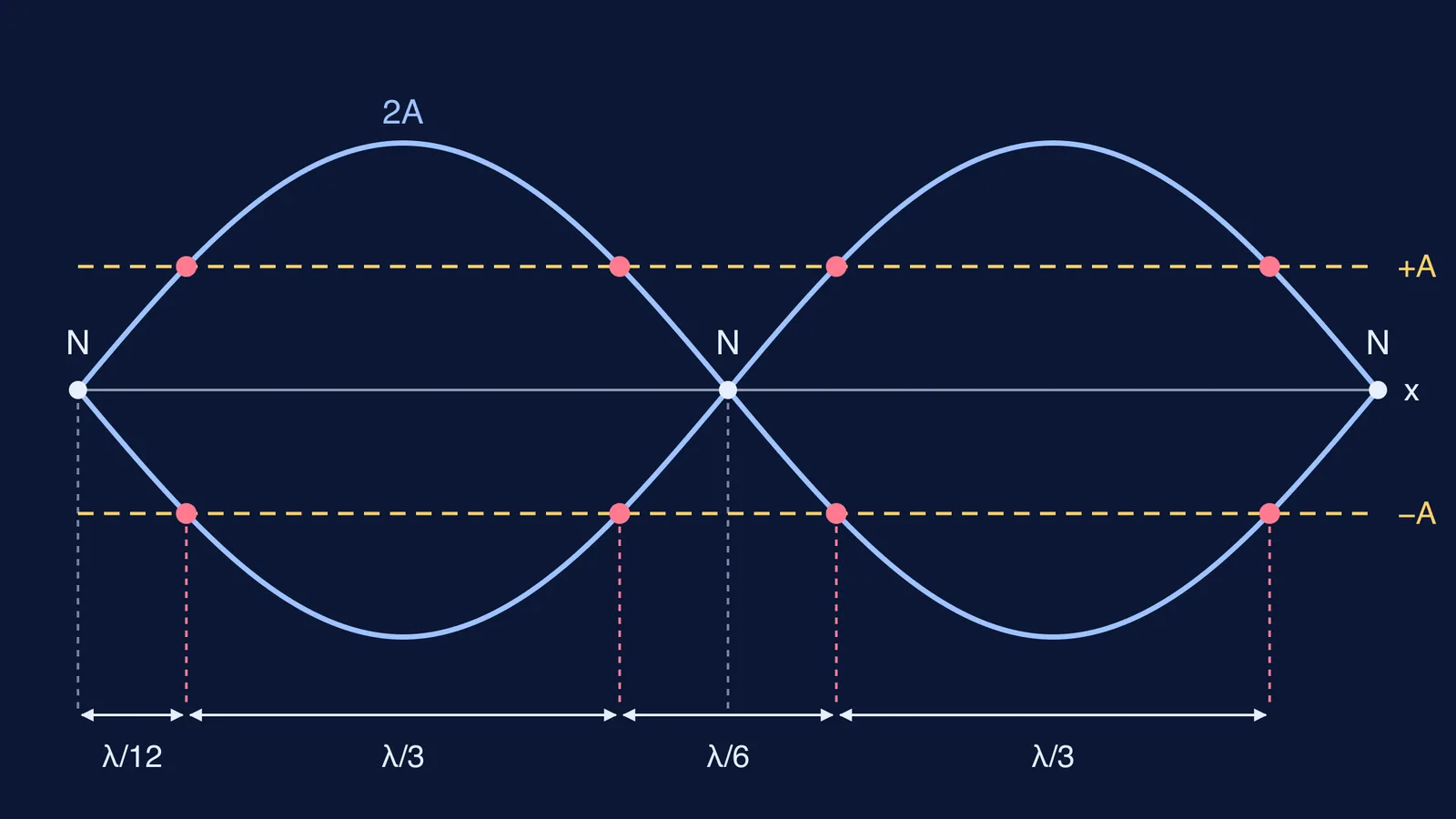
A standing wave question often looks harmless: find the points where the amplitude is half the maximum, then find the distance between two of them. A tempting answer is λ/8, because it sounds like "halfway to the antinode". The right answer is λ/12 from a node, and the gap between two points is either λ/3 or λ/6, depending on which pair the question means.
What is the amplitude at each point of a standing wave?
When two identical waves travel in opposite directions, they add to give y(x,t) = [2A sin(kx)] cos(ωt), as derived in OpenStax University Physics Volume 1, section 16.6. The part in brackets, 2A sin(kx), is the amplitude of the particle at position x. The cos(ωt) part only makes every particle swing up and down in step.
The same OpenStax section places the nodes at x = nλ/2 and the antinodes at odd multiples of λ/4, where particles swing between +2A and −2A. Here k = 2π/λ is the wave number. If the equation itself is new to you, see how two travelling waves combine into the standing wave equation.
Where is the amplitude half the maximum?
The maximum amplitude is 2A, so half of it is A. Amplitude is a size, so take the absolute value:
Set |2A sin kx| = A, which gives |sin kx| = 1/2.
Solve: kx = π/6, 5π/6, 7π/6, 11π/6, and so on. In one line, kx = nπ ± π/6.
Put k = 2π/λ: x = λ/12, 5λ/12, 7λ/12, 11λ/12, and so on. In one line, x = nλ/2 ± λ/12.
Every half-amplitude point lies λ/12 from the nearest node. Each loop, which is λ/2 long, has two of them, one on each side of its antinode, so there are four in every wavelength.
What is the distance between two half-amplitude points?
The points are not evenly spaced. List them in order and subtract:
Same loop, on either side of an antinode: 5λ/12 − λ/12 = λ/3. These two particles move in phase.
Neighbouring loops, on either side of a node: 7λ/12 − 5λ/12 = λ/6. These two move in opposite phase, because sin kx changes sign at a node.
So the gaps alternate λ/3, λ/6, λ/3, λ/6 along the string. Read the question carefully. "Minimum distance between two points of amplitude A" means λ/6. "Nearest two such points vibrating in the same phase" means λ/3.
A worked example with numbers
Take y = 4 sin(πx/15) cos(96πt), with x and y in cm and t in seconds.
Maximum amplitude: 4 cm, so half is 2 cm. (Here the 4 already plays the role of 2A.)
Wavelength: k = π/15 per cm, so λ = 2π/k = 30 cm. Nodes are at 0, 15 and 30 cm.
Condition: sin(πx/15) = ±1/2, so πx/15 = π/6, 5π/6, 7π/6, 11π/6.
Points: x = 2.5, 12.5, 17.5 and 27.5 cm.
Check: λ/12 = 2.5 cm, and 2.5 cm is exactly how far each point sits from its nearest node.
Distances: 12.5 − 2.5 = 10 cm (λ/3) and 17.5 − 12.5 = 5 cm (λ/6).
The time part, cos(96πt), never enters. Amplitude depends on position only.
What if the antinode is at x = 0?
At an open end the equation is often written y = 2A cos kx cos ωt, with an antinode at x = 0. Now |cos kx| = 1/2 gives kx = π/3, so the first point is at x = λ/6. That looks different, but the nearest node is at λ/4, and λ/4 − λ/6 = λ/12. The rule survives: measure from the node, not from x = 0. The gaps are still λ/3 and λ/6.
How to check your answer in 30 seconds
Run this before you mark an option:
Distance from the nearest node is λ/12; distance from the nearest antinode is λ/6.
There are four such points per wavelength.
Plug back in: sin 30° = 1/2, so 2A sin 30° = A.
For any fraction f of the maximum, the distance from a node is (λ/2π) × arcsin f. With f = 1/√2 this gives λ/8, and only then are the points evenly spaced, λ/4 apart.
If you want to see this before you solve it, our post on finding harmonics in a standing wave simulation lets you watch the envelope while the nodes stay still.
If a variant still trips you up, such as "amplitude √3 A" or a pipe instead of a string, the Fermi Problem Library has worked problems with a step-by-step solver that explains the reasoning rather than printing an answer. If the gap is in the idea of wave number or phase itself, start with the matching lesson in the Fermi Concept Library.