

On this page
When two identical waves travel in opposite directions through the same medium, they interfere to form a standing wave. This is the phenomenon that creates the notes on a guitar string and the resonant frequencies in a flute.
Understanding how to derive the standing wave equation from two travelling waves is a standard requirement for physics courses. Here is the step-by-step mathematical derivation and how to find the positions of the nodes and antinodes.
How do two travelling waves form a standing wave equation?
A standing wave is formed by the superposition of two identical waves travelling in opposite directions [[1]](https://openstax.org/books/university-physics-volume-1/pages/16-6-standing-waves-and-resonance).
Let us define the two sinusoidal waves. They must have the same amplitude (A), wavelength (λ), and angular frequency (ω).
The wave travelling in the positive x-direction is described by y₁ = A sin(kx − ωt).
The wave travelling in the negative x-direction is described by y₂ = A sin(kx + ωt).
Here, k is the wave number, defined as k = 2π/λ.
According to the principle of superposition, the resultant wave y(x, t) is the algebraic sum of the two individual waves: y(x, t) = A sin(kx − ωt) + A sin(kx + ωt)
To simplify this, we use the trigonometric identity for the sum of two sines: sin α + sin β = 2 sin((α + β)/2) cos((α − β)/2)
Let α = kx + ωt and β = kx − ωt. Adding and subtracting these gives: (α + β)/2 = kx (α − β)/2 = ωt
Substituting these into our sum yields the standing wave equation: y(x, t) = 2A sin(kx) cos(ωt)
This result is a single equation where the position (x) and time (t) are separated into different functions.
What do the spatial and temporal parts mean?
Unlike a travelling wave, a standing wave does not propagate through space. We can see this in its equation, which has two distinct parts:
The spatial part: The term 2A sin(kx) represents the amplitude of the wave at any given position x. This means the amplitude is not constant; it depends on where you are on the x-axis.
The temporal part: The term cos(ωt) indicates that every point on the wave oscillates in simple harmonic motion with the same frequency.
If you are studying how waves interact, you might also find it helpful to review how we convert phase difference vs path difference to understand interference patterns.
Where are the nodes and antinodes located?
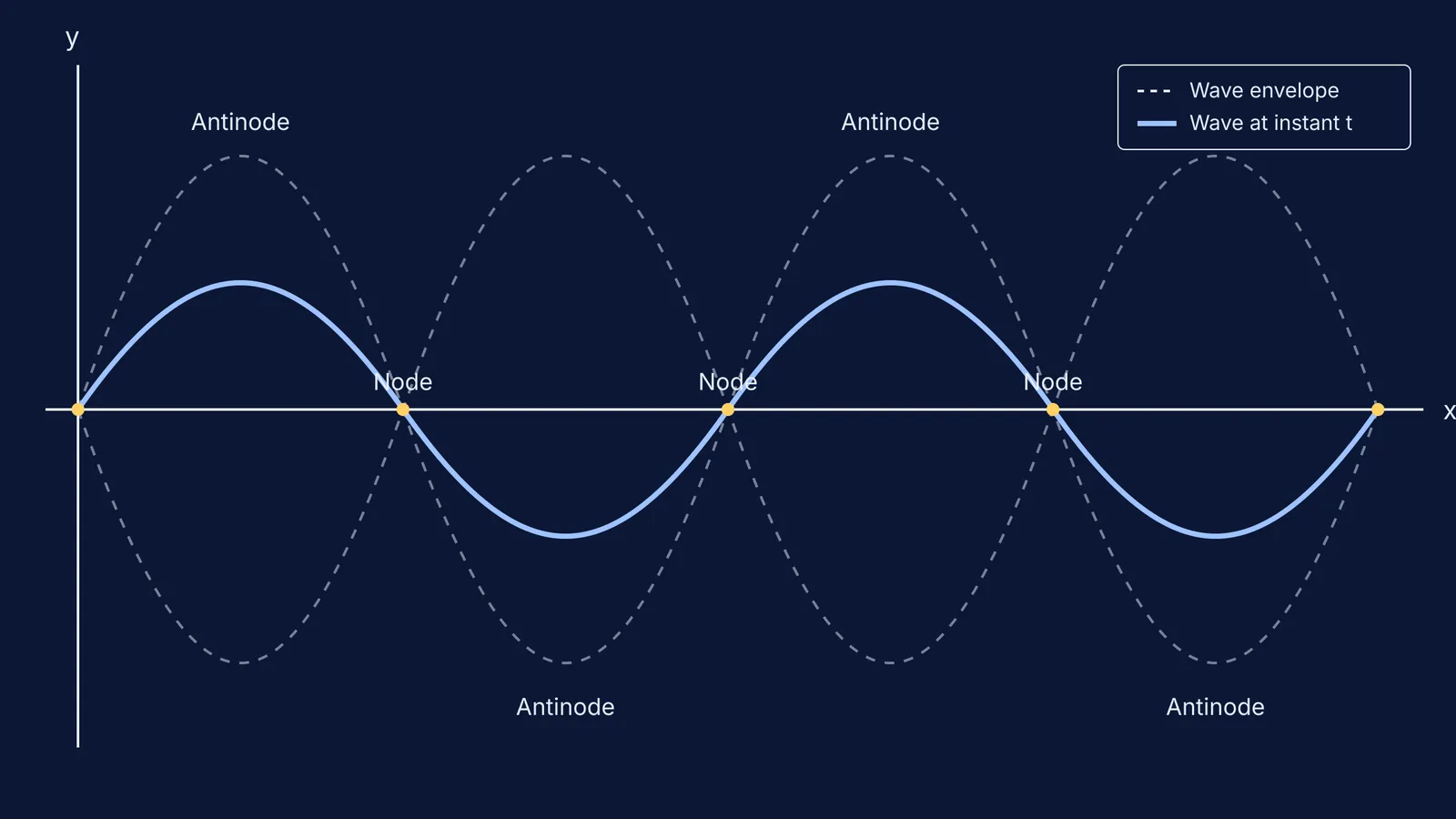
The spatial term 2A sin(kx) dictates the physical shape of the standing wave.
Nodes are points that never move. They occur where the amplitude is always zero. This happens when sin(kx) = 0, which means kx = nπ (for n = 0, 1, 2, ...). Substituting k = 2π/λ into this condition gives: (2π/λ)x = nπ x = n(λ/2) Therefore, nodes are located at integer multiples of half a wavelength [[1]](https://openstax.org/books/university-physics-volume-1/pages/16-6-standing-waves-and-resonance).
Antinodes are points of maximum motion. They occur where the amplitude reaches its peak of 2A. This happens when sin(kx) = ±1, which means kx = (n + 1/2)π. Substituting k = 2π/λ gives: (2π/λ)x = (n + 1/2)π x = (n + 1/2)(λ/2) Therefore, antinodes are located exactly halfway between the nodes.
How do you read a standing wave equation?
Consider the standing wave equation y = 4 sin(5πx) cos(100πt), where x and y are in centimetres and t is in seconds. Let us find the amplitude of the original travelling waves and the positions of the first three nodes.
Find the original amplitude: The standing wave amplitude is 2A = 4 cm. Therefore, the amplitude of the individual travelling waves is A = 2 cm.
Find the wavelength: The spatial part gives us the wave number k = 5π. Since k = 2π/λ, we have 2π/λ = 5π, which means λ = 0.4 cm.
Find the nodes: Nodes occur at x = n(λ/2). For λ = 0.4 cm, the nodes are at x = n(0.2). The first three nodes (n = 0, 1, 2) are at x = 0 cm, x = 0.2 cm, and x = 0.4 cm.
This analytical approach also applies to other wave types, such as the displacement and pressure waves in sound.
How can Fermi help you study waves?
If you are preparing for exams and need to practise deriving equations, the Fermi Concept Library maps out every concept in physics. If you get stuck on a problem, Fermi's AI tutor can break down the superposition steps, check your understanding as you go, and build a plan to help you master wave mechanics.


