On this page
If your Class 7 homework says "write in standard form", your teacher wants one agreed way of writing a rational number, so every correct answer looks the same. Here is what that form is, a four-step routine to reach it, and the classic check: are −6/8 and 3/−4 the same number?
What is the standard form of a rational number?
The NCERT Class 7 mathematics textbook, Chapter 9 "Rational Numbers" (2020-21 print) gives the definition: a rational number is in standard form if its denominator is a positive integer and the numerator and denominator have no common factor other than 1.
That is two conditions, and you need both:
Positive denominator. Any minus sign sits in the numerator. So −3/4 is fine; 3/−4 is not.
Lowest terms. The HCF of the numerator and denominator, ignoring signs, is 1. So −3/4 is fine; −6/8 is not, because 6 and 8 share a factor of 2.
The same chapter shows that multiplying or dividing the numerator and denominator by the same non-zero integer gives an equivalent rational number. That rule changes how a number looks without changing its value.
How do you reduce p/q to standard form?
NCERT's rule is to divide the numerator and denominator by their HCF, ignoring the negative sign, and to divide by "−HCF" when the minus sign is in the denominator (NCERT, Chapter 9). In practice that becomes four steps:
Fix the sign. If q is negative, multiply top and bottom by −1. If both are negative, the number is positive and both signs disappear.
Find the HCF of the two numbers without their signs.
Divide the numerator and denominator by that HCF.
Check that the denominator is positive and the only common factor left is 1.
The textbook's own examples follow this path. For −45/30, the HCF of 45 and 30 is 15, so −45/30 = −3/2. For 36/−24, the HCF of 36 and 24 is 12, and dividing both by −12 gives −3/2. Same answer, which tells you −45/30 and 36/−24 are equivalent.
If step 2 is slow for you, practise finding the HCF by continued division first; it makes larger pairs such as 84 and 126 quick.
Are −6/8 and 3/−4 equivalent?
Yes. Reduce both to standard form and compare.
−6/8: the denominator is already positive. The HCF of 6 and 8 is 2. Divide: −6 ÷ 2 = −3 and 8 ÷ 2 = 4. Standard form: −3/4.
3/−4: the denominator is negative, so multiply top and bottom by −1: 3 × (−1) = −3 and (−4) × (−1) = 4. The HCF of 3 and 4 is 1, so there is nothing more to divide. Standard form: −3/4.
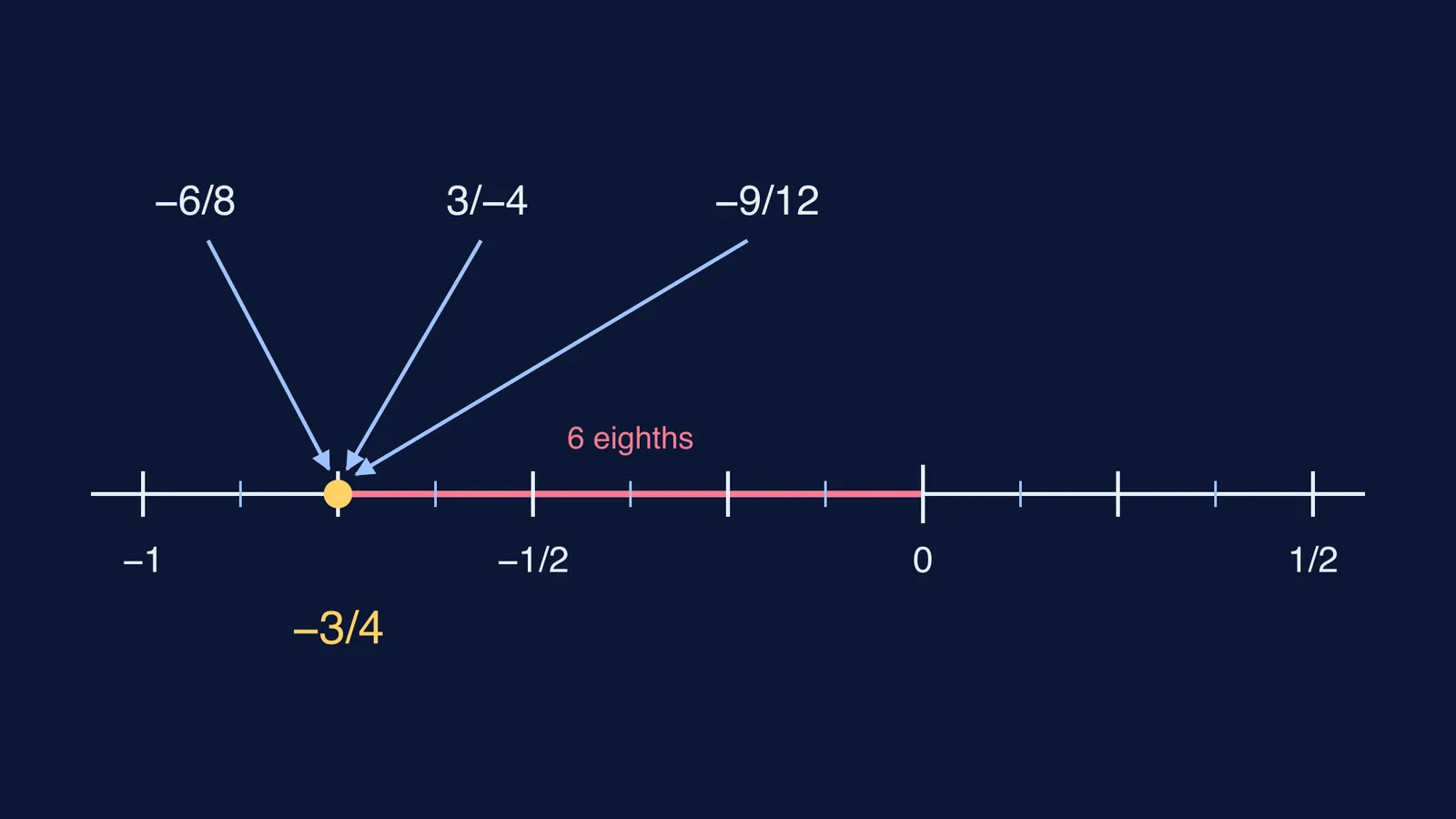
Both reduce to −3/4, so they are the same rational number. On a number line, both sit three quarters of the way from 0 to −1.
You can confirm with cross-multiplication: a/b = c/d exactly when a × d = b × c. Here (−6) × (−4) = 24 and 8 × 3 = 24. The products match, so the numbers are equivalent. Use this as a quick check; the standard form is what the question usually wants written.
The same step helps with ordering, as in our guide to comparing negative rational numbers.
Which mistakes cost marks?
Leaving the minus in the denominator. 3/−4 equals −3/4, but it is not in standard form.
Stopping early. −6/9 still has a common factor of 3. Check the HCF of your final pair.
Losing the sign. −6/8 becomes −3/4, not 3/4. Write the sign first, then reduce.
Two minus signs. −3/−5 is positive; the NCERT chapter shows −3/−5 = 3/5.
Changing only one part. Whatever you do to the numerator, do to the denominator.
If the same slip keeps appearing, the Fermi Problem Library has worked problems with a step-by-step solver that explains the reasoning rather than printing an answer, so you can see exactly which step went wrong.
How can you practise this tonight?
Try these before reading the answers. The first two come from a "Try These" box in the NCERT chapter.
−18/45
−12/18
14/−21
−25/−40
Are −10/15 and 4/−6 equivalent?
Answers: (1) −2/5, dividing by the HCF 9. (2) −2/3, dividing by 6. (3) −2/3: fix the sign to get −14/21, then divide by 7. (4) 5/8: both signs go, then divide by 5. (5) Yes: both reduce to −2/3, and (−10) × (−6) = 60 = 15 × 4.
If the basic reduction still feels shaky, our post on equivalent fractions and simplest form covers the same HCF method with positive fractions, and the Fermi Concept Library gives each mathematics concept its own lesson and its place in the map.