On this page
Many students get −2/3 versus −3/4 wrong the first time, and for a good reason. With positive fractions, 3/4 is bigger than 2/3, so instinct says −3/4 must be bigger too. The minus sign flips that. Here is a method that works every time, the reason it works, and the one step people skip.
Which is greater, −2/3 or −3/4?
−2/3 is greater. Rewrite both with denominator 12, the LCM of 3 and 4:
−2/3 = −8/12
−3/4 = −9/12
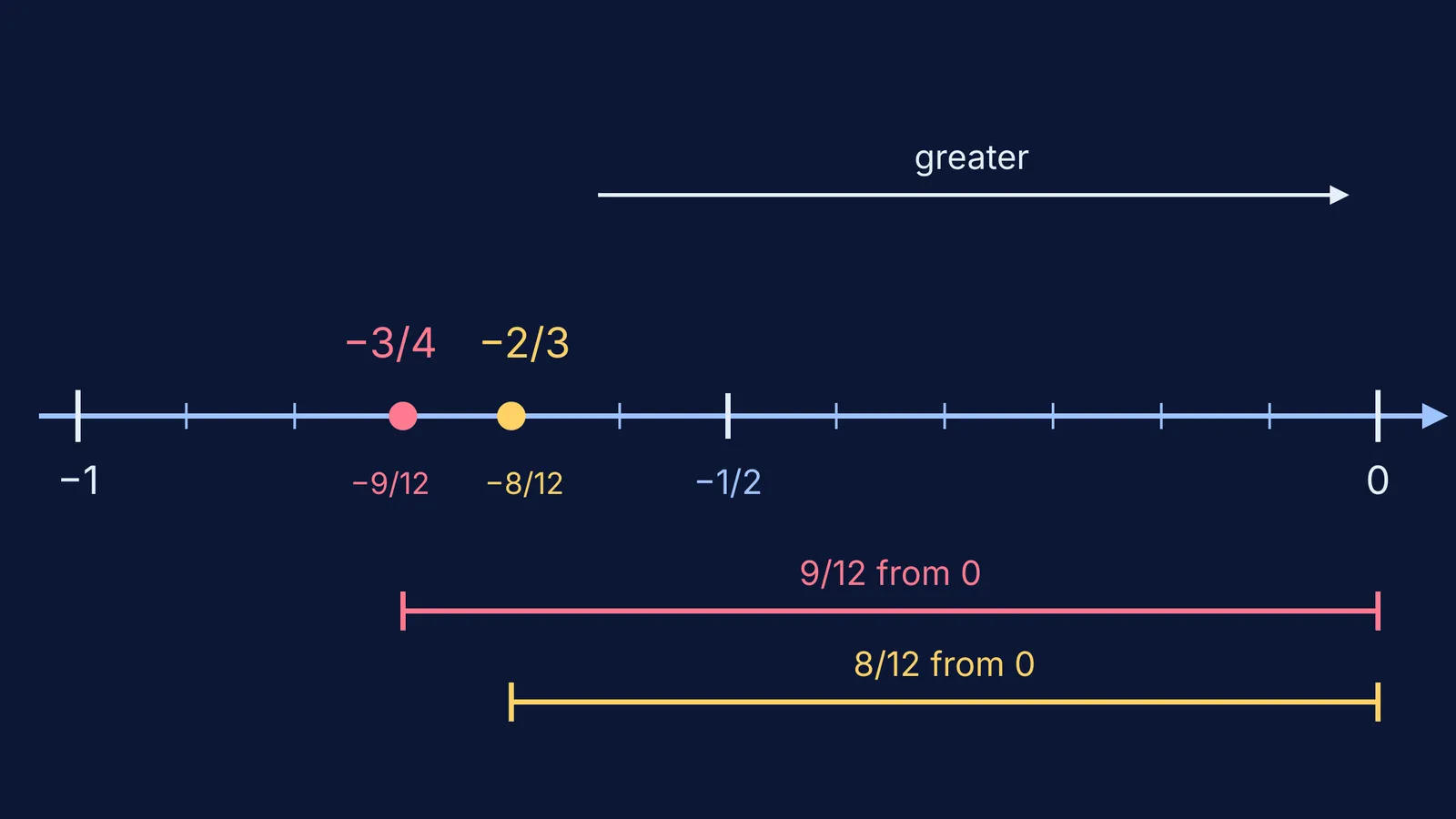
Now the denominators match, so compare the numerators. −8 is greater than −9, because −8 lies to the right of −9 on the number line. So −8/12 > −9/12, which means −2/3 > −3/4.
As decimals, −2/3 is about −0.667 and −3/4 is −0.75. Being "less negative" means being greater.
How do you compare two negative rational numbers?
A rational number is a number that can be written as p/q, where p and q are integers and q ≠ 0, as the NCERT Class 8 chapter on rational numbers defines it. Because the minus sign can sit on top or bottom, 4/−5 and −4/5 are the same number.
Make every denominator positive. Move any minus sign from the denominator to the numerator: 4/−5 becomes −4/5, and −7/−9 becomes 7/9.
Sort by sign first. Any positive number is greater than any negative number, with zero between them. If one is positive and one negative, you are done.
Make the denominators equal. Take the LCM of the denominators and rewrite each fraction.
Compare the numerators as integers. The larger integer gives the larger fraction. For two negatives, that is the numerator closer to zero.
Check with a decimal or a number line. This catches sign slips.
Why does making denominators positive matter?
Many students use cross-multiplication: for a/b and c/d, compare a × d with b × c. This is safe only when b and d are both positive.
Try it on 1/−2 and −1/3 without fixing the signs. 1 × 3 = 3 and (−2) × (−1) = 2, so cross-multiplication says 1/−2 is bigger. It isn't: 1/−2 = −0.5 and −1/3 is about −0.333, so −1/3 is greater.
Fix the signs first, giving −1/2 and −1/3, and cross-multiplication behaves: (−1) × 3 = −3 and 2 × (−1) = −2. Since −2 > −3, −1/3 > −1/2. Correct.
Why does −3/4 look bigger than it is?
On the number line, greater means further right. −3/4 is three-quarters of a unit to the left of zero; −2/3 is only two-thirds of a unit to the left. The one closer to zero is greater. For two negatives, a larger distance from zero means a smaller number.
The trap is carrying a habit over from positive numbers. In a study of 227 at-risk fourth-grade students ordering fractions, 81% of problems were completed incorrectly, and 65% of errors came from misapplying whole-number logic to fractions, according to Malone and Fuchs in the Journal of Learning Disabilities.
Negatives add a second layer. In a Frontiers in Human Neuroscience brain-imaging study of 22 adults comparing pairs of numbers, reaction times were slower for negative numbers than for positive ones. So a written method beats a gut feeling.
How do you compare other negative fractions?
4/−5 or −5/7? Fix the signs: −4/5 and −5/7. With LCM 35 they are −28/35 and −25/35. Since −25 > −28, −5/7 is greater.
−7/−9 or −8/9? Fix the signs: 7/9 is positive and −8/9 is negative, so 7/9 is greater. No LCM needed.
−3/8 or −5/12? With LCM 24 they are −9/24 and −10/24. Since −9 > −10, −3/8 is greater. Check: −0.375 > −0.417.
Order −1/2, −2/3 and −3/4 from smallest to greatest. With LCM 12 they are −6/12, −8/12 and −9/12, so the order is −3/4, −2/3, −1/2.
The same equal-denominator step helps when finding rational numbers between two rational numbers. To see why −2/3 lands where it does, practise marking fractions on a number line step by step. The sign rules come back when subtracting rational numbers by adding the additive inverse.
What should you check before writing the answer?
Did I move every minus sign to the numerator?
Did I sort by sign before doing any arithmetic?
Are both denominators now the same and positive?
For negative numerators, did I pick the one closer to zero as greater?
Does a quick decimal agree?
If one of these keeps tripping you up, the Fermi Problem Library has worked problems with a step-by-step solver that explains the reasoning rather than printing an answer, so you can see which step went wrong. For the idea underneath, the Fermi Concept Library gives each mathematics concept its own lesson and its place in the map.
Try it now: compare −5/6 and −7/9 with the five steps, then check with a decimal.