On this page
If 1/2 − (−5/6) makes you pause, the double minus is usually the problem, not the fractions. One rule handles it: turn every subtraction into addition of the negative. A second habit, grouping like denominators, then makes long sums much shorter.
What is the negative of a rational number?
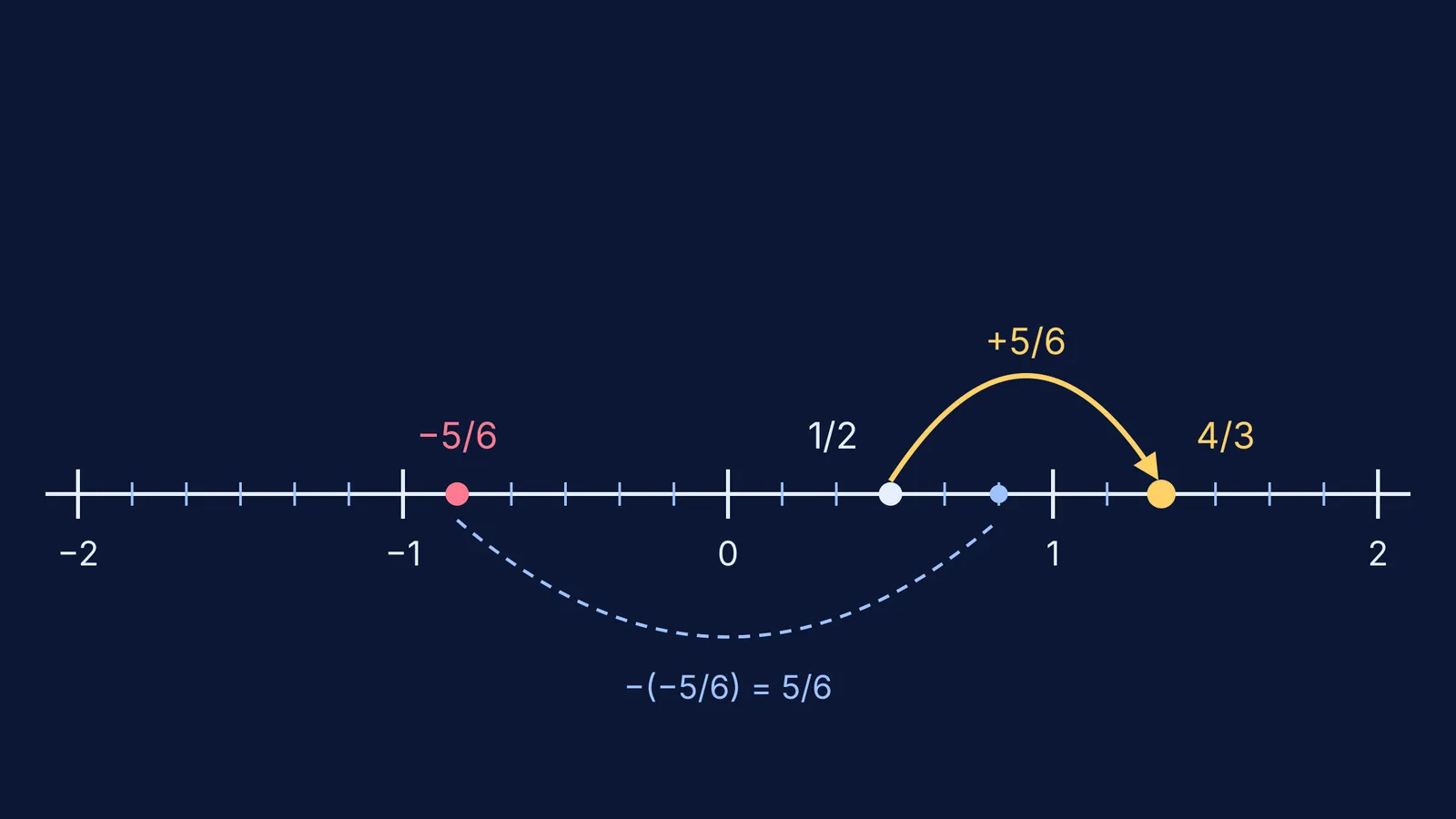
The additive inverse (or negative) of a rational number a is the number −a that gives 0 when added to a. So the negative of 5/6 is −5/6, the negative of −3/8 is 3/8, and 0 is its own negative. On a number line, a and −a sit the same distance from 0, on opposite sides.
NCERT's Class 8 chapter on rational numbers (2024-25 reprint) calls 0 "the identity for the addition of rational numbers", and a number plus its negative always lands there. For a refresher on both kinds of inverse, read our explainer on additive and multiplicative inverses in rational numbers.
One caution: −x means "the negative of x", not "a negative number". If x is −3/8, then −x is 3/8, which is positive. We cover this trap in why −x is not always negative in algebra.
How do you subtract rational numbers using the additive inverse?
NCERT's Class 7 Exemplar unit on rational numbers states the rule directly: while subtracting two rational numbers, we add the additive inverse of the number being subtracted to the other number. In symbols, a − b = a + (−b).
Use it in three steps:
Keep the first number as it is.
Change the subtraction sign to addition.
Replace the second number with its negative, then add as usual.
Example 1: 1/2 − (−5/6) = 1/2 + 5/6 = 3/6 + 5/6 = 8/6 = 4/3.
Example 2: −2/3 − 1/4 = −2/3 + (−1/4) = −8/12 + (−3/12) = −11/12.
If the denominators differ, you still need a common denominator. Our guide to adding fractions with different denominators using the LCM walks through that step.
Why can you rearrange a long sum but not a long subtraction?
The NCERT Class 8 chapter shows that for rational numbers, addition is commutative (a + b = b + a) and associative (a + (b + c) = (a + b) + c), but subtraction is neither. For example, 2/3 − 5/4 = −7/12, while 5/4 − 2/3 = 7/12.
So the first move in any long expression is to rewrite every subtraction as addition of a negative. Then each term carries its own sign and can be moved or bracketed freely.
How do you simplify a long sum by grouping like denominators?
The same NCERT chapter works an example, 3/7 + (−6/11) + (−8/21) + 5/22, two ways. One way uses the LCM of all four denominators, 462. The other groups 3/7 with −8/21 and −6/11 with 5/22, giving 1/21 + (−7/22) = −125/462 with much smaller numbers along the way.
Here is our own example to try: 5/8 − 2/3 − (−3/8) + 1/3 − 1/6.
Rewrite as a sum: 5/8 + (−2/3) + 3/8 + 1/3 + (−1/6).
Group like denominators: (5/8 + 3/8) + (−2/3 + 1/3) + (−1/6).
Simplify each group: 1 + (−1/3) + (−1/6).
Finish with sixths: 6/6 − 2/6 − 1/6 = 3/6 = 1/2.
Check with one LCM (24): (15 − 16 + 9 + 8 − 4)/24 = 12/24 = 1/2.
A grouping checklist for any long sum:
Convert all subtractions first, before moving anything.
Pair equal denominators, then denominators where one divides the other (3 and 6, 7 and 21).
Look for groups that make 0 or a whole number.
Simplify each group before combining the groups.
Give the answer in standard form: positive denominator, no common factor, as the Exemplar defines it.
What mistakes cost marks, and how do you check?
Moving a term without its sign. In 5/8 − 2/3 + 3/8, the 2/3 stays negative wherever it goes.
Dropping brackets. 1/2 − (1/3 − 1/6) = 1/3, but 1/2 − 1/3 − 1/6 = 0. Find the negative of the whole bracket: −(1/3 − 1/6) = −1/3 + 1/6.
Changing only one sign in a − (−b) and writing a − b.
Parents can help without doing the sum: ask, "What did you add instead of subtracting?" If your child can name the negative they used, the method is in place.
If the signs keep going wrong, the Fermi Problem Library has worked problems with a step-by-step solver that explains the reasoning rather than printing an answer, so you can compare each step with your own working. If the idea of an inverse itself feels shaky, the Fermi Concept Library gives each mathematics concept its own lesson.
Try rewriting three long sums from your textbook as pure addition tonight, then group them before you add.