

On this page
If you cut a pizza into three slices and eat one, you have eaten 1/3 of the pizza. If you cut another identical pizza into four slices and eat one, you have eaten 1/4. How much have you eaten in total?
Many students will quickly answer 2/7. This error—adding the numerators and adding the denominators—is one of the most stubborn misconceptions in mathematics. According to a 2013 study in *Developmental Psychology* by Robert Siegler and Aryn Pyke (PMC4103412), students incorrectly add numerators and denominators as independent whole numbers. This strategy accounted for 27% of all errors in fraction arithmetic. The rate was even higher for low-achieving students, who used this flawed strategy on 55% of unequal-denominator addition problems.
Why is adding denominators wrong?
The denominator is a label that tells you the size of the pieces, while the numerator tells you how many of those pieces you have.
When you add fractions, you are counting the total number of pieces. If you have 1/2 of a rupee (50 paise) and add another 1/2 of a rupee (50 paise), you have 1 whole rupee (2/2). If you were to add both the tops and the bottoms, you would get 2/4. This would mean that 50 paise plus 50 paise equals 50 paise—a mathematical impossibility.
Students often make this error because they overgeneralize the rules of whole numbers. Because 1 + 1 = 2, it feels natural to just add across. This mistake is deeply tied to what researchers call magnitude understanding. A child who understands fraction magnitudes knows how big 1/2 and 1/3 actually are. If they place them on a number line, they can see that adding them must result in a number close to 1. But if they blindly add the numbers to get 2/5, they end up with an answer that is smaller than 1/2. Because they lack a sense of size for fractions, they do not notice that their answer makes no logical sense.
Building this intuition is just as important as learning the calculation steps. The Fermi Problem Library has worked problems with a step-by-step solver that explains the reasoning rather than printing an answer, catching procedural mistakes like this by reminding you to check your piece sizes.
How to add fractions with different denominators?
You can only add pieces together if they are exactly the same size. To make 1/3 and 1/4 the same size, you must find a common denominator. This is where the Least Common Multiple (LCM) comes in.
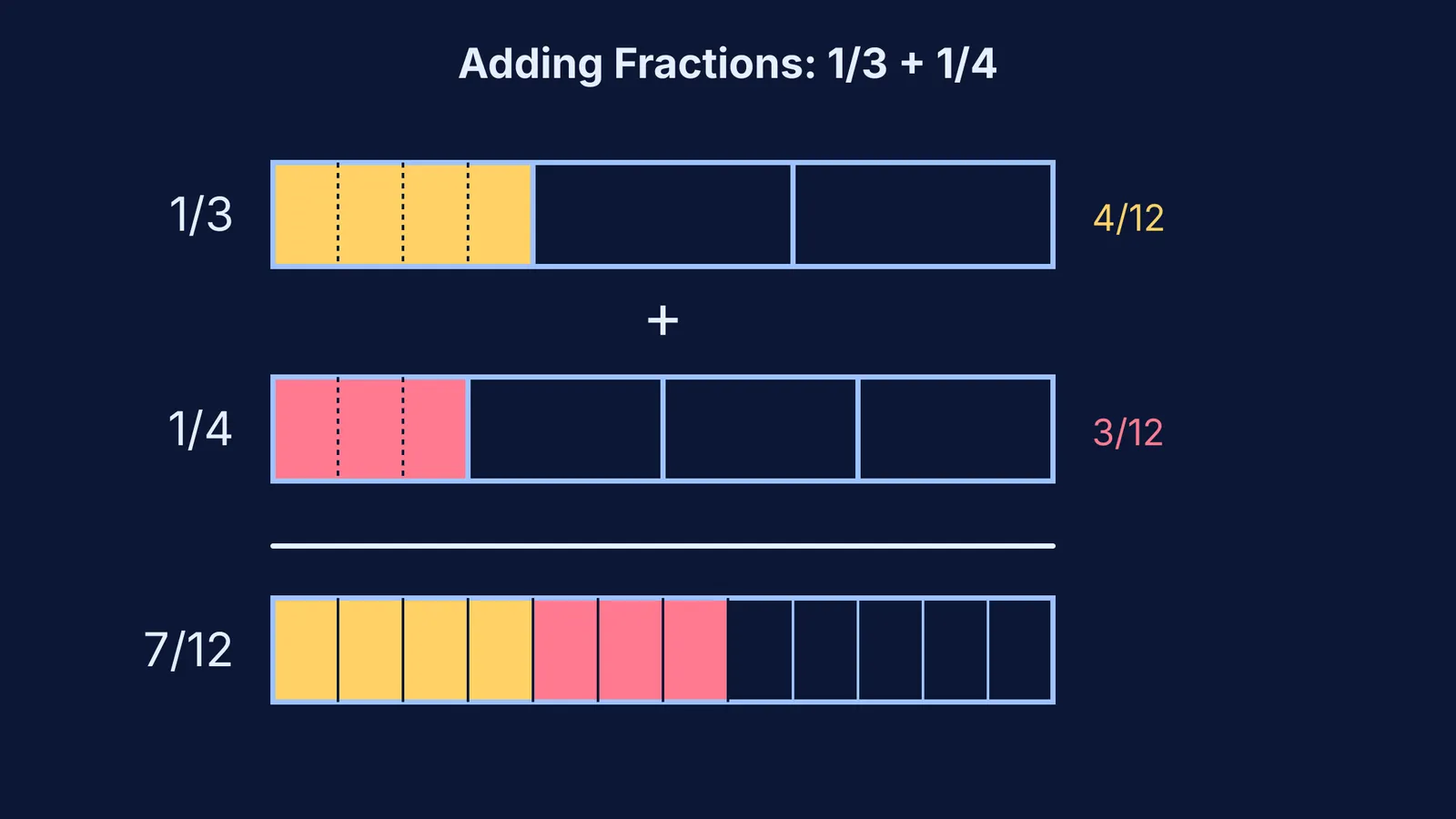
Here is the step-by-step method to add 1/3 + 1/4:
Find the LCM of the denominators. The multiples of 3 are 3, 6, 9, 12, 15... The multiples of 4 are 4, 8, 12, 16... The smallest number in both lists is 12. This becomes your new denominator.
Build equivalent fractions. You must convert both fractions into twelfths. For 1/3, multiply both the numerator and the denominator by 4 to get 4/12. For 1/4, multiply both the numerator and the denominator by 3 to get 3/12. You can review how this resizing works in our guide to Fractions in Class 6: equivalent fractions and how to compare them.
Add the numerators. Now that both fractions are out of 12, you are simply adding pieces of the same size. 4/12 + 3/12 = 7/12.
Keep the denominator the same. The size of the pieces (twelfths) does not change when you combine them.
What happens if you skip finding the lowest common denominator?
If you use any common multiple instead of the Least Common Multiple (LCM), the addition still works mathematically, but the numbers become unwieldy. For example, if you are adding 1/6 and 1/8, you could multiply the denominators together (6 × 8 = 48) and use 48 as your common denominator.
1/6 would become 8/48, and 1/8 would become 6/48. Adding them gives 14/48. You must then simplify this fraction by dividing both the top and the bottom by their highest common factor (which is 2) to reach the final answer of 7/24.
However, if you first find the LCM of 6 and 8—which is 24—you can skip the complicated simplification step at the end. You convert 1/6 to 4/24 and 1/8 to 3/24. Adding them immediately gives 7/24. Using the LCM saves time and reduces calculation errors, especially under exam conditions.
Does this method work for subtraction?
Yes. The rules for subtracting fractions are exactly the same as for adding them. If you want to subtract 1/4 from 1/3, you first convert them to a common denominator of 12. Then, you subtract the numerators: 4/12 − 3/12 = 1/12.
Once you move on to multiplication, the rules change entirely, as you are taking a fraction of a fraction rather than combining them. We cover those distinct rules in Working with fractions in Class 7: multiplying and dividing. But whenever you see a plus or a minus sign between fractions, finding the LCM is always your mandatory first step.


