

On this page
When we first learn about numbers, a minus sign acts as a simple label. A number like −5 sits firmly below zero on the number line, and we treat the minus sign as a permanent part of its identity. But when letters enter the picture, that visual habit becomes a trap. It is incredibly easy to look at −x and assume that it represents a negative quantity.
Is minus x always negative?
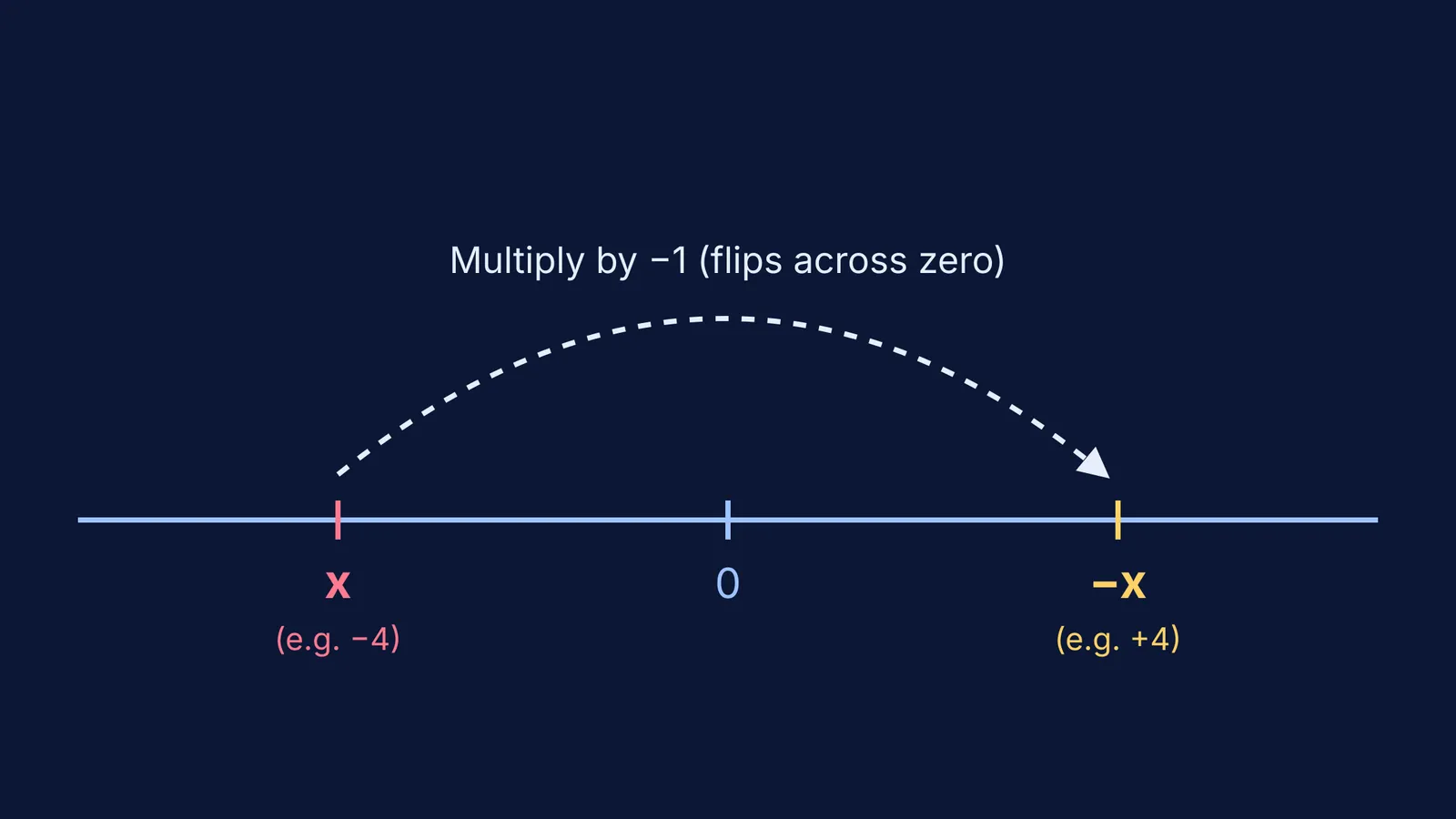
No. In algebra, −x simply means "the opposite of x". Its actual value depends entirely on what x is. If x is a positive number, then −x is negative. But if x itself is a negative number, then −x is positive.
This confusion is one of the most common hurdles when moving from arithmetic to algebra. In a 2004 study published in *Learning and Instruction*, educational researcher Joëlle Vlassis found that students struggle because the minus sign plays three different roles. It can be unary (a label marking a negative number like −5), binary (an operation between two numbers like 7 − 3), or symmetric (a command to take the opposite, like −x).
When you see −x, the minus sign is acting in its symmetric role. It tells you to flip the sign of whatever x holds. If a student stays stuck in the unary mindset, treating the minus sign purely as a label of negativity, algebraic expressions that change based on their inputs become very difficult to parse.
What happens to minus x in modulus questions?
This misconception causes the most trouble when solving equations and inequalities with modulus.
The modulus, or absolute value, measures the distance a number is from zero. Because physical distance cannot be negative, |x| is always zero or positive. Yet, the formal algebraic definition of the modulus function is:
|x| = x if x is positive or zero.
|x| = −x if x is negative.
Many students stare at that second rule and think it is impossible. How can an absolute value equal −x? The answer lies entirely in the symmetric role of the minus sign. If x is a negative number (say, −8), then taking −x means taking the opposite of −8, which evaluates to +8. The expression −x is simply the mechanism that turns a negative input into a positive output.
If you are stuck on why a case split works this way, the Fermi Problem Library has worked problems with a step-by-step solver that explains the reasoning rather than printing an answer.
How does minus x affect inequalities?
The same visual trap causes errors in algebraic inequalities. When you solve an inequality like −2x < 10, the standard procedure is to divide both sides by −2. The correct next step is to flip the inequality sign, giving x > −5.
If you forget that −x is a dynamic command rather than a fixed negative number, you might treat the inequality exactly like a standard equation and forget the flip. Multiplying or dividing by a negative number mirrors the entire number line across zero. The larger positive numbers become the "more negative" smaller numbers, which is why the greater-than or less-than relationship must reverse to remain true.
Mastering this symmetric mirroring is also vital later on when testing when is ax² + bx + c positive for all x, where the signs of variables dictate the entire shape of a curve. To see where directed numbers and intervals fit into the bigger picture of mathematics, explore the Fermi Concept Library, which covers every concept in physics, chemistry, biology, mathematics and computing, each with its own lesson and its place in the map.
The quick substitution check
To break the habit of reading −x as a negative number, use this concrete routine during exams or homework:
Spot the variable: Identify the variable that has a minus sign in front of it.
Pick a test number: Choose a simple negative integer, like −3.
Substitute it in: Write out the expression with brackets. For −x, write −(−3).
Evaluate: See that the two minus signs cancel out to make +3.
This takes only a moment and instantly grounds abstract algebra back in the concrete arithmetic you already trust. Over time, you will stop seeing the minus sign as a permanent label, and start seeing it as an instruction to find the other side of zero.


