

On this page
Rational numbers follow specific rules when they are added or multiplied. Two of the most important concepts you will encounter in early algebra are the additive inverse and the multiplicative inverse. While their names sound similar, they perform completely different jobs. One brings a number back to zero, and the other scales it to one.
What is an additive inverse?
Every number has an opposite. If you walk 5 steps forward, walking 5 steps backwards brings you exactly back to where you started. In mathematics, this return to the starting point—zero—is called the additive identity.
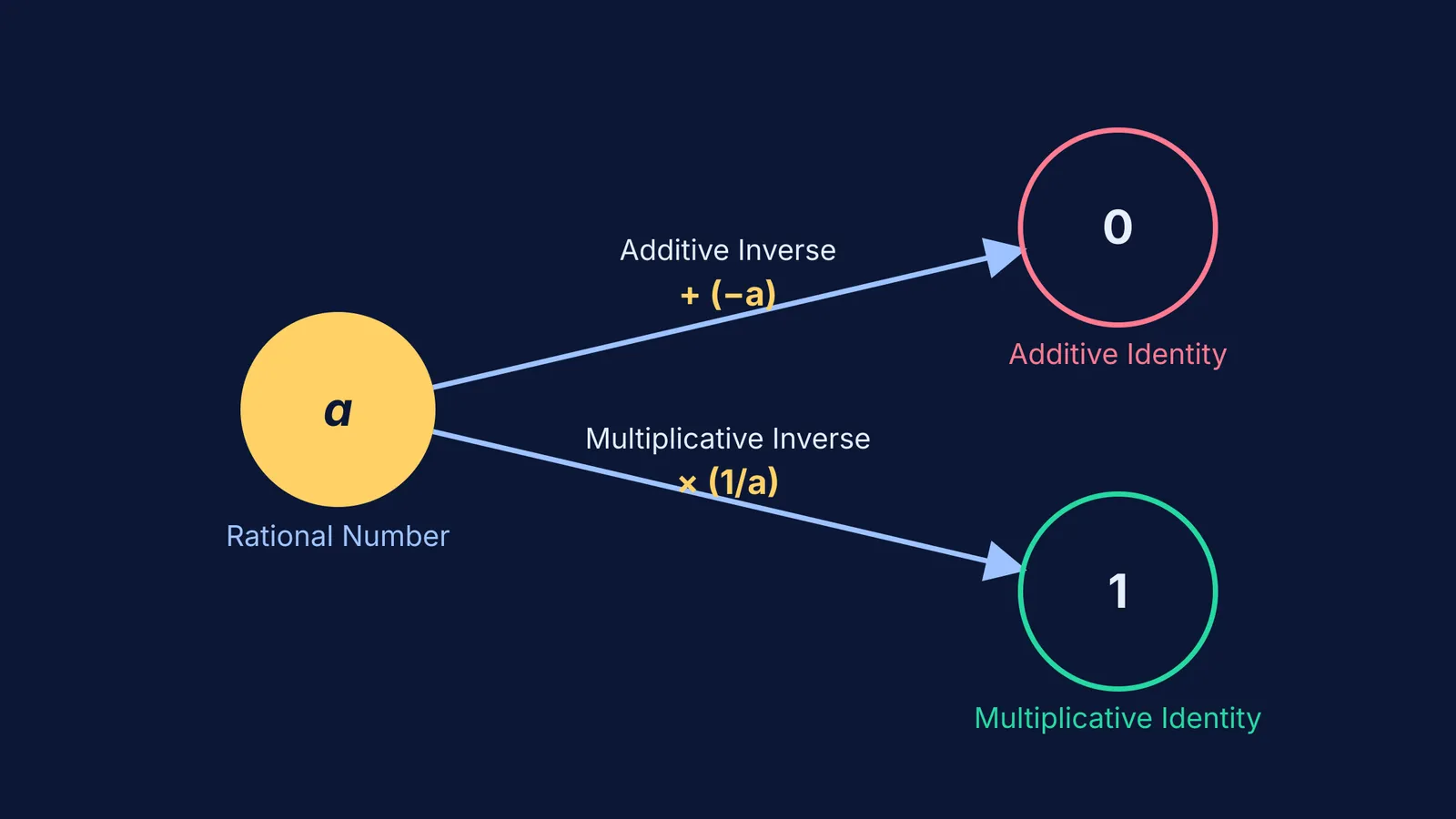
The additive inverse of a number is the value that, when added to the original number, results in zero. The NCERT Class 8 Mathematics textbook defines zero as the additive identity for rational numbers, stating that a + 0 = 0 + a = a. For any rational number a, its additive inverse is −a because a + (−a) = 0.
Finding an additive inverse is straightforward: you simply change the sign of the number.
The additive inverse of 7 is −7.
The additive inverse of −3/4 is 3/4.
The additive inverse of 0 is 0, because 0 + 0 = 0.
When you subtract a number, you are mathematically just adding its additive inverse.
What is a multiplicative inverse?
While addition is anchored by zero, multiplication is anchored by the number one. If you multiply any number by one, its value remains unchanged. This makes one the multiplicative identity.
The multiplicative inverse (often called the reciprocal) of a number is the value that, when multiplied by the original number, results in one. According to the same NCERT text, the multiplicative inverse of a rational number a/b is b/a, such that their product is 1. For any non-zero number a, its multiplicative inverse is 1/a.
To find it, you "flip" the fraction. The numerator becomes the denominator, and the denominator becomes the numerator. Crucially, the sign does not change.
The multiplicative inverse of 5 (which is 5/1) is 1/5.
The multiplicative inverse of −2/3 is −3/2, because (−2/3) × (−3/2) = 1.
The multiplicative inverse of −1 is −1, because (−1) × (−1) = 1.
Why does 0 have no reciprocal?
You can find an additive inverse for any rational number, including zero. But when finding a multiplicative inverse, zero is the one exception.
Zero has no multiplicative inverse. To find the reciprocal of 0, you would need a number that multiplies by 0 to equal 1. However, the property of zero states that any number multiplied by zero is always zero, never one. If you tried to write it as a fraction, 1/0 is mathematically undefined. Because of this, zero is the only rational number without a reciprocal.
How do you use inverses in rational number exercises?
Inverses are not just definitions to memorise; they are the active tools you use to solve algebraic equations. Every time you move a number to the other side of an equation, you are actually applying an inverse.
Consider the equation 3x + 5 = 17. To isolate x, you must reverse the operations acting on it, step by step, using inverses.
Step 1: Apply the additive inverse First, you need to remove the + 5. You do this by adding its additive inverse, which is −5, to both sides of the equation. 3x + 5 + (−5) = 17 + (−5) Because 5 + (−5) is zero (the additive identity), the left side simplifies to 3x + 0, or just 3x. The right side becomes 12. 3x = 12
Step 2: Apply the multiplicative inverse Next, you need to isolate x from the 3. The operation is multiplication, so you multiply by the multiplicative inverse of 3, which is 1/3, on both sides. 3x × (1/3) = 12 × (1/3) Because 3 × (1/3) is one (the multiplicative identity), the left side simplifies to 1x, or just x. The right side becomes 4. x = 4
By breaking algebra down into these formal steps, you eliminate the guesswork of moving terms around.
How do you check if an inverse is correct?
When an exercise asks you to find an inverse for a number x, use this framework:
Is it an additive inverse? Multiply the number by −1. (Example: −4 becomes 4, and 2/3 becomes −2/3). Check your work: does the original plus the inverse equal zero?
Is it a multiplicative inverse? Write the number as a fraction and flip it. (Example: −4 becomes −1/4, and 2/3 becomes 3/2). The sign stays exactly the same. Check your work: does the original times the inverse equal one? (And verify the number is not zero, as zero has no reciprocal).
If you find yourself repeatedly making sign errors or flipping fractions incorrectly, you can explore these foundational definitions further in the Fermi Concept Library. If you need to see how these rules apply line-by-line in a specific homework assignment, running the equation through the Fermi Problem Library will show the mathematical reasoning explained step by step. When working with fractions, it is also useful to have a solid grasp of fundamental operations, such as Rational numbers for Class 8 and 9: properties and the number line and how they fit into broader Number systems in Class 9: rational, irrational and real numbers.


