

On this page
Writing 1s² 2s² 2p⁶ 3s² 3p⁶ for every element after argon is slow and easy to miscount. The noble gas core shorthand fixes that: you put the inner electrons in one bracket and spend your attention on the electrons that decide chemistry. It takes three decisions: which noble gas, how many electrons are left, and what order to write them in.
What does the noble gas core in [Ar] mean?
The symbol in square brackets stands for the complete electron configuration of that noble gas. In its Class 11 chapter Structure of Atom, NCERT shows sodium written as [Ne]3s¹ and argon as [Ne]3s² 3p⁶, with neon standing in for the first two shells.
NCERT also defines the terms: electrons in completely filled shells are core electrons, and electrons added to the shell with the highest principal quantum number are valence electrons. So [Ar] in iron's configuration means "18 electrons arranged exactly as in argon", and everything after the bracket is what you work out.
How do you choose the right noble gas for the core?
Use the noble gas with the largest atomic number that is still smaller than your element's. The atomic numbers you need for Class 11 and JEE work, from NCERT Table 2.6, are:
He: 2
Ne: 10
Ar: 18
Kr: 36
Xe: 54
So potassium (19) to krypton (36) take [Ar]; rubidium (37) to xenon (54) take [Kr]. A noble gas itself takes the previous noble gas as its core: NCERT writes argon as [Ne]3s² 3p⁶. And never jump ahead to the next noble gas; [Kr] for bromine would claim 36 electrons when bromine has 35.
In what order do you write the subshells after the core?
The filling order is the order electrons go in. NCERT gives it as 1s, 2s, 2p, 3s, 3p, 4s, 3d, 4p, 5s, 4d, 5p, 6s, 4f, 5d, 6p, 7s, which follows the (n + l) rule: lower n + l fills first, and on a tie the lower n wins. That is why 4s (n + l = 4) fills before 3d (n + l = 5), as NCERT Table 2.5 shows.
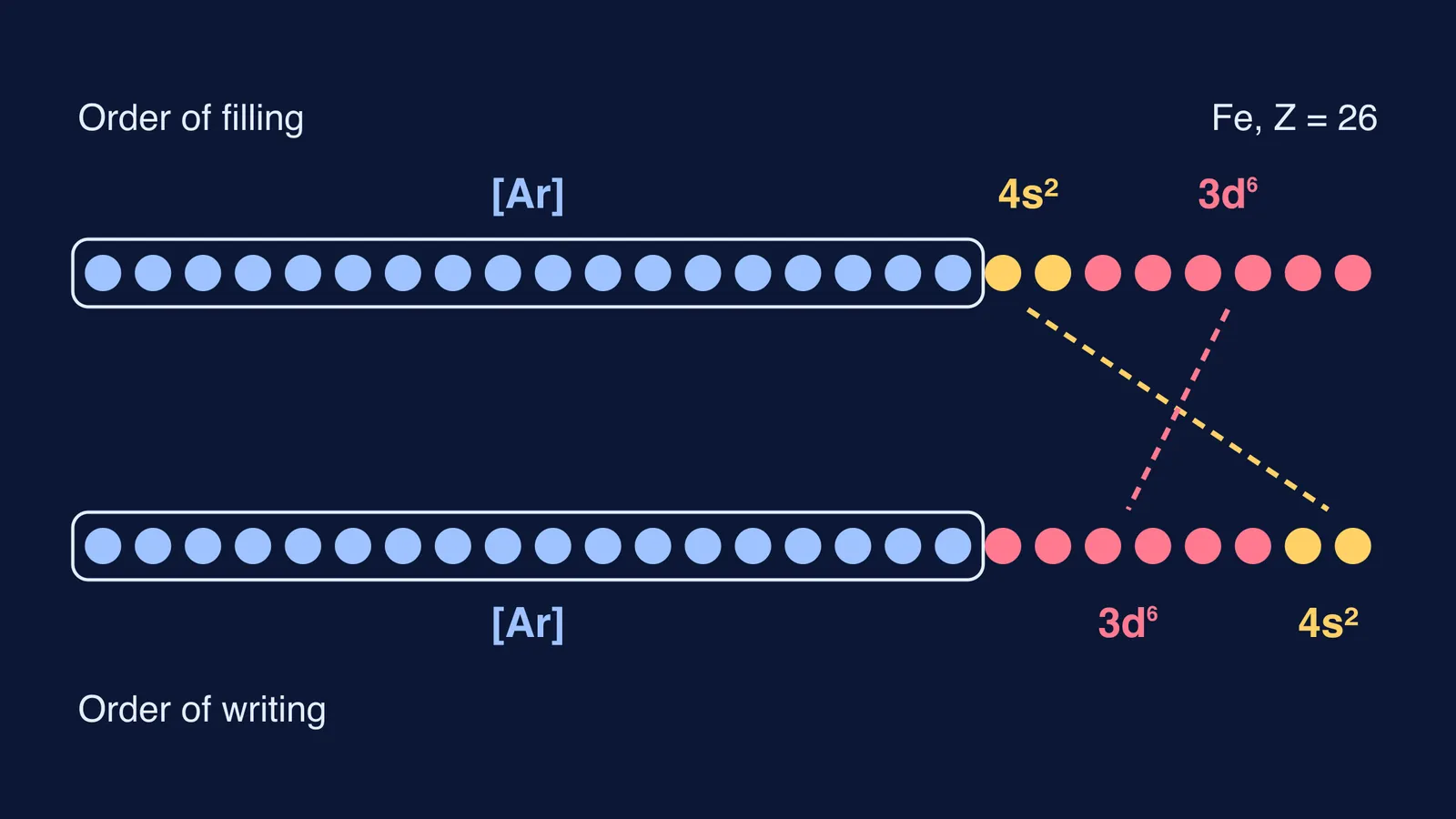
The writing order groups subshells by shell number n. NCERT Table 2.6 places the 3d column beside 3p, ahead of 4s, and the NIST Atomic Spectra Database lists iron's ground state as 3d⁶4s². Some books write [Ar] 4s² 3d⁶ instead; the counts are identical. Fill with the first order, then write with the second.
Worked examples: from atomic number to shorthand
Use the same four steps every time, and check your answers against NCERT Table 2.6:
Find the atomic number Z (the electron count for a neutral atom).
Pick the core: the noble gas just below Z. Subtract its atomic number.
Place the leftover electrons in filling order after that noble gas.
Rewrite them grouped by shell, then check the superscripts add up to Z minus the core.
Iron (Z = 26). Core [Ar] takes 18, leaving 8. Filling order after argon: 4s takes 2, 3d takes 6. Written by shell: [Ar] 3d⁶ 4s². Check: 6 + 2 = 8.
Bromine (Z = 35). Core [Ar], leaving 17: 4s², then 3d¹⁰, then 4p⁵. Written: [Ar] 3d¹⁰ 4s² 4p⁵. Check: 10 + 2 + 5 = 17. A common slip is to drop the 3d¹⁰ and write [Ar] 4s² 4p⁵, which only accounts for 25 electrons.
Tin (Z = 50). Core [Kr] takes 36, leaving 14: 5s², 4d¹⁰, 5p². Written: [Kr] 4d¹⁰ 5s² 5p². Check: 10 + 2 + 2 = 14.
Chromium (Z = 24). The steps predict [Ar] 3d⁴ 4s², but NCERT gives the actual configuration as [Ar] 3d⁵ 4s¹, and copper as [Ar] 3d¹⁰ 4s¹ rather than 3d⁹ 4s², because half-filled and completely filled subshells have extra stability. Table 2.6 also marks niobium, molybdenum, ruthenium, rhodium, palladium and silver as exceptional. Our guide to why chromium and copper break the aufbau order explains the reasoning.
Which mistakes cost marks in configuration questions?
Using the wrong core: [Ne] for potassium, or the element's own symbol for a noble gas.
Dropping the filled 3d¹⁰ or 4d¹⁰ for elements in the p-block of periods 4 and 5.
Skipping the superscript check, a quick sum that catches counting slips.
Applying the neutral-atom answer to an ion. Writing ions needs one more rule about which electrons leave first, covered in how to write configurations of ions like Fe³⁺ and Cu⁺.
If the shorthand still feels shaky, revisit the shells underneath it. Counting them once by hand, with how many subshells and orbitals each shell n holds, makes the brackets mean something. For a lesson on each idea in its place on the map, the Fermi Concept Library covers every concept in chemistry, and the Fermi Problem Library has worked problems with a step-by-step solver that explains the reasoning rather than printing an answer.
Try it now: write the shorthand for manganese (25), gallium (31) and silver (47), then check each one against NCERT Table 2.6.


