

On this page
When you first learn about the number line, it looks like a ladder with evenly spaced rungs: 1, 2, 3, 4. It is easy to see that there are no whole numbers between 3 and 4. But as you zoom in on the gaps, the picture changes. What lies between 1/3 and 1/2? The answer is infinitely many fractions and decimals. This principle, the fact that you can always find another number packed between any two others, is known as the density property of rational numbers.
Understanding how to find these numbers is a standard task in the secondary mathematics curriculum. It transitions students from counting whole objects to understanding how the continuous number line behaves. It also tests your grip on fraction arithmetic and scaling.
There are two main ways to hunt down these numbers: the averaging method for finding one or two numbers, and the denominator method for generating a long list at once. Here is how they work, along with the trick for finding irrational numbers in the same gaps.
How do you use the averaging method?
The arithmetic mean (or average) of any two numbers always falls exactly halfway between them on the number line. To find a rational number between two fractions, you simply add them together and divide the result by 2. (This is the same logic you use when dealing with evenly spaced sequences, such as when studying topics like Inserting arithmetic and geometric means between two numbers).
Let's walk through an example. If you need a number exactly halfway between 1/3 and 1/2, first add the two fractions together by finding a common denominator: 1/3 + 1/2 = 2/6 + 3/6 = 5/6.
Then, divide the sum by 2 (which is mathematically identical to multiplying by 1/2): (5/6) × (1/2) = 5/12.
So, 5/12 sits precisely between 1/3 and 1/2. Because of the density property, you can repeat this process indefinitely. To find a second number, you can take the mean of your lower bound (1/3) and your new midpoint (5/12): 1/3 + 5/12 = 4/12 + 5/12 = 9/12. (9/12) × (1/2) = 9/24, which simplifies to 3/8.
Now you have two numbers: 3/8 and 5/12. This method is foolproof and builds a deep intuition for finding midpoints. However, because you have to calculate a new average for every single number you find, it becomes intensely tedious if an exam question asks you to list five or ten rational numbers.
How do you use the (n+1) denominator method?
When a problem requires you to find many rational numbers at once, scaling up equivalent fractions is a much faster route. The goal here is not to find the exact midpoint, but to make the visual gap between the numerators large enough to fit all the integers you need, while keeping the fundamental value of the boundary fractions unchanged.
Suppose a test paper asks you to list three rational numbers between 1/3 and 1/2.
First, rewrite the given fractions with a common denominator. The least common multiple of 3 and 2 is 6, so they transform into 2/6 and 3/6.
We need three numbers (so n = 3), but currently, there is no whole integer between the numerators 2 and 3.
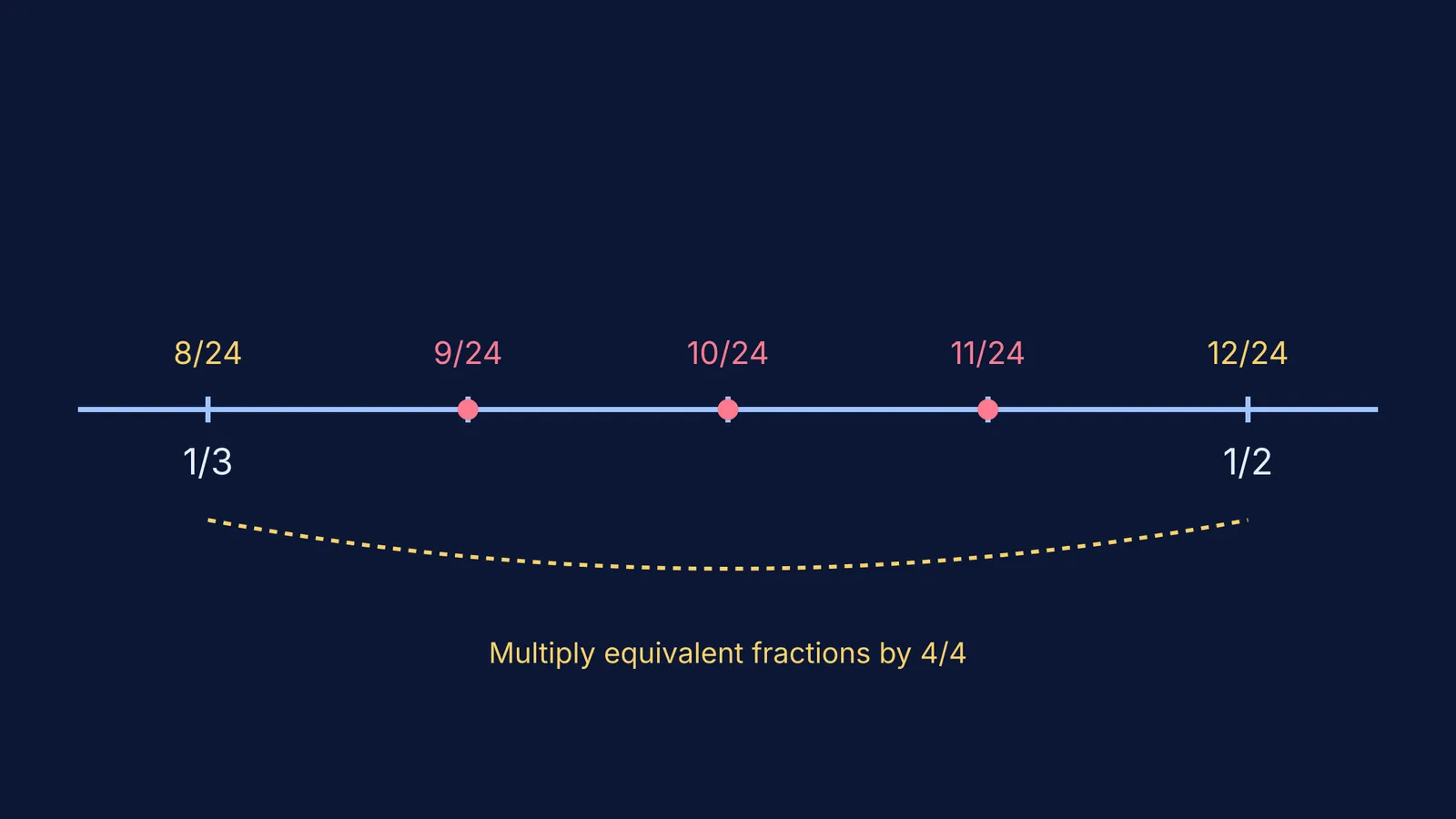
To widen the gap, multiply both the numerator and denominator of both fractions by (n + 1). Since n = 3 in our example, we multiply by 4/4.
For the lower bound: (2 × 4) / (6 × 4) = 8/24 For the upper bound: (3 × 4) / (6 × 4) = 12/24
Now, the gap is wide open. The integer numerators strictly between 8 and 12 are 9, 10, and 11. Your three rational numbers are therefore 9/24, 10/24, and 11/24.
This method scales effortlessly without piling up nested fractions. If you suddenly needed twenty numbers between 1/3 and 1/2, you would simply take the 2/6 and 3/6 bounds and multiply them by 21/21 to generate a large enough gap.
If you are working through a dense assignment and lose track of the arithmetic when the fractions get messy, the Fermi Problem Library has a step-by-step solver that explains the reasoning rather than printing an answer.
What about finding irrational numbers between two numbers?
A rational number can always be written neatly as a fraction p/q. You will see this form often in calculus, such as when evaluating Limits at infinity of rational functions: compare the degrees. An irrational number, however, cannot be written as a simple fraction. When converted into a decimal format, irrational numbers like √2, √3, or π have expansions that never terminate and never settle into a repeating block of digits.
To find an irrational number between 1/3 (which is 0.333...) and 1/2 (which is 0.5), you can simply invent a decimal sequence that deliberately breaks the repeating rule. For example, the decimal 0.4141141114... grows without a fixed, repeating pattern and fits comfortably between the two decimal bounds. You can create as many of these as you need by slightly varying the non-repeating digits.
Another standard trick, particularly useful when dealing with whole number boundaries, is to use square roots. If you need an irrational number between 2 and 3, square both numbers to get their root equivalents: √4 and √9. Any square root of a non-perfect square that falls between √4 and √9—such as √5, √6, √7, or √8—will automatically be an irrational number situated in the correct range.
If the mathematical distinction between these types of numbers feels blurry, the Fermi Concept Library has a lesson for every concept in mathematics and its place in the map. Grasping the difference between a repeating decimal and an endless, chaotic one is the key to mastering the real number line and understanding how densely numbers are packed together.


