

On this page
When you look at a fraction like 3/4 or 7/4, what do you picture? Slicing circles like pizzas may help with early sharing problems, but placing fractions on a continuous number line transforms how you understand mathematical magnitude. By splitting unit intervals into equal segments, a number line reveals that every fraction occupies a precise physical location on the real number continuum.
Why do students struggle with fractions on a number line?
When learners rely solely on circular or area models, they often develop a persistent cognitive barrier. In an analysis in Educational Psychologist, researchers Yujing Ni and Yong-Di Zhou showed that area models trigger a "whole number bias." Students count shaded parts and total parts as disconnected integers, mistakenly concluding that 1/4 is larger than 1/3 because 4 exceeds 3.
Longitudinal research reveals how deeply early fraction mastery shapes future achievement. A study in Psychological Science led by Robert Siegler found that elementary students' knowledge of fractions and division uniquely predicted their high school algebra and overall mathematics performance 5 or 6 years later.
To build accurate mental models, the IES Practice Guide recommends the number line as the primary representational tool. In PLOS ONE, Lisa Fazio, Casey Kennedy, and Robert Siegler demonstrated that number-line estimation practice with feedback significantly improves children's understanding of fraction magnitudes.
Connecting early fractions in Class 6 to rational numbers on the number line establishes this continuous progression. For students looking to master these mathematical foundations, the Fermi Concept Library organizes every concept in mathematics, each with its own lesson and its place in the map.
How do you mark proper fractions between 0 and 1?
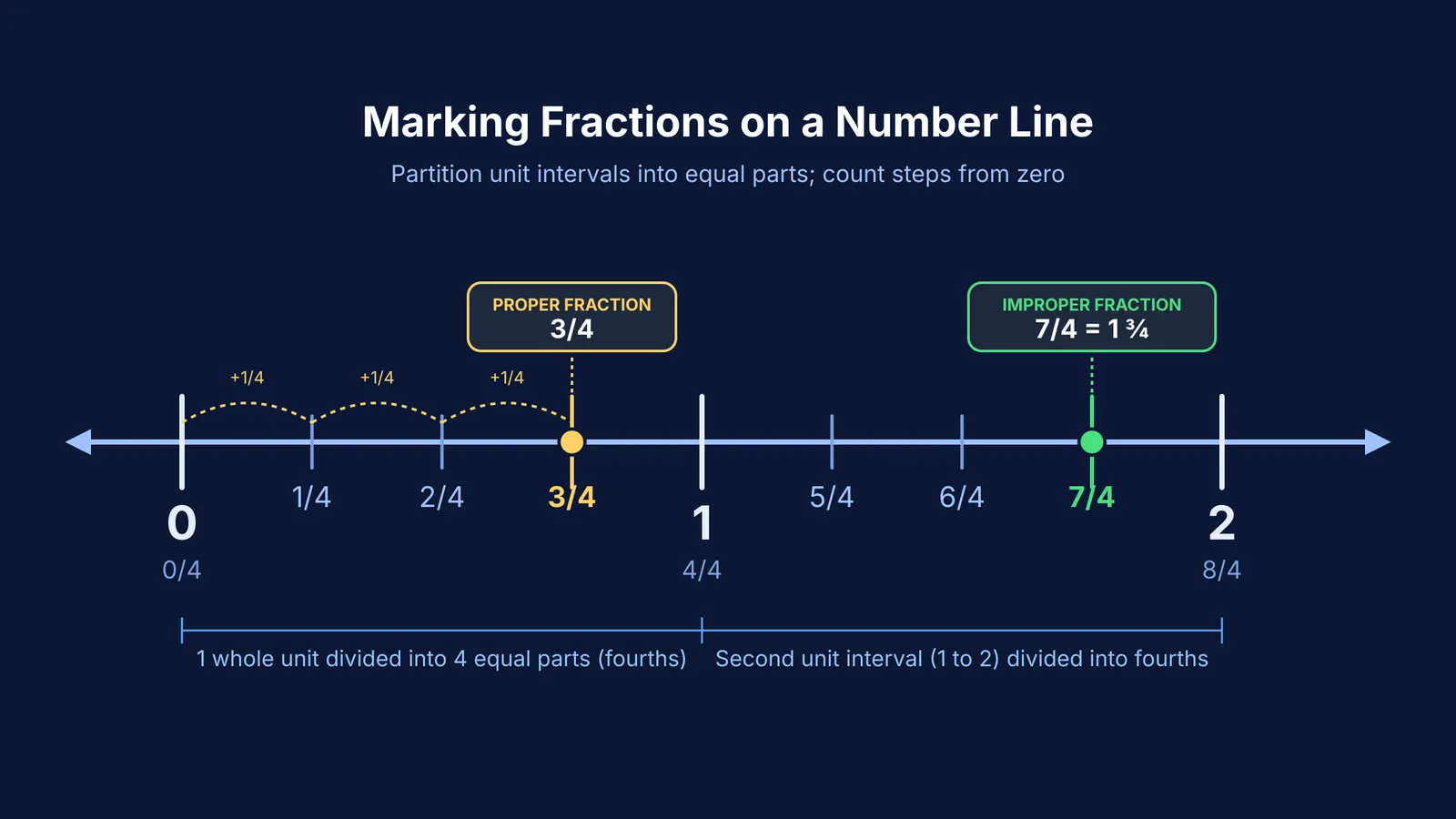
As outlined in Chapter 7 of the NCERT Class 6 Mathematics textbook, a proper fraction has a numerator smaller than its denominator, placing its value strictly between 0 and 1. Marking any proper fraction a/b on a number line takes two steps:
Partition the unit interval: Divide the segment between 0 and 1 into b equal parts by drawing b − 1 equally spaced interior ticks. For fourths, draw 3 ticks between 0 and 1.
Count segments from zero: Move a segments to the right from 0. The ath tick marks the fraction a/b.
A common mistake is counting tick marks rather than intervals. Placing 4 ticks between 0 and 1 creates 5 segments, inadvertently turning fourths into fifths.
How do you mark improper and mixed fractions past 1?
An improper fraction has a numerator equal to or greater than its denominator, locating it at or beyond 1. You can plot an improper fraction such as 7/4 using two equivalent strategies:
Continuous counting: Divide each unit interval (0 to 1, 1 to 2) into 4 equal segments. Starting from 0, count forward 7 quarter-segments to land on 7/4.
Mixed number conversion: Convert 7/4 to 1 ¾ by division (7 ÷ 4 = 1 remainder 3). Locate 1 on the line, divide the interval between 1 and 2 into 4 equal parts, and move 3 parts to the right of 1.
Both methods pinpoint the same location. When tackling multi-step conversions, the Fermi Problem Library provides worked problems with a step-by-step solver that explains the reasoning rather than printing an answer.
How do you compare fractions by their positions?
On a number line, magnitude increases from left to right: any value situated to the left of another is smaller.
To compare fractions with different denominators, such as 2/3 and 3/4, use a common denominator:
Find the common denominator: The least common multiple of 3 and 4 is 12.
Partition the unit interval: Divide the interval between 0 and 1 into 12 equal sub-segments.
Express as equivalent fractions: 2/3 equals 8/12, and 3/4 equals 9/12.
Locate the points: Count 8 segments from 0 for 2/3, and 9 segments for 3/4.
Because 8/12 lies to the left of 9/12, 2/3 is strictly less than 3/4. Our review of how fractions and division predict later maths shows that linear spatial representation prevents persistent confusion in algebra.
What is the step-by-step checklist for marking any fraction?
Follow this four-step sequence whenever you mark a fraction on paper:
Identify the whole-number interval: Proper fractions fall between 0 and 1. For improper fractions, convert to a mixed number q r/b to locate the interval between q and q + 1.
Partition into equal parts: Look at denominator b and divide that unit interval into b equal segments using b − 1 interior marks.
Count steps from the left boundary: Starting from the lower whole number, count r segments of length 1/b to the right.
Label and check against benchmarks: Draw a distinct point, label the fraction, and verify its position relative to 1/2.
Placing fractions on a number line grounds abstract values in clear spatial distances, turning numerical intuition into a reliable mathematical foundation.


