

On this page
You are looking at x² + 6x + 9 and the question says "factorise". The answer is (x + 3)², but the useful skill is knowing why, so you can spot the same shape in 4x² − 12xy + 9y² too. Here is a quick test, two worked examples and a practice set.
What is a perfect square trinomial?
A perfect square trinomial is a three-term expression that equals the square of a binomial, following a² + 2ab + b² = (a + b)² or a² − 2ab + b² = (a − b)², as set out in OpenStax Intermediate Algebra, section 6.3.
The NCERT Class 8 Factorisation chapter lists these as Identities I and II in section 12.2.3 and gives the method: if the expression fits the right-hand side of an identity, the left-hand side is the factorisation.
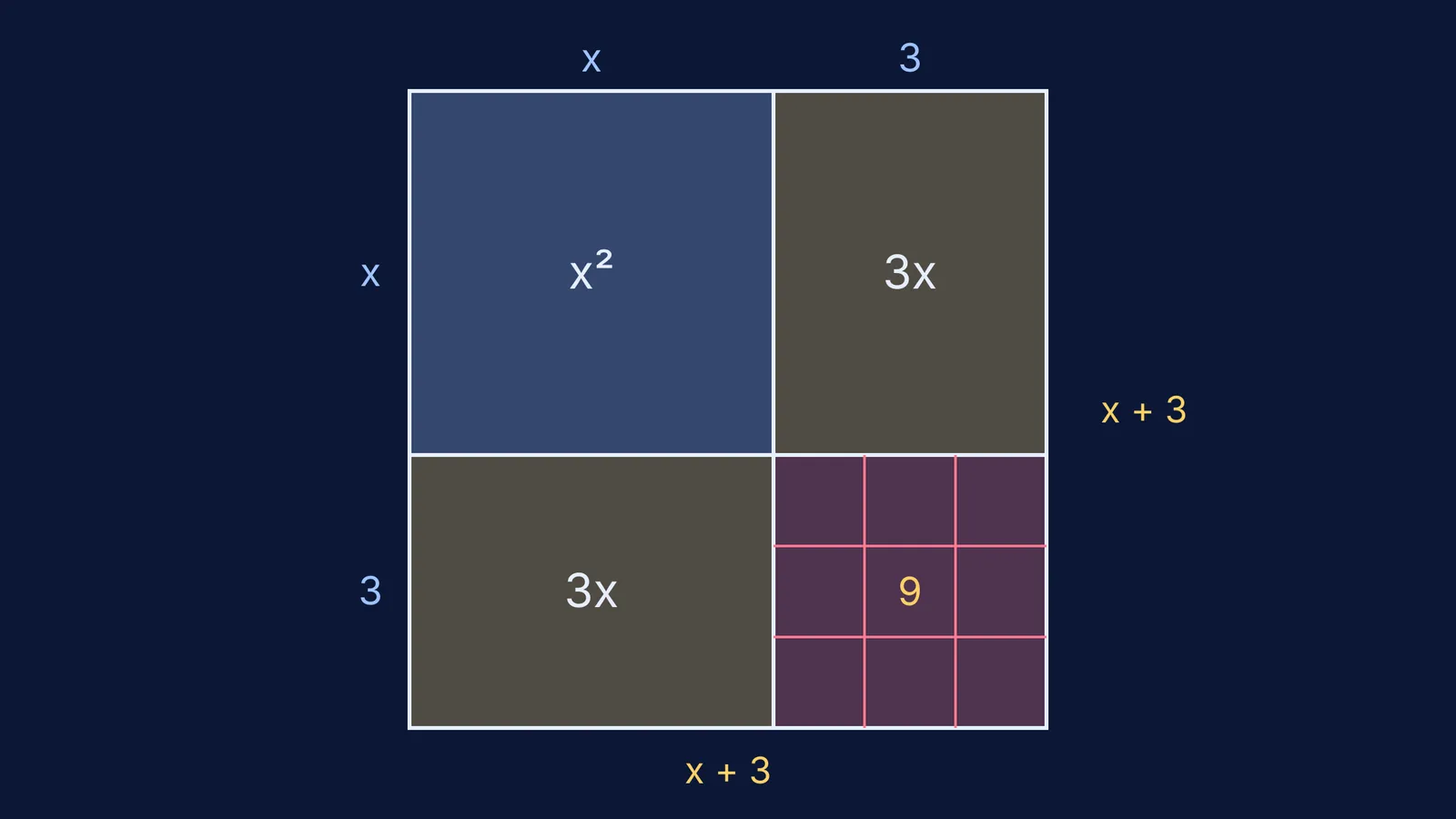
The diagram at the top of this post shows why. A square of side x + 3 splits into x², two x-by-3 strips and nine unit squares. The two strips are where the "2" in 2ab comes from.
How do you factorise x² + 6x + 9?
Is the first term a perfect square? x² = (x)², so a = x.
Is the last term a perfect square? 9 = 3², so b = 3.
Is the middle term 2ab? 2 × x × 3 = 6x. Yes.
The middle sign is +, so use (a + b)².
Write the answer: x² + 6x + 9 = (x + 3)².
Check by expanding: (x + 3)(x + 3) = x² + 3x + 3x + 9 = x² + 6x + 9.
How do you factorise 4x² − 12xy + 9y²?
First term: 4x² = (2x)², so a = 2x.
Last term: 9y² = (3y)², so b = 3y.
Middle term: 2 × 2x × 3y = 12xy. The expression has −12xy, so it matches the minus pattern.
Answer: 4x² − 12xy + 9y² = (2x − 3y)².
Check: (2x − 3y)² = 4x² − 6xy − 6xy + 9y² = 4x² − 12xy + 9y².
This is the two-variable version of NCERT's Example 5, which factorises 4y² − 12y + 9 as (2y − 3)² in the same chapter.
How can you tell if a trinomial is a perfect square?
Take out any common factor first. 2x² − 12x + 18 does not look like a square, but it is 2(x² − 6x + 9) = 2(x − 3)². Our guide to taking out a common factor in Class 8 covers this step.
Are the first and last terms both perfect squares, with a plus sign on the last? x² − 6x − 9 fails because its last term is negative.
Is the middle term exactly twice the product of the square roots? 4x² + 6x + 9 fails: 2 × 2x × 3 = 12x, not 6x.
For ax² + bx + c, try the discriminant. OpenStax states that if b² − 4ac = 0 the equation has one real solution. For x² + 6x + 9, b² − 4ac = 36 − 36 = 0. A zero discriminant means a constant times a square, such as 2x² + 4x + 2 = 2(x + 1)².
An expression that fails can still factorise. The NCERT chapter points out that x² + 5x + 6 is not a perfect square because 6 is not a perfect square, and factorises it as (x + 2)(x + 3) instead. For that route, see how to factorise by splitting the middle term, signs included.
What mistakes should you watch for?
Writing (x + 3)² = x² + 9. The 6x, the two strips in the diagram, has gone missing.
Taking the root of the coefficient but not the variable, or the other way round: 9y² is (3y)², not (9y)² or (3y²)².
Copying the wrong sign into the bracket. A −12xy middle term means (2x − 3y)², even though the last term is +9y².
Expanding your answer catches all three. Our post on expanding (a + b + c)² and finding ab + bc + ca uses the same idea with one more term.
Can you spot which of these are perfect squares?
x² + 10x + 25 gives (x + 5)².
9a² − 30ab + 25b² gives (3a − 5b)².
16p² + 8p + 1 gives (4p + 1)².
x² + 8x + 12 is not a perfect square, because 12 is not a square number. It factorises as (x + 2)(x + 6).
3x² − 12x + 12 gives 3(x − 2)², once you take out the 3.
If you got one wrong, the Fermi Problem Library has worked problems with a step-by-step solver that explains the reasoning rather than printing an answer. For the identity itself, the Fermi Concept Library gives each mathematics concept its own lesson and its place in the map.
Try the practice set again tomorrow without this page open.


