

On this page
Splitting the middle term comes down to one search: two numbers with a fixed product and a fixed sum.
What does splitting the middle term mean?
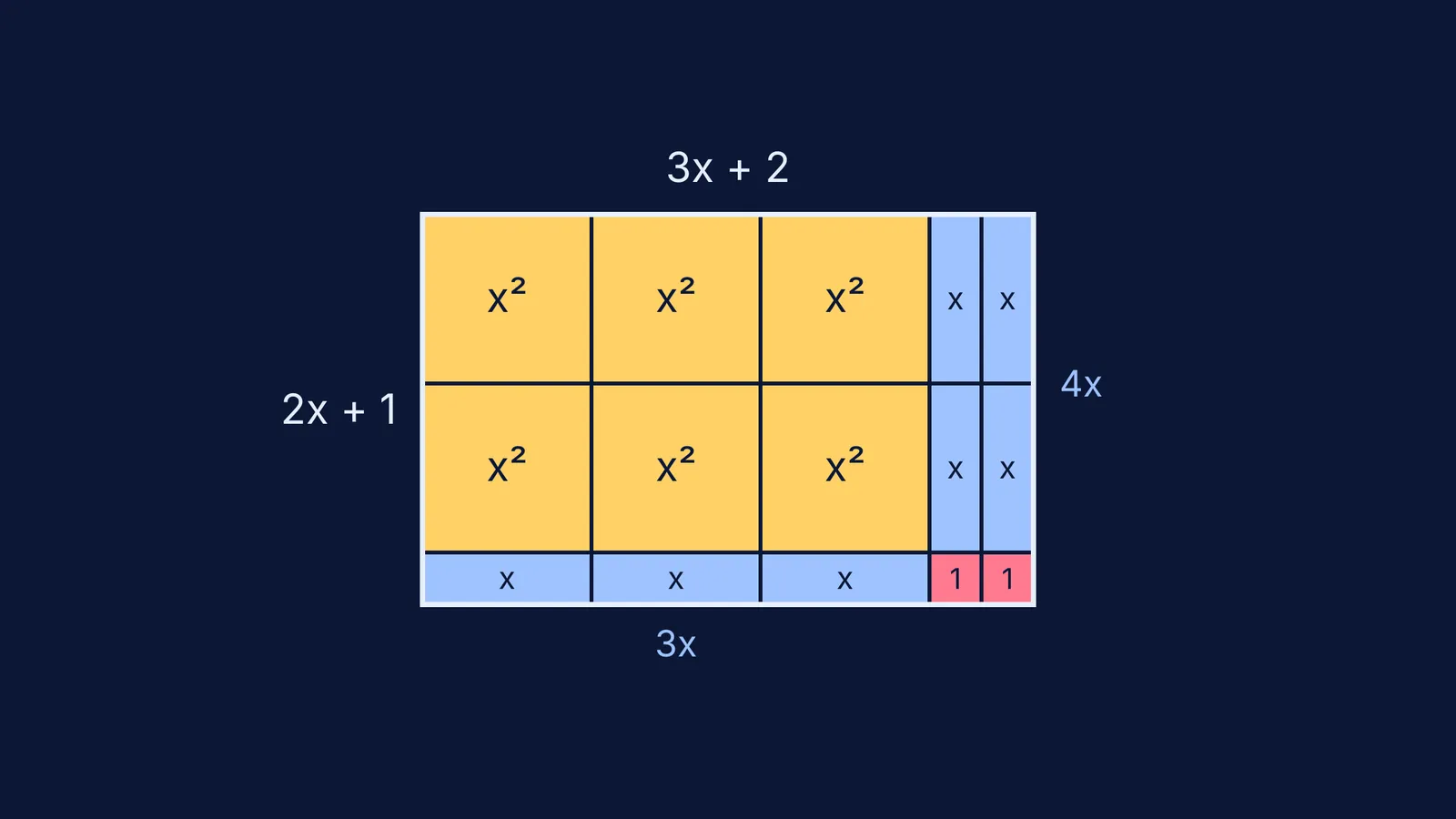
For a quadratic ax² + bx + c, splitting the middle term means rewriting bx as px + qx, where p + q = b and p × q = a × c, then factorising the four terms in pairs.
NCERT's current Class 9 textbook, Ganita Manjari, teaches this in Chapter 4, Exploring Algebraic Identities, first with algebra tiles (Section 4.5) and then without them (Section 4.6) (NCERT Ganita Manjari, Chapter 4). Its opening example, x² + 7x + 12, comes from (x + 3)(x + 4), so 7x splits as 3x + 4x.
It works because of the identity (x + a)(x + b) = x² + (a + b)x + ab: the sum makes the middle term and the product makes the constant.
How do you find the two numbers when a is 1?
List the factor pairs of c.
Pick the pair that adds up to b.
Write the answer as (x + p)(x + q).
In NCERT's Example 11, x² + 11x + 30, the pairs 2 and 15 or 3 and 10 give the right product but the wrong sum. Only 5 + 6 = 11 works, so x² + 11x + 30 = (x + 5)(x + 6).
How do the signs of b and c decide the signs of the numbers?
Decide the signs before you search for sizes. There are three cases.
c positive, b positive: both numbers positive, as in Example 11.
c positive, b negative: both negative. For x² − 5x + 6 (NCERT Example 12) you need sum −5 and product 6: −2 and −3, so (x − 2)(x − 3).
c negative: opposite signs, and the larger number takes the sign of b. NCERT's Example 18, a pool problem, gives x² − 4x − 96; the numbers are −12 and 8, so (x − 12)(x + 8).
When a is not 1, apply the same rules to the sign of a × c.
How do you factorise when a is not 1?
This is often called the ac method.
Multiply a × c.
Find two numbers with product ac and sum b.
Split bx into those two terms.
Take out the common factor of each pair.
Take out the common bracket.
Worked example 1: 6x² + 7x + 2 (Exercise Set 4.4 in the NCERT chapter). Here ac = 12, both numbers positive. Of the pairs 1 and 12, 2 and 6, 3 and 4, only 3 + 4 = 7. So 6x² + 3x + 4x + 2 = 3x(2x + 1) + 2(2x + 1) = (2x + 1)(3x + 2).
Worked example 2: 10x² − 11x − 6 (same exercise). Here ac = −60, so the signs are opposite and the bigger number is negative. Sum −11 means −15 and 4. So 10x² − 15x + 4x − 6 = 5x(2x − 3) + 2(2x − 3) = (2x − 3)(5x + 2), which fills the textbook's blanks (2x − __)(__ + 2).
Is there a shortcut when a is not 1?
Yes: pretend a is 1, then divide by a. Find p and q as above, write (ax + p)(ax + q), and cancel a from the brackets. For 6x² + 7x + 2: (6x + 3)(6x + 4) ÷ 6 = 3(2x + 1) × 2(3x + 2) ÷ 6 = (2x + 1)(3x + 2).
It works because (ax + p)(ax + q) = a²x² + a(p + q)x + pq, which equals a(ax² + bx + c) when p + q = b and pq = ac. It skips grouping, so use it to check answers.
What if no pair of numbers works?
If no factor pair of ac adds to b, the quadratic has no factors with whole-number coefficients: any factorisation (px + q)(rx + s) would hand you the pair ps and qr.
Before you decide that, check:
Did you take out a common factor first? In NCERT's Example 16, the denominator 5x² + 5x − 100 becomes 5(x² + x − 20) = 5(x − 4)(x + 5).
Did you copy the signs of b and c correctly?
Does expanding your answer bring back the middle term?
If you keep landing on the wrong pair or the wrong signs, the Fermi Problem Library has worked problems with a step-by-step solver that explains the reasoning rather than printing an answer, so you can see which step slipped. If the identity itself feels shaky, the Fermi Concept Library has a lesson on each mathematics concept.
Other shapes need other tools: factorisation by regrouping terms for four-term expressions, and the difference of squares and sum of cubes rules for expressions like x⁴ − 81. Once a quadratic is in factors, you can sketch its parabola from the roots.
Tonight, work through the quadratics in Exercise Set 4.4, write the sign case beside each before you start, and check every answer by expanding it.


