

On this page
Algebraic manipulation is a notorious hurdle for students taking higher-level maths and physics. Knowing how to factorise polynomials—breaking them down into simpler brackets that multiply together—is essential for everything from evaluating limits of the form 1^∞ to finding Aⁿ for a matrix by spotting the pattern. Yet, this skill remains elusive.
The key to unlocking these problems is structure. Instead of guessing factors, you must recognise familiar patterns. Two of the most heavily tested patterns in exams like JEE Main and NEET-UG are the difference of squares and the sum or difference of cubes.
What are the difference of squares and cubes rules?
Before tackling complex expressions, you need the three foundational identities.
Difference of squares: a² − b² = (a − b)(a + b)
Difference of cubes: a³ − b³ = (a − b)(a² + ab + b²)
Sum of cubes: a³ + b³ = (a + b)(a² − ab + b²)
A frequent mistake is attempting to factorise a sum of squares (a² + b²) using real numbers. Educational resources like Purplemath stress that the sum of squares is prime and cannot be factored further (Purplemath).
To remember the signs for the cube rules, teachers often use the SOAP mnemonic (Purplemath). When looking at the signs in the factored form compared to the original expression, they are:
Same
Opposite
Always Positive
For example, in a³ + b³, the first bracket is (a + b) because it has the Same sign. The second bracket starts with Opposite (a² − ab) and ends with Always Positive (+ b²).
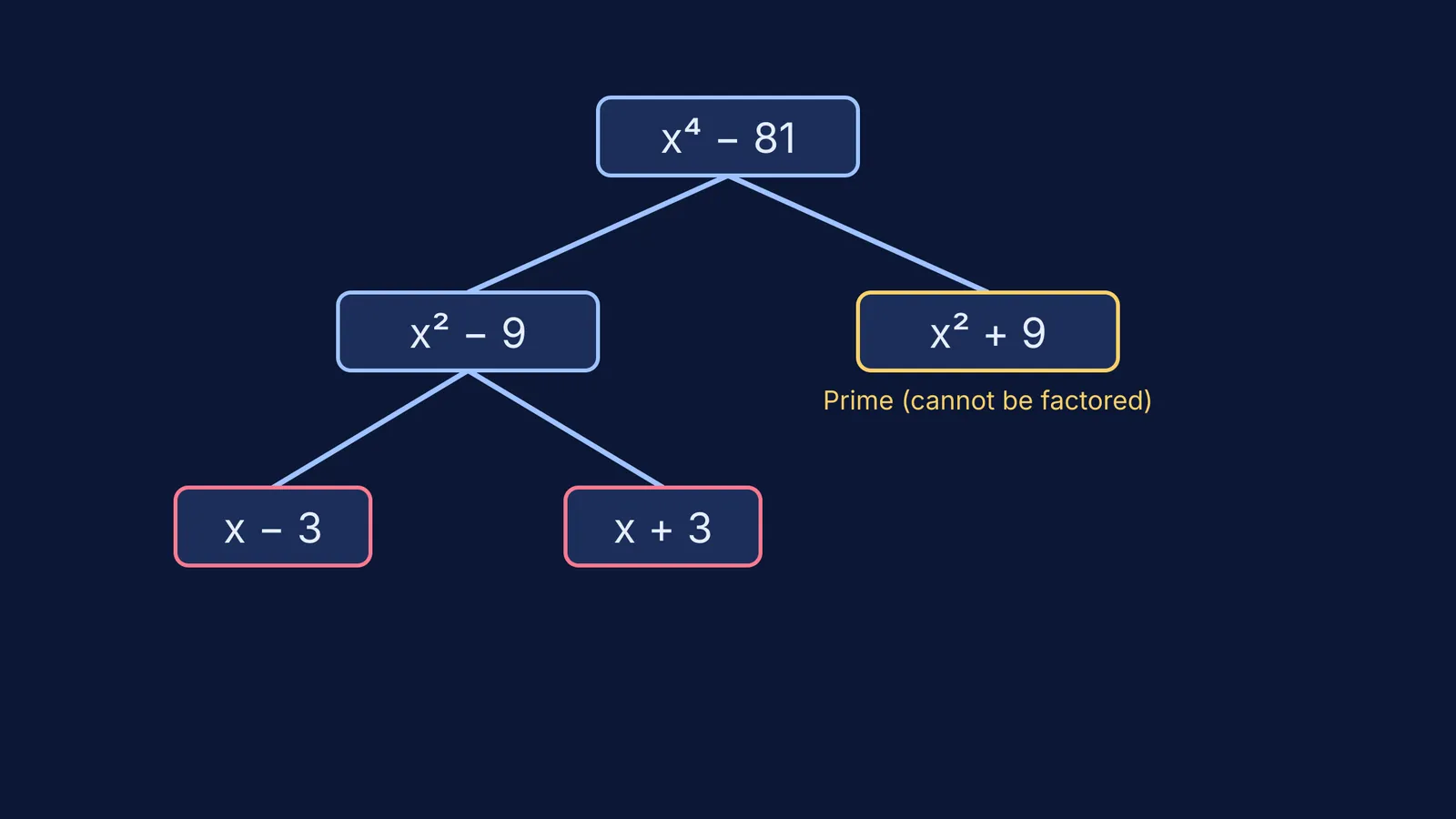
How do you factorise x⁴ minus 81?
Expressions with a power of 4 are often just a difference of squares in disguise. You have to apply the rule a² − b² = (a − b)(a + b) repeatedly.
Rewrite as squares: Treat x⁴ as (x²)² and 81 as 9². The expression becomes (x²)² − 9².
Apply the rule once: Here, a is x² and b is 9. This gives (x² − 9)(x² + 9).
Check for further factors: Look at the two brackets you created. The second bracket, x² + 9, is a sum of squares and cannot be broken down. The first bracket, x² − 9, is another difference of squares: x² − 3².
Apply the rule again: Break down x² − 9 into (x − 3)(x + 3).
Putting it all together, the fully factorised form is (x − 3)(x + 3)(x² + 9).
If you cannot see the pattern in a long polynomial, the Fermi Concept Library has every concept in mathematics, each with its own lesson and its place in the map.
How do you factorise x³ plus 27?
This is a classic sum of cubes problem. To solve it, you must identify your base values for a and b before applying the formula.
Rewrite as cubes: Write x³ as x³ and 27 as 3³. The expression is x³ + 3³.
Identify a and b: Your a is x, and your b is 3.
Apply the SOAP rule: Because it is a sum (+), the signs will be Same (+), Opposite (−), Always Positive (+).
Write the brackets: (x + 3)(x² − 3x + 3²).
Simplify: (x + 3)(x² − 3x + 9).
A common error is trying to factorise the quadratic part (x² − 3x + 9) further, perhaps confusing it with Quadratic word problems in Class 10. The quadratic trinomial generated by the sum or difference of cubes is always prime.
What if an expression needs both rules?
Sometimes you will encounter an expression like x⁶ − y⁶. Because 6 is a multiple of both 2 and 3, you can treat it as a difference of squares or a difference of cubes.
It is always easier to apply the difference of squares first:
Squares first: (x³)² − (y³)² = (x³ − y³)(x³ + y³)
Cubes second: Now you have both a difference of cubes and a sum of cubes.
Expand both: (x − y)(x² + xy + y²)(x + y)(x² − xy + y²).
When you bring a tricky polynomial to Fermi's AI tutor, it notices where you are stuck and explains the reasoning step by step, rather than just handing you the final brackets. Practising these sequences will turn algebra from a stumbling block into a reliable tool.


