

On this page
When you first learn algebra in Class 8, you are taught to look for a common factor in an expression. For example, in 2x + 4, you can easily pull out the 2. But what happens when you face an expression like 2xy + 2y + 3x + 3? There is no single number or letter that divides evenly into all four terms. This is where regrouping comes in.
According to a 2026 study in *SCIENCE: Jurnal Inovasi Pendidikan Matematika dan IPA*, 40.33% of students struggle at the 'understanding the problem' stage of algebraic factorization (10.51878/science.v5i4.11703). However, by breaking expressions into smaller parts and working methodically, you can overcome this initial hurdle.
When do you need to regroup terms?
You need to use the regrouping method when an algebraic expression (usually containing four terms) does not share a universal common factor. Instead of looking at the whole expression at once, you break it down into smaller groups—typically pairs—that do have common factors.
This technique requires a bit of trial and error, which can sometimes be frustrating. If you get stuck, the Fermi Concept Library has a lesson for every concept in mathematics, helping you see where each technique fits in the map.
How do you factorise by regrouping terms?
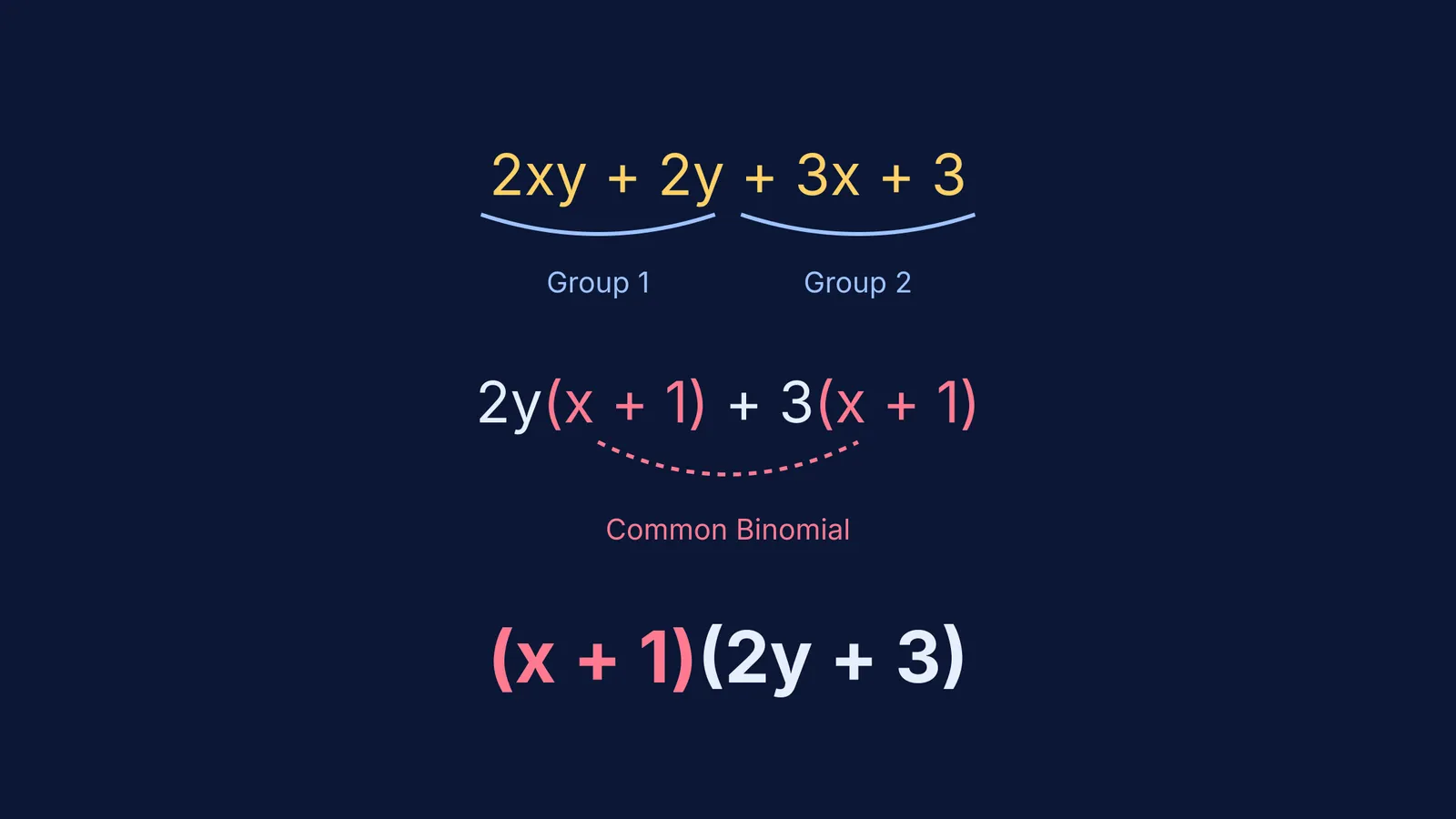
The process of regrouping involves pairing terms, factoring each pair, and then factoring out the resulting common binomial. Let us walk through the expression 2xy + 2y + 3x + 3.
Check for a universal factor: Look at 2xy, 2y, 3x, and 3. There is nothing common to all four.
Group the terms: Group the first two terms together, and the last two terms together.
(2xy + 2y) + (3x + 3)
Factorise each group:
In the first group (2xy + 2y), both terms share a 2y. Pulling it out gives 2y(x + 1). In the second group (3x + 3), both terms share a 3. Pulling it out gives 3(x + 1). Now rewrite the expression: 2y(x + 1) + 3(x + 1)
Pull out the common binomial: Notice that the bracket (x + 1) is identical in both parts. This is your new common factor. Pull (x + 1) out to the front.
(x + 1)(2y + 3)
What if the first grouping does not work?
Sometimes, the terms are written in an order that does not yield a common binomial when you group the first two and the last two. If this happens, you must rearrange the terms before grouping.
Example: Factorise 6xy − 4y + 6 − 9x
If you try to group it as (6xy − 4y) + (6 − 9x), you get 2y(3x − 2) + 3(2 − 3x). The brackets (3x − 2) and (2 − 3x) are similar but have opposite signs. You can fix this by factoring out a −3 from the second group instead of a positive 3: 2y(3x − 2) − 3(3x − 2) Now the brackets match, giving you (3x − 2)(2y − 3).
Alternatively, you can rearrange the original expression to bring similar terms together first: 6xy − 9x − 4y + 6 Group them: (6xy − 9x) − (4y − 6) Notice how the sign of 6 changed to −6 because we put it inside a bracket with a minus sign in front. Factorise each pair: 3x(2y − 3) − 2(2y − 3) The brackets match perfectly, leading to the same final answer: (2y − 3)(3x − 2).
If you find yourself repeatedly struggling with signs, it might help to review the basics of factorisation for Class 8.
How do you avoid common mistakes?
When regrouping terms, the most common mistake is dealing with negative signs incorrectly. Always remember that when you factor out a negative number, the signs of the terms remaining inside the bracket must change. If you miss this step, your binomial brackets will not match, and you will not be able to proceed to a final factored form. Another common error is forgetting to look for a universal common factor first; always check if a single number or variable divides into every term before you start grouping.
How do you check your answer by expanding?
One of the best habits you can build in algebra is verifying your work. You can always check a factorisation by expanding the brackets using the distributive property.
To check if (x + 1)(2y + 3) is correct:
First terms: x × 2y = 2xy
Outer terms: x × 3 = 3x
Inner terms: 1 × 2y = 2y
Last terms: 1 × 3 = 3
Add them all together: 2xy + 3x + 2y + 3. This matches our original expression (just in a slightly different order), proving the factorisation is correct. Building this verification step into your routine is excellent preparation for more complex topics like quadratic equations in Class 10.


