

On this page
When you look at an algebraic expression, it can sometimes feel like a jumble of letters and numbers. Factorisation is the process of breaking that jumble down into its simplest building blocks, turning a sum or difference into a product of factors. It is the exact reverse of expanding brackets.
While the concept is straightforward, the execution can be tricky. A 2019 study by Maat et al., published in the International Journal of Instruction, investigated students' algebraic thinking and found that failing to identify the Greatest Common Factor (GCF)—especially when negative signs or multiple variables are involved—is one of the most frequent errors students make when learning factorisation.
What is factorisation by taking common factors?
Taking a common factor means finding the highest number and the largest power of each variable that divides exactly into every single term of your expression. Once you identify this common factor, you "pull it out" and place it outside a set of brackets, leaving the remaining parts of the expression inside.
Think of it as untangling a knot. If you have the expression 12x + 36, both terms share a common numerical factor of 12. By pulling 12 out, the expression simplifies to 12(x + 3).
How to factorise by taking common factors step by step?
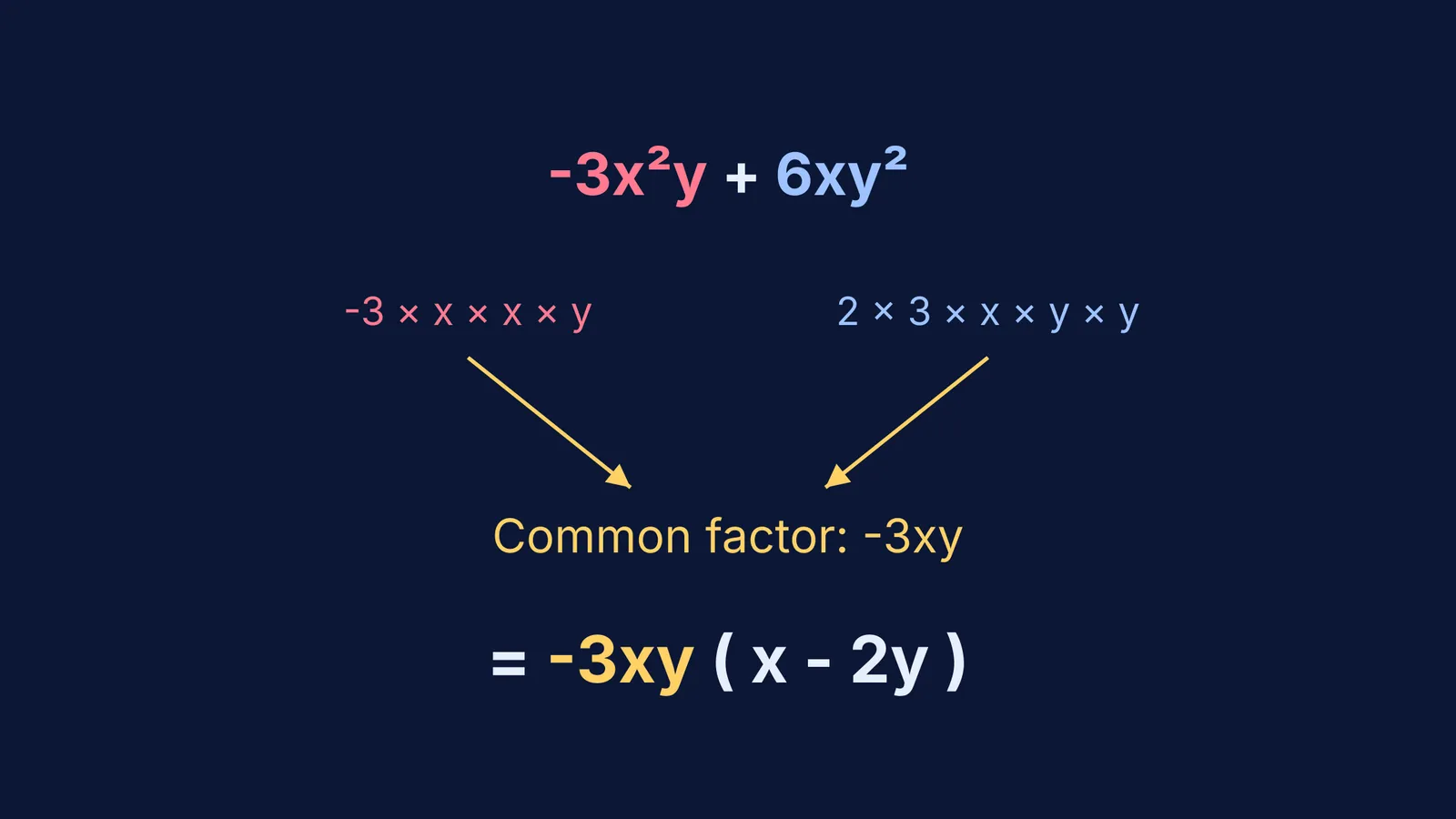
Let us tackle a harder expression with negative numbers and multiple variables: factorise -3x²y + 6xy².
Find the highest common numerical factor. The numbers are -3 and 6. The highest common factor here is 3. However, when the leading term is negative, it is standard practice to pull out the negative sign as well, so we use -3.
Find the highest common variable factor. The first term has x²y (which is x × x × y) and the second term has xy² (which is x × y × y). They both share exactly one x and one y. So, the common variable factor is xy.
Combine them to get the Greatest Common Factor. Multiplying the number and the variables gives a GCF of -3xy.
Divide each term by the GCF to find what goes inside the brackets. For the first term, dividing -3x²y by -3xy leaves just x. For the second term, dividing 6xy² by -3xy leaves -2y.
Putting it all together, the fully factorised expression is -3xy(x - 2y).
How to factorise by grouping terms?
Sometimes you will face an expression with four or more terms where there is no single factor common to all of them. In this case, you can factorise by grouping.
Take the expression ax + bx - ay - by.
First, group the terms into pairs that share something in common: (ax + bx) and (-ay - by). Next, factorise each group separately. Pull out x from the first group to get x(a + b). From the second group, pull out -y to get -y(a + b).
Now look at your new expression: x(a + b) - y(a + b). Notice that the binomial (a + b) is perfectly common to both halves. You can now pull (a + b) out to the front, leaving the x and the -y to form the second bracket.
The final factorised form is (a + b)(x - y).
How to check your factorisation?
The best part about factorisation is that you can always test if you are right. To check your work, simply expand the brackets by multiplying the terms back together.
Let us check our earlier answer, -3xy(x - 2y). Multiply the outside term by the first inside term: -3xy × x gives -3x²y. Then, multiply the outside term by the second inside term: -3xy × -2y gives +6xy². We get back to -3x²y + 6xy², which matches our original expression perfectly.
If you get stuck on the signs, or if expanding your answer does not give you back the original expression, the Fermi Problem Library has worked problems with a step-by-step solver that explains the reasoning rather than printing an answer. It can show you exactly where a negative sign was dropped or a variable was missed.
Read more:


