

On this page
When you learn algebra, swapping letters for numbers seems straightforward until the numbers turn negative. Suddenly, evaluating equations like y = -x² or 3a - (b + a) leads to unexpected wrong answers.
The problem is rarely the arithmetic itself. Research into mathematical cognition shows that the negative sign is a primary source of algebraic errors, as students often fail to treat it as part of the term they are substituting.
Why do minus signs cause so much trouble, and how can you substitute numbers reliably without tripping up on the rules?
What are the three jobs of a minus sign?
A major source of confusion is that the minus sign does three different jobs in mathematics. A 2004 study found that students struggle to switch between these three distinct meanings of the minus sign (Vlassis, 2004):
Binary (subtraction): Telling you to subtract one number from another, as in 5 - 3.
Unary (negative number): Stating that a number is below zero, like the -3 in -3x.
Symmetry (opposite of): Telling you to take the opposite of whatever follows, as in -(-3) or -x.
When evaluating expressions, students often treat the minus sign only as subtraction (a binary operation). They see the existing minus sign in 5 - x and think the "negative" part of x = -2 is already covered, calculating 5 - 2 = 3 instead of the correct 5 - (-2) = 7.
Why does -2² equal -4 on a calculator?
This is a classic trap when evaluating powers. Many students type -2² into a scientific calculator, get -4, and assume the calculator is broken because "a negative times a negative is a positive."
The calculator is actually following the strict order of operations (BODMAS or PEMDAS). Exponents happen before multiplication. In mathematics, a floating minus sign at the front of a number is treated as multiplying by -1.
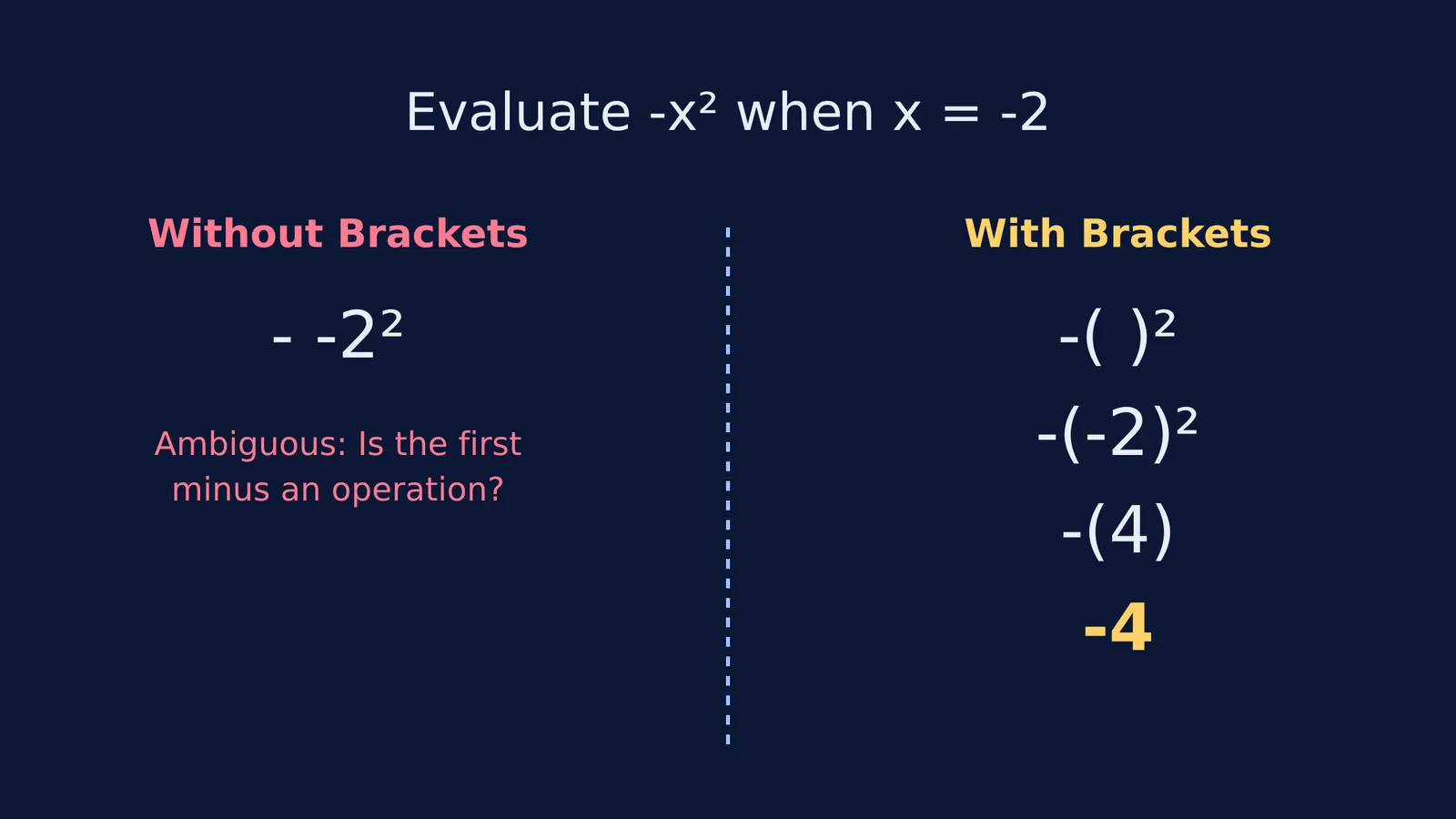
When you write -2², the rules say: square the 2 first (giving 4), then apply the minus sign. The result is -4.
When you write (-2)², the brackets tell the rules: apply the exponent to everything inside. (-2) × (-2) gives 4.
When evaluating expressions by hand, failing to write those brackets will almost always lead to the wrong sign in your final answer.
How do you evaluate algebraic expression when x equals minus 2?
If a question asks you to evaluate -x² + 3x when x = -2, the safest approach is the "empty brackets" method. This stops you from losing track of whether a minus sign belongs to the equation or to the number itself.
Step 1: Rewrite the expression with empty brackets. Replace every instance of the variable with a pair of empty brackets. Leave all the original plus and minus signs exactly where they are. -( )² + 3( )
Step 2: Drop the negative value into the brackets. Now, write -2 inside every set of brackets. -(-2)² + 3(-2)
Step 3: Follow the order of operations. Deal with the exponents first. Since (-2)² is 4, the expression becomes: -(4) + 3(-2)
Next, do the multiplication. 3 × (-2) is -6. -4 + (-6)
Finally, do the addition. The answer is -10.
Getting unstuck with step-by-step help
If you know the rules but still find your signs getting scrambled on long equations, it helps to check your logic line by line rather than just looking at the final answer. Fermi's AI tutor can work out what you already know and build a plan for the session, stepping in only when you drop a sign or break the order of operations.
You can also use the Fermi Problem Library, which has worked problems with a step-by-step solver that explains the reasoning rather than printing an answer. It can be useful to pair this with the Concept Library to review the underlying rules of algebra when you get stuck. Knowing *why* you made a mistake—such as misjudging your own learning and skipping brackets—is much more effective than just writing out the correct solution. Research on tutor hints vs answers shows that targeted nudges help you retain the right method for the exam.
By forcing yourself to use brackets every time you substitute a value, you turn a tricky decision into a reliable habit.


