

On this page
Squaring three terms looks like more work than it is. Treat it as the two-term square you know with one extra piece, and it comes down to six terms and one sign rule.
What is the a plus b plus c whole square formula?
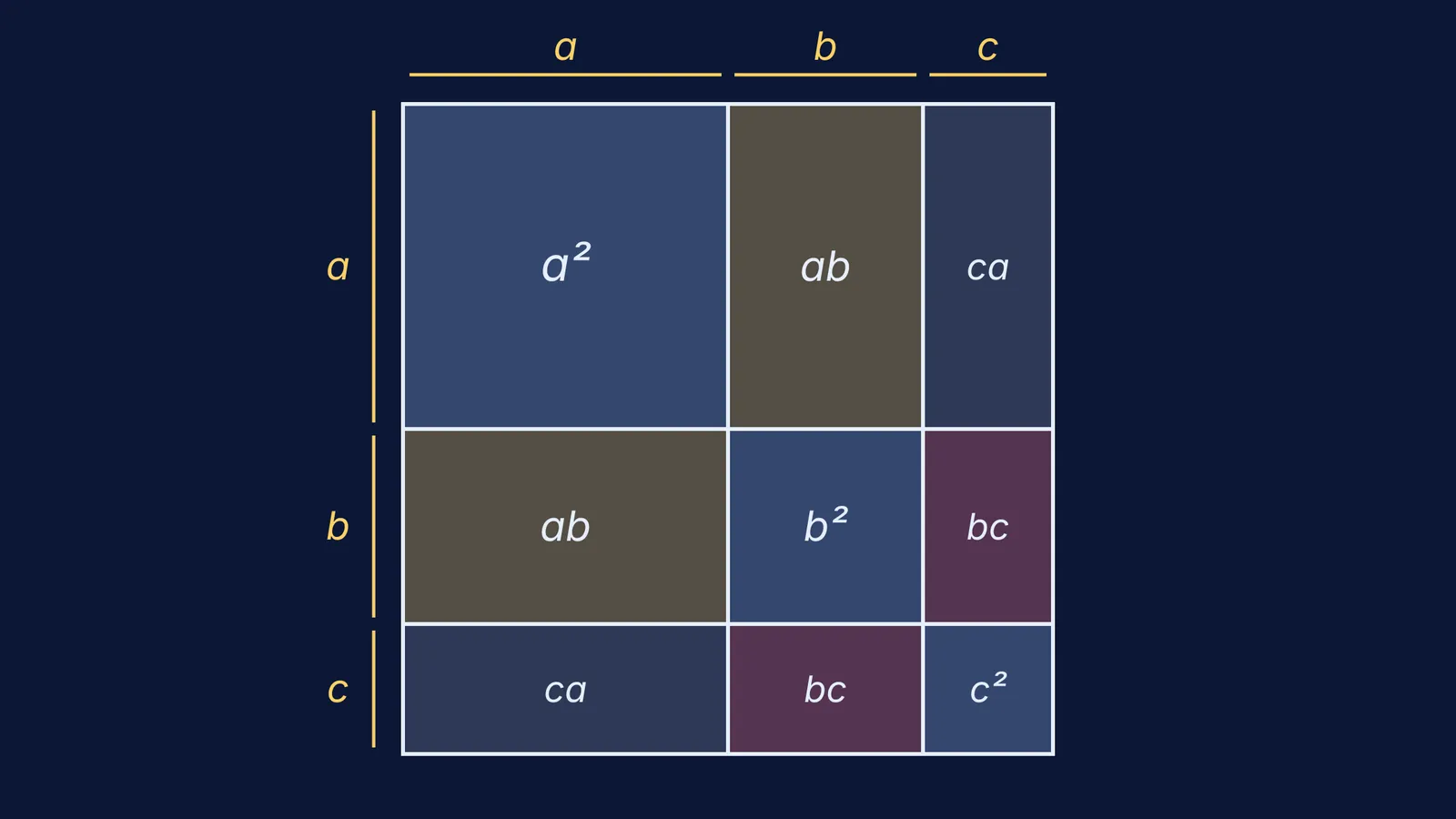
The identity is (a + b + c)² = a² + b² + c² + 2ab + 2bc + 2ca, and it holds for every value of a, b and c.
NCERT's Grade 9 textbook, Ganita Manjari Part I, Chapter 4 "Exploring Algebraic Identities", derives it by putting d = b + c into (a + d)² = a² + 2ad + d² and opening the brackets. The same chapter draws it as a square of side a + b + c cut into nine pieces: three squares (a², b², c²) on the diagonal and six rectangles that pair up into 2ab, 2bc and 2ca. That is the picture at the top of this post.
So the count is fixed at six terms. If your expansion has five or seven, something is missing or doubled. If the word "identity" itself feels fuzzy, our explainer on the difference between an algebraic identity and an equation sorts it out.
How do you find ab + bc + ca from a + b + c and a² + b² + c²?
Move the squares to the other side and halve: ab + bc + ca = [(a + b + c)² − (a² + b² + c²)] ÷ 2. You never need to find a, b and c themselves.
Example 1. If a + b + c = 9 and a² + b² + c² = 35, then 81 = 35 + 2(ab + bc + ca), so ab + bc + ca = 46 ÷ 2 = 23. Check with real numbers: 1, 3 and 5 add to 9, their squares add to 35, and 3 + 15 + 5 = 23.
Example 2. If a + b + c = 2 and a² + b² + c² = 14, then 4 = 14 + 2(ab + bc + ca), so ab + bc + ca = −5. A negative answer is fine: 1, −2 and 3 fit both conditions, and −2 − 6 + 3 = −5.
Run backwards, a² + b² + c² = (a + b + c)² − 2(ab + bc + ca), and for real numbers that sum of squares can never be negative. It is the same idea as finding a³ + b³ from the sum and product: use a known square to get a quantity you were never given directly.
How do you expand (a + b + c)² when one term is negative?
Keep each sign attached to its term. Exercise Set 4.3 in the same NCERT chapter asks you to expand (3x − 2y + 4z)². Set a = 3x, b = −2y and c = 4z, then fill the six slots:
Squares: (3x)² = 9x², (−2y)² = 4y², (4z)² = 16z².
2ab = 2(3x)(−2y) = −12xy.
2bc = 2(−2y)(4z) = −16yz.
2ca = 2(4z)(3x) = 24zx.
So (3x − 2y + 4z)² = 9x² + 4y² + 16z² − 12xy − 16yz + 24zx.
That is why (a − b − c)² = a² + b² + c² − 2ab + 2bc − 2ca: the bc term is positive because both b and c are negative. Carrying the sign inside the bracket matters for higher powers too, as in our guide to expanding a binomial with a negative term.
The rule also works backwards. The same exercise set asks you to factor 9a² + 4b² + c² − 12ab + 6ac − 4bc. The two negative cross terms both contain b, so b is the odd one out: the answer is (3a − 2b + c)². Flipping every sign, (−3a + 2b − c)², gives the same expression, so either form is correct.
What should you check before moving on?
Run this list over every answer:
Six terms, not three: (a + b + c)² is never just a² + b² + c².
A 2 in front of every cross term.
Square the coefficient as well: (−2y)² = 4y², not −4y² or 2y².
One minus in a pair gives a negative cross term; two minuses give a positive one.
In the ab + bc + ca rearrangement, halve at the very end.
If you keep losing the sign at the same step, work a few problems in the Fermi Problem Library, where a step-by-step solver explains the reasoning rather than printing an answer, so you can see the line where the minus went missing. If the trouble is the idea behind identities rather than the arithmetic, the Fermi Concept Library gives each mathematics concept its own lesson and its place in the map.
Try one now: if a + b + c = 6 and a² + b² + c² = 14, then ab + bc + ca should come out to 11.


