

On this page
Often, in competitive exams or school mathematics, you are given the sum of two numbers, a + b, and their product, ab, and asked to find the value of a³ + b³. Your first instinct might be to set up a quadratic equation to find the exact values of a and b, and then cube those individual numbers.
This approach works, but the roots are often messy fractions or complex numbers. There is a faster, more elegant way. According to the CBSE Class 9 Mathematics syllabus, algebraic identities are introduced early on to evaluate these exact types of expressions without ever finding the individual values of the variables.
How do you find a³ + b³ from a + b and ab?
The quickest way to find a³ + b³ relies on a rearranged form of the standard binomial cube expansion.
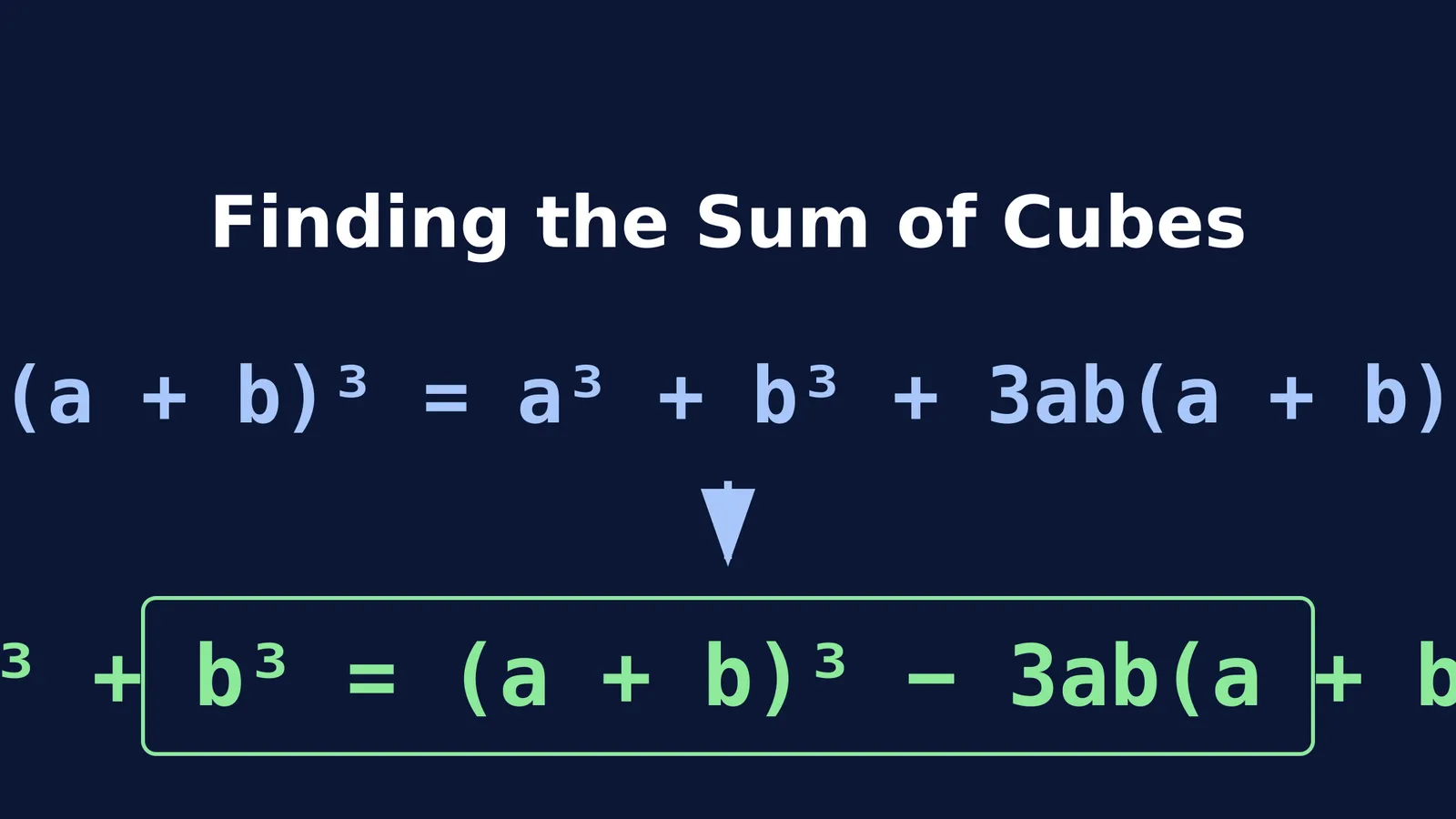
We know that: (a + b)³ = a³ + b³ + 3a²b + 3ab²
By factoring out the common term 3ab from the last two terms, this expression becomes: (a + b)³ = a³ + b³ + 3ab(a + b)
When you rearrange this equation to make a³ + b³ the subject, you get the fundamental identity: a³ + b³ = (a + b)³ − 3ab(a + b)
This formula is very useful because the right side of the equation depends entirely on the sum (a + b) and the product (ab). If a competitive exam question gives you these two values, you can just plug them in directly. You never have to figure out what a or b actually are.
How does the a³ + b³ identity work in practice?
Suppose you are given a + b = 4 and ab = 5, and you need to find a³ + b³.
If you tried to solve for a and b using the quadratic equation t² − 4t + 5 = 0, you would find that the discriminant is negative (16 − 20 = −4). This means the numbers are the complex conjugate pair 2 + i and 2 − i. Cubing these complex numbers by hand takes a significant amount of time and strongly invites arithmetic mistakes under time pressure.
Using the identity is much simpler. Substitute the known values into the rearranged formula: a³ + b³ = (4)³ − 3(5)(4) a³ + b³ = 64 − 60 a³ + b³ = 4
The final answer drops out in three lines, bypassing the complex roots entirely. If you are practising for exams and get stuck on manipulations like these, the Fermi Problem Library has worked problems with a step-by-step solver that explains the reasoning rather than printing an answer.
How do you evaluate a³ − b³ from the difference and product?
You can evaluate a³ − b³ using a very similar approach. While the sum of cubes relies on (a + b)³, the difference of cubes relies on the expansion of (a − b)³.
Start with the standard expansion for the binomial cube of a difference: (a − b)³ = a³ − 3a²b + 3ab² − b³
Rearrange the terms to group the cubes together: (a − b)³ = a³ − b³ − 3a²b + 3ab²
Next, factor out −3ab from the last two terms: (a − b)³ = a³ − b³ − 3ab(a − b)
Finally, make a³ − b³ the subject of the equation by adding 3ab(a − b) to both sides: a³ − b³ = (a − b)³ + 3ab(a − b)
This identity mirrors the one for the sum of cubes. However, instead of requiring the sum (a + b), it requires the difference (a − b). If a problem gives you the sum a + b and the product ab, you can still find a³ − b³. You would first calculate a − b using the square root formula we derived below, and then substitute that result into this cubic identity. This two-step process allows you to find asymmetric expressions from purely symmetric inputs.
How do you find a² + b²?
The exact same principle applies to squares and differences. When tackling questions about the symmetric functions of roots (often written as α and β instead of a and b), you frequently need to find a² + b² or a − b purely from the sum and product.
Start with the standard expansion of a perfect square: (a + b)² = a² + 2ab + b²
Rearrange it to isolate the sum of the squares: a² + b² = (a + b)² − 2ab
Using our earlier example where a + b = 4 and ab = 5: a² + b² = (4)² − 2(5) a² + b² = 16 − 10 = 6
You can even take this a step further. If an exam asks for a⁴ + b⁴, you simply square your result for a² + b² and subtract 2(ab)², saving yourself even more algebra.
How do you find the difference a − b?
To find a − b, you start by finding the square of the difference: (a − b)² = a² − 2ab + b²
Substitute the expression for a² + b² that we just derived: (a − b)² = (a + b)² − 2ab − 2ab (a − b)² = (a + b)² − 4ab
Taking the square root of both sides gives: a − b = ±√((a + b)² − 4ab)
In quadratic problems, this formula is frequently used to find the difference between the roots of an equation. The quantity residing under the square root, (a + b)² − 4ab, is actually the discriminant of the quadratic equation. You can easily see how this algebraic tool links directly to the condition for a quadratic to be always positive.
By keeping these companion formulas alongside the cubic identity, you can evaluate almost any symmetric expression of two variables cleanly and directly from their sum and product. These algebraic tools not only save time during high-stakes exams but also prevent arithmetic mistakes that often creep in when handling irrational roots or complex numbers. Understanding how these identities interlock gives you a much stronger grasp of polynomial algebra as a whole.


