

On this page
Mathematics uses the equals sign (=) to mean two different things. When you write 3x - 1 = 8, you are setting a condition that only one number can meet. But when you write (x + 1)² = x² + 2x + 1, you are stating a universal fact that holds true no matter what number you pick.
Mixing up these two concepts leads to some of the most common mistakes in algebra.
What is the difference between an algebraic identity and an equation?
An identity is an equality between two mathematical expressions that remains true for all possible values of the variables within a specific domain). Think of it as a grammar rule of mathematics: it gives you permission to rewrite an expression in a different, often simpler, form without changing its fundamental value.
An equation, on the other hand, is an equality that holds true only for certain specific values, which we call its solutions). An equation is a question ("Which values make this true?"), whereas an identity is a fact ("These two things are always exactly the same"). When you are asked to solve an equation, your goal is to find the hidden numbers that balance the scales. When you use an identity, you are just trading one layout of variables for another layout that is easier to work with.
If you are stuck on a problem because you cannot remember the correct algebraic rule, the Fermi Concept Library contains every concept in physics, chemistry, biology, mathematics and computing, each with its own lesson and its place in the map.
What are the standard algebraic identities?
In early algebra, a few specific identities appear so often that they form the foundation of more advanced mathematics. Memorizing these saves you from manually multiplying brackets over and over again. The fundamental identities include:
The square of a sum: (a + b)² = a² + 2ab + b²
The square of a difference: (a - b)² = a² - 2ab + b²
The difference of two squares: (a + b)(a - b) = a² - b²
These rules are universally true. Whether a and b are integers, fractions, negative numbers, or even complex numbers, the left side will always match the right side.
Why does (a + b)² = a² + b² fail?
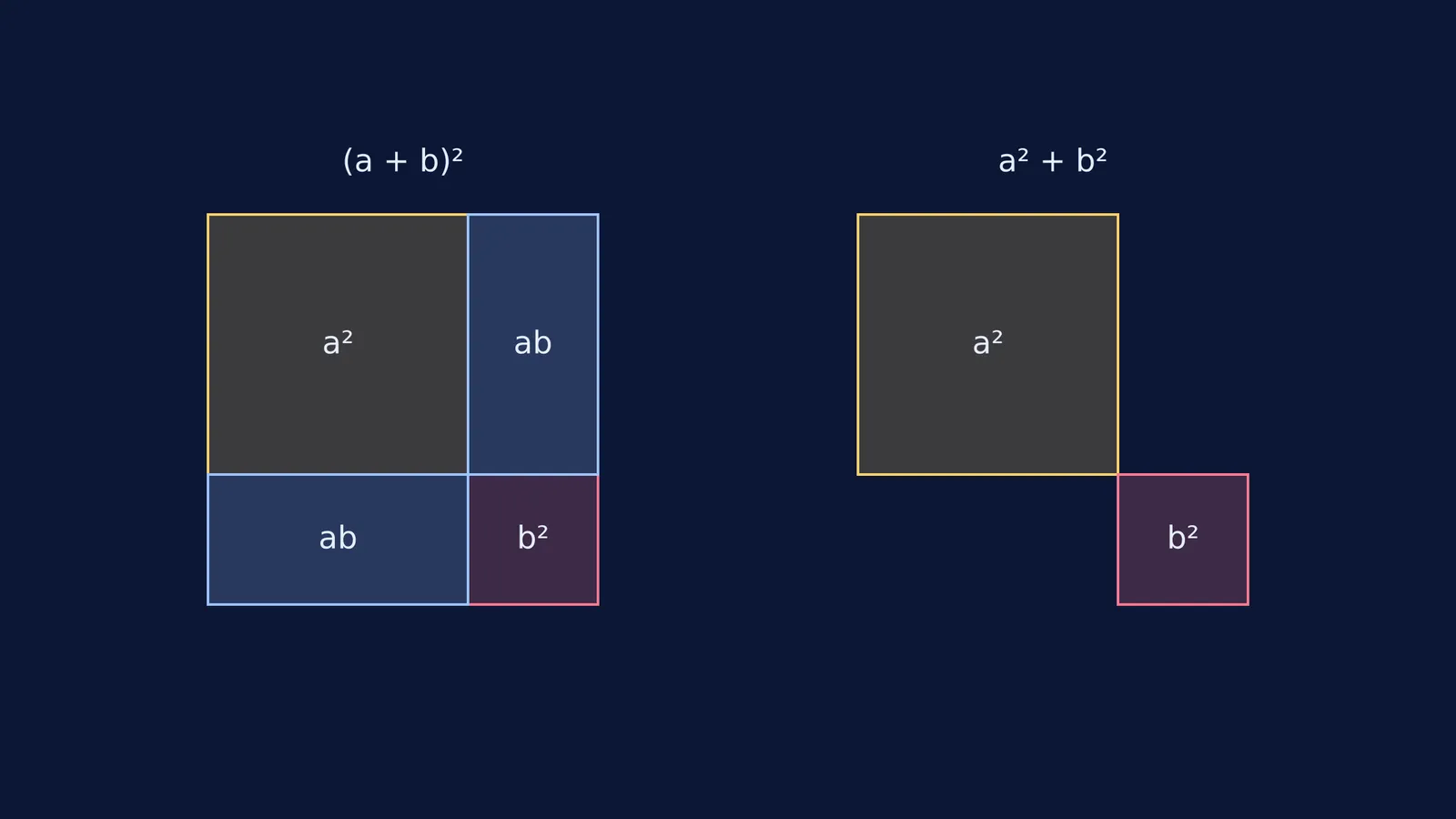
When students first encounter algebra, it is tempting to distribute a power across a sum. This frequent error—assuming that (a + b)² = a² + b²—is so widespread it has a formal name: the "freshman's dream".
It fails because you are ignoring the cross-terms. If you draw a square with side length (a + b), the total area is (a + b)². When you partition that square, you get one block of area a², one block of b², and two rectangular blocks of area ab. The expression a² + b² only gives you the squares, leaving out the two ab rectangles entirely.
If you consistently make this kind of structural mistake in calculations, the Fermi Problem Library has worked problems with a step-by-step solver that explains the reasoning rather than printing an answer.
How to test an identity with two random values
If you are in an exam and cannot remember if a formula is a true identity or an incorrect guess, you should test it with a random value. Since an identity must hold for all possible values, a single counterexample is enough to prove it false.
Let us test the freshman's dream with a = 1 and b = 2:
Substitute the values into the Left Hand Side (LHS): (1 + 2)² = 3² = 9.
Substitute the values into the Right Hand Side (RHS): 1² + 2² = 1 + 4 = 5.
Since 9 ≠ 5, the statement (a + b)² = a² + b² cannot be an identity.
Why should you pick two random values to test a rule? Sometimes, a false formula accidentally acts like a true one for a specific number. For instance, if you test (a + b)² = a² + b² with a = 0 and b = 5:
LHS: (0 + 5)² = 5² = 25
RHS: 0² + 5² = 0 + 25 = 25
The sides match, but it is a trap. That equality is a conditional equation that is true only when a = 0 or b = 0. By testing a second pair of non-zero values, you confirm whether the rule is universally safe to use or just a conditional equation in disguise.
Read more about solving equations and checking roots:


