

On this page
Expanding a binomial like (a + b)ⁿ is straightforward: you take the coefficients from Pascal's triangle, let the powers of a fall, and let the powers of b rise. But when you face a negative sign, as in (2x − 3/x)⁴, the minus sign needs careful handling. The trick is to treat the subtraction as adding a negative term, so the signs alternate in the final polynomial.
Why do the signs alternate in a binomial expansion?
When you expand (a − b)ⁿ, you are actually expanding (a + (−b))ⁿ. As the power of the second term increases from 0 to n, it alternates between even and odd. According to the Binomial Theorem, an expression of the form (x − y)ⁿ alternates signs because odd powers of a negative number remain negative, while even powers become positive. This makes the final signs follow a strict pattern: +, −, +, −, and so on.
The coefficients themselves come from the fourth row of Pascal's triangle: 1, 4, 6, 4, 1. For a deeper look at where these numbers come from, you can read about Al-Karaji and the binomial table.
How do you expand 2x minus 3/x whole power 4?
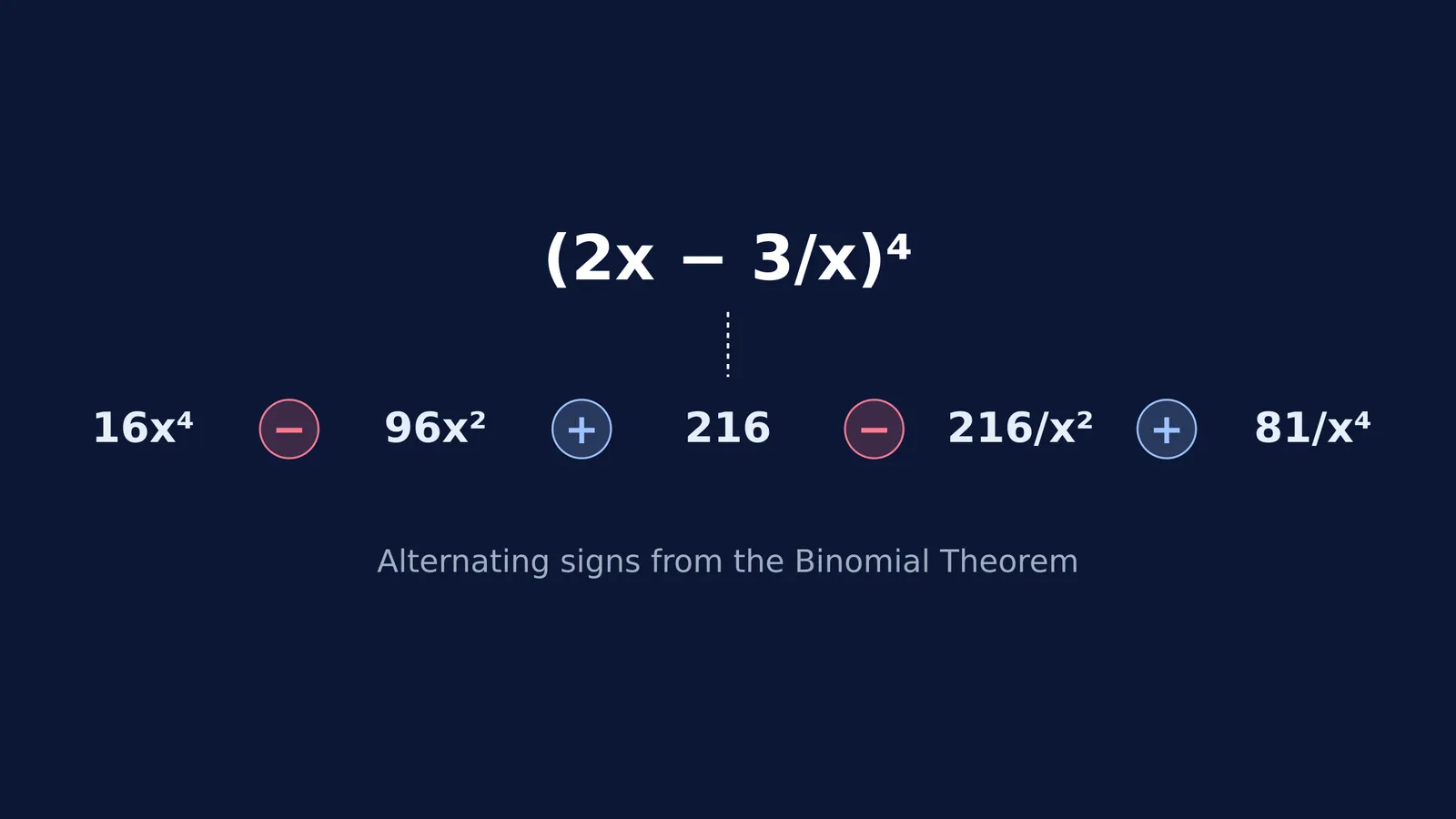
Let's expand the specific problem (2x − 3/x)⁴ step by step. We treat a = 2x and b = 3/x. The signs will alternate, starting with a positive term for the highest power of a.
Write the coefficients and alternating signs:
+1(…) − 4(…) + 6(…) − 4(…) + 1(…)
Fill in the powers of the first term (2x), counting down from 4:
+1(2x)⁴ − 4(2x)³ + 6(2x)² − 4(2x)¹ + 1(2x)⁰
Fill in the powers of the second term (3/x), counting up from 0:
+1(2x)⁴(3/x)⁰ − 4(2x)³(3/x)¹ + 6(2x)²(3/x)² − 4(2x)¹(3/x)³ + 1(2x)⁰(3/x)⁴
Expand the powers inside the brackets carefully:
Term 1: 1 × 16x⁴ × 1 = 16x⁴ Term 2: −4 × 8x³ × (3/x) = −96x² Term 3: 6 × 4x² × (9/x²) = 216 Term 4: −4 × 2x × (27/x³) = −216/x² Term 5: 1 × 1 × (81/x⁴) = 81/x⁴
Combine them for the final answer:
16x⁴ − 96x² + 216 − 216/x² + 81/x⁴
Notice how the powers of x cancel out exactly in the middle term, leaving 216 as a constant. When variables appear in both the numerator and denominator, as they do here, expanding them cleanly is just as important as knowing the sums of binomial coefficients.
If you are stuck on similar algebraic questions and need to see exactly where your working went wrong, the Fermi Problem Library has a step-by-step solver that explains the reasoning rather than just printing an answer.
What are the common mistakes when expanding binomials?
When dealing with negative signs and fractions at the same time, it is easy to make a small error that throws off the entire result. Watch out for these three pitfalls:
Forgetting to apply the power to the constant: In the term (2x)³, you must cube both the 2 and the x to get 8x³. Many students incorrectly write 2x³.
Applying the negative sign twice: The alternating sign pattern (+, −, +, −) already accounts for the minus sign in the original expression. If you use the pattern but still write the second term as (−3/x), you will end up multiplying two negatives and getting the wrong sign.
Mishandling the denominator: When squaring or cubing a fraction like 3/x, remember that the power applies to the denominator as well. (3/x)³ becomes 27/x³, not 27/x.
How can you check your expansion using x = 1?
When you have finished a long algebraic expansion, it is easy to make a small multiplication error or flip a sign. You can catch these mistakes by plugging a simple number, like x = 1, into both your original expression and your final answer. The two results must match exactly.
Let's test our answer for (2x − 3/x)⁴.
First, put x = 1 into the original bracket: (2(1) − 3/1)⁴ = (2 − 3)⁴ = (−1)⁴ = 1
Next, put x = 1 into our expanded answer: 16(1)⁴ − 96(1)² + 216 − 216/(1)² + 81/(1)⁴ = 16 − 96 + 216 − 216 + 81 = 16 − 96 + 81 = 97 − 96 = 1
Both sides equal 1. Because the results match, you can be highly confident that your coefficients and signs are correct. This quick substitution technique works for any algebraic identity or expansion, saving you from losing marks to simple arithmetic errors.


