

On this page
If your Class 11 practical file says "To determine specific heat capacity of a given solid by method of mixtures", you are doing experiment 7 of Section B in CBSE's 2025-26 physics curriculum. Getting close to the textbook value takes care, because most mistakes push your answer the same way.
How does the method of mixtures work?
It rests on one rule of calorimetry. NCERT's Class 11 physics textbook states that in an isolated system, the heat lost by the hotter part equals the heat gained by the cooler part. You heat a solid in boiling water or a steam heater, drop it into a calorimeter of cold water, and everything settles at one final temperature. NCERT's Example 10.3 uses this balance to get 0.911 kJ/kg K for an aluminium sphere; its Table 10.3 lists 900 J/kg K.
With s for the solid, w for water and c for the calorimeter:
m_s × c_s × (T_h − T_f) = (m_w × c_w + m_c × c_c) × (T_f − T_i)
The water equivalent W of a calorimeter is the mass of water that would absorb the same heat for the same temperature rise, so W = m_c × c_c / c_w. The right side becomes (m_w + W) × c_w × (T_f − T_i), and you solve for c_s. See our explainer on the water equivalent of a calorimeter; chemistry uses the same balance in coffee-cup calorimetry.
What readings should you write down?
Mass of the empty calorimeter with stirrer, m_c.
Mass of calorimeter, stirrer and water; subtract to get m_w.
Mass of the solid, m_s.
Temperature of the water and calorimeter just before mixing, T_i.
Temperature of the hot solid just before transfer, T_h.
Highest steady temperature of the mixture while stirring, T_f.
Note the calorimeter material, so you can look up c_c. NCERT's Table 10.3 gives 386.4 J/kg K for copper, 900 J/kg K for aluminium and 4186 J/kg K for water.
Worked example: a copper block in a copper calorimeter
The readings are illustrative; specific heats are from NCERT's Table 10.3.
Solid: 100 g of copper, heated to 99.0 °C
Calorimeter and stirrer: 80 g of copper
Water: 150 g at 25.0 °C
Final steady temperature: 29.0 °C
Water equivalent: W = 80 g × 386.4 / 4186 = 7.4 g.
Heat gained: (0.150 + 0.0074) kg × 4186 J/kg K × 4.0 K = 2635 J.
Heat lost by the block: 0.100 kg × c_s × (99.0 − 29.0) K = 7.0 × c_s.
Answer: c_s = 2635 / 7.0 = 376 J/kg K.
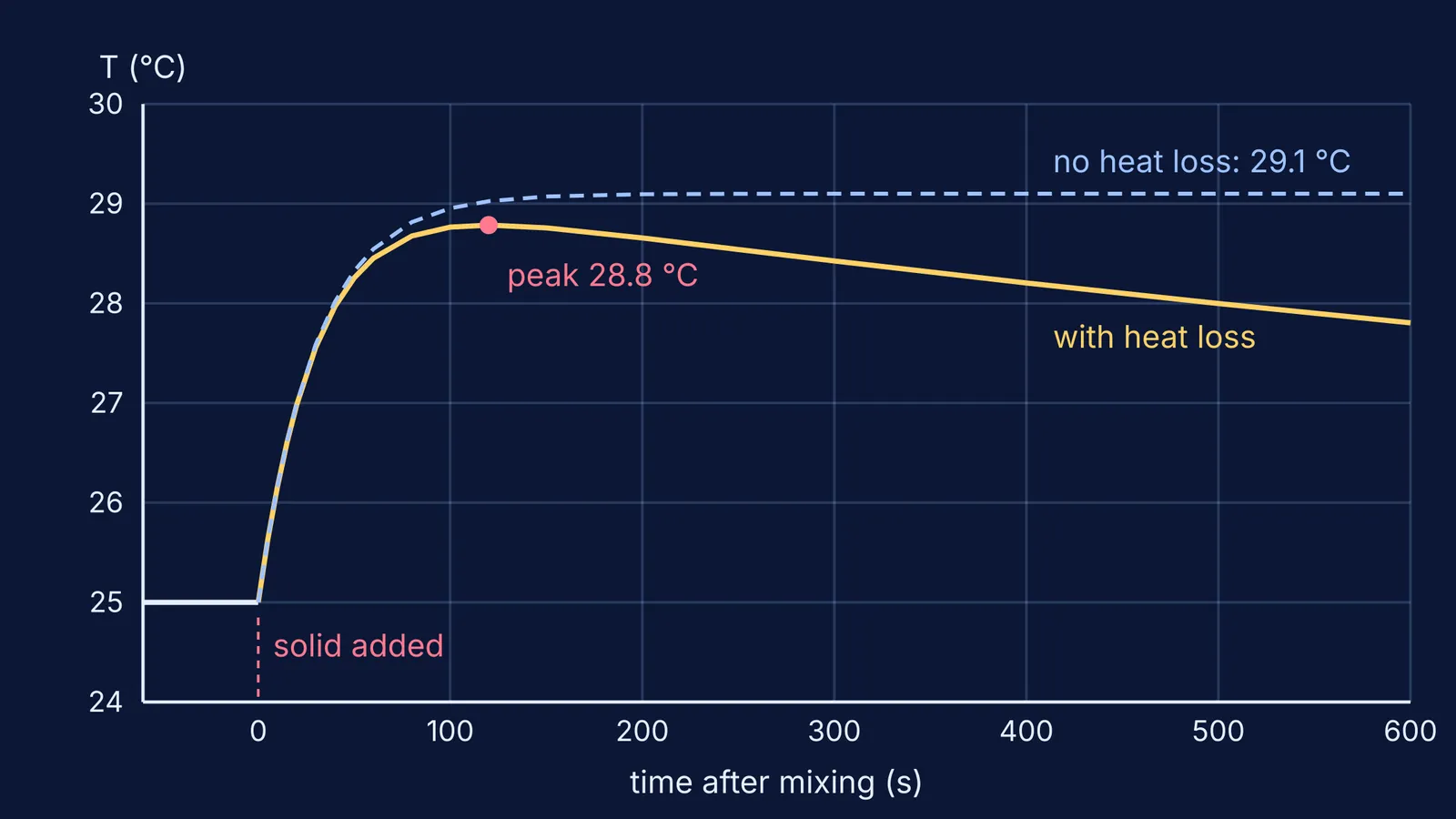
Against the table value of 386.4 J/kg K, this is 2.6% low. Ignore the calorimeter and you get 359 J/kg K, about 7% low. The rise is only 4 °C. With perfect insulation this mixture would reach 29.1 °C, so a reading just 0.1 °C short causes the whole gap. Read 28.5 °C and you get 327 J/kg K; read 29.5 °C and you get 427 J/kg K.
Which heat losses bias your answer, and in which direction?
The equation assumes no heat escapes. The 1911 Encyclopaedia Britannica article on calorimetry notes that some heat is generally lost while moving the heated body into the calorimeter, and that working fast reduces this loss but cannot remove it. Here is which way each problem pushes c_s:
The solid cools during transfer. It enters below the T_h you wrote down, so you overestimate the heat it gave. Result: too low.
The calorimeter loses heat to the room after mixing. T_f reads lower than it should. Result: too low.
You read T_f too early, before the mixture peaks. Result: too low.
Hot water clinging to the solid drips in. It brings extra heat. Result: too high.
You assume the wrong c_c. Either direction, depending on the mix-up.
How do you get closer to the textbook value?
Move the solid to the calorimeter in a few seconds and close the lid at once. A ThermTest guide to the method of mixtures also warns against letting water clinging to the heating tube drip into the calorimeter.
Stir gently and record the highest steady reading.
Keep the calorimeter in its insulating jacket, which NCERT describes as a heat shield that reduces heat loss.
Aim for a rise of several degrees, so the thermometer's least count is a small share of it.
Repeat the run and average your answers.
Some guides suggest starting the water below room temperature so gains cancel losses. Count Rumford proposed this, but the 1911 Britannica calls it really bad: the correction shrinks but becomes more uncertain, because a vessel seldom gains heat at the rate it loses it.
If you get stuck turning readings into an answer, the Fermi Problem Library has worked problems with a step-by-step solver that explains the reasoning rather than printing an answer. To revise specific heat first, open the Fermi Concept Library, then test yourself with our guide to predicting the final temperature when hot and cold water mix.


