

On this page
Pour hot water into cold water and the mix lands somewhere in between. A mixing simulation lets you test exactly where, again and again in a few minutes, and one rule predicts the result for an ideal, sealed mix: the heat lost by the hot liquid equals the heat gained by the cold one.
How do you find the final temperature when mixing hot and cold water?
Specific heat is "the amount of heat necessary to change the temperature of 1.00 kg of mass by 1.00 °C", as defined in OpenStax College Physics 2e. The same chapter gives the heat for a temperature change as Q = mcΔT: mass times specific heat times the change in temperature.
If no heat escapes to the cup or the air:
Heat lost by the hot liquid: m1c1(T1 − Tf)
Heat gained by the cold liquid: m2c2(Tf − T2)
Set them equal and solve: Tf = (m1c1T1 + m2c2T2) / (m1c1 + m2c2)
So the final temperature is a weighted average of the two starting temperatures, and each weight is that liquid's heat capacity, mass times specific heat. It is the same idea as thermal equilibrium and the zeroth law, turned into a number you can predict.
What final temperature should you predict for each mix?
OpenStax College Physics 2e lists water's specific heat as 4186 J/(kg·°C) and ethanol's as 2450 J/(kg·°C) in its Table 14.1. Predict each mix before you press play.
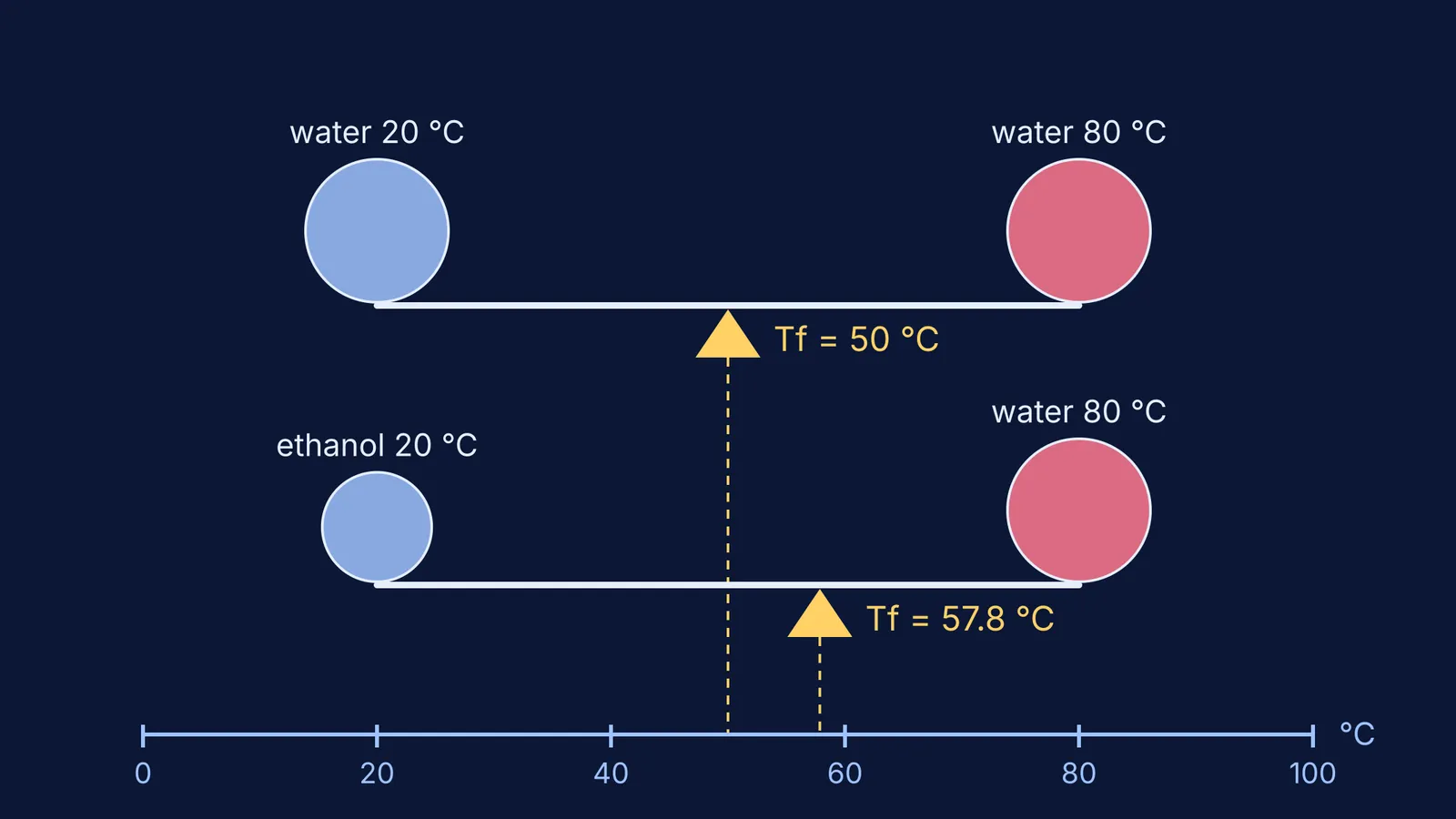
200 g water at 80 °C + 200 g water at 20 °C: equal weights, so Tf = 50 °C, exactly halfway.
200 g water at 80 °C + 300 g water at 20 °C: c cancels, so Tf = (200 × 80 + 300 × 20) / 500 = 44 °C.
200 g water at 80 °C + 200 g ethanol at 20 °C: Tf = (4186 × 80 + 2450 × 20) / (4186 + 2450) ≈ 57.8 °C.
Swap the roles, 200 g ethanol at 70 °C (kept below its boiling point) + 200 g water at 20 °C: Tf = (2450 × 70 + 4186 × 20) / 6636 ≈ 38.5 °C.
Check mix 3 against the rule. The water loses 0.2 × 4186 × 22.15 ≈ 18.5 kJ and the ethanol gains 0.2 × 2450 × 37.85 ≈ 18.5 kJ.
What does a high specific heat do in a mix?
Water has "one of the largest specific heats of any material", and it takes five times as much heat to warm water by the same amount as glass and ten times as much as iron, according to OpenStax College Physics 2e.
A high specific heat means the temperature moves less for the same amount of heat. In mix 3 both liquids trade about 18.5 kJ, yet the water moves 22 °C and the ethanol 38 °C. So Tf sits nearer water's start whether the water begins hot (mix 3, 57.8 °C) or cold (mix 4, 38.5 °C).
The same textbook's Example 14.3 shows it more sharply: 0.250 kg of water at 20.0 °C poured into a 0.500 kg aluminium pan at 150 °C settles at 59.1 °C, much closer to the water's start even though the pan has twice the mass (OpenStax College Physics 2e).
Change a mass or a liquid with a slider and watch Tf slide along the line like the balance point of a seesaw. Ideas that are easier to see than to read are what the interactive simulations in the Fermi Simulation Lab are for, and we compare the two ways of learning in simulations vs static diagrams.
Why doesn't my answer match the experiment?
The formula assumes a perfect, sealed mix. Real setups break it in a few ways:
Heat leaks to the air and the cup, so a mix warmer than the room usually ends a little below the prediction.
The container absorbs heat too; add a term for it, as in our guide to calorimetry and heat transfer problems.
Ice or steam means a phase change, and latent heat has to enter the balance before the temperature moves.
Two different liquids can give out or take in some heat as they mix, which this simple model ignores.
How do you practise with a mixing simulation?
Predict Tf on paper for one mix.
Run it and note the gap.
Change one thing only: a mass, a starting temperature or the liquid.
Say in one sentence why Tf moved the way it did.
Try a target: how much ethanol at 20 °C, mixed with 200 g of water at 80 °C, gives exactly 50 °C? The two heat capacities must match, so with the OpenStax values m = 200 × 4186 / 2450 ≈ 342 g.
If step 4 still feels slippery, Fermi's AI tutor can draw the figure, run the simulation and check your understanding as it goes.
Start with mix 3, predict 57.8 °C, and see how close you get.


