

On this page
If you mix hot and cold liquids in a container, the container itself takes some of the heat. In physics experiments, we use a calorimeter—often made of copper or aluminum—to measure this heat transfer. But to make calculations simple, instead of calculating the heat absorbed by the metal separately, we convert the metal into an imaginary mass of water.
What is the water equivalent of a calorimeter?
The water equivalent of a body is the mass of water that would require the same amount of heat as the body to undergo the same temperature change.
If a copper calorimeter has a water equivalent of 20 grams, it behaves thermally exactly like 20 grams of water. When hot water is poured in, the heat energy required to warm the copper container is identical to the heat needed to warm an extra 20 grams of water.
How do you calculate water equivalent?
The formula for water equivalent (W) comes from equating the heat capacity of the calorimeter to the heat capacity of water.
W = m × (s / s_w)
Where:
m is the mass of the calorimeter.
s is the specific heat capacity of the calorimeter's material (for example, copper or aluminum).
s_w is the specific heat capacity of water.
In the CGS system, the specific heat of water is exactly 1 cal/g°C. This makes the formula much simpler:
W = m × s
The SI unit for water equivalent is the kilogram (kg), though you will almost always see it written in grams (g) in Class 11 and JEE problems.
Heat capacity vs water equivalent: what's the difference?
It is easy to confuse heat capacity with water equivalent because they both measure a system's ability to absorb heat, and numerically, they often look identical.
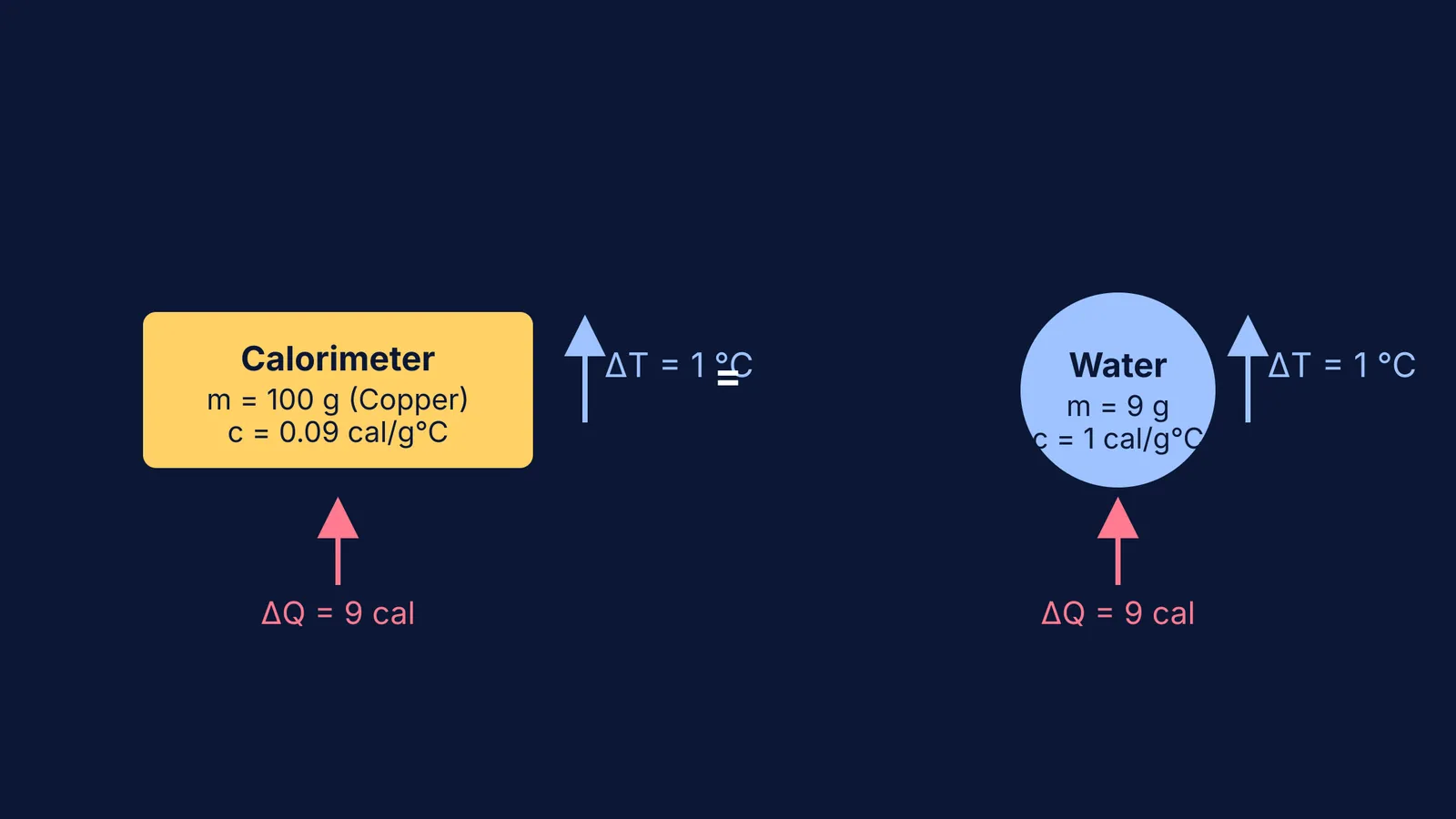
The heat capacity (C) of the calorimeter is the actual amount of heat required to raise the temperature of the whole container by 1 °C. For a 100 g copper calorimeter with a specific heat of 0.09 cal/g°C, its heat capacity is 100 × 0.09 = 9 cal/°C. Its unit is energy per degree. (You can read more about how heat capacity changes under different conditions in Heat in isobaric and isochoric processes: using nCpΔT and nCvΔT).
The water equivalent (W), however, is a mass. It asks the question: "How much water would have this exact same heat capacity?" Because the specific heat of water is 1 cal/g°C, the heat capacity of 9 g of water is also 9 cal/°C. Therefore, the water equivalent is 9 g. Its unit is purely mass.
The distinction matters in your final equations. You can add the water equivalent directly to the mass of the water (m_w + W) and multiply the sum by the specific heat of water. If you used heat capacity instead, your equation would look like m_w × s_w × ΔT + C × ΔT. Both give the same result, but calculating the equivalent mass keeps the equation cleaner and prevents unit errors.
Why do we use water equivalent in mixture problems?
When dealing with Calorimetry and heat transfer: mixing, melting and conduction, the principle is always the same: Heat Lost = Heat Gained.
If you pour hot water at T₂ into a calorimeter containing cold water at T₁, the hot water loses heat. Both the cold water and the calorimeter gain that heat until they settle at a final temperature T₃.
Instead of writing a separate term for the calorimeter, you simply add its water equivalent (W) to the mass of the cold water (m₁). The total effective mass absorbing heat becomes (m₁ + W).
The heat balance equation becomes:
m₂ × s_w × (T₂ - T₃) = (m₁ + W) × s_w × (T₃ - T₁)
If you find setting up these balance equations confusing, the Fermi Problem Library has worked problems with a step-by-step solver that explains the reasoning rather than printing an answer, helping you catch exactly where you missed a term.
A worked example: heat of a mixture
Let's say a copper calorimeter has a mass of 100 g. The specific heat of copper is 0.09 cal/g°C. It contains 50 g of water at 20 °C. You add 40 g of water at 60 °C. What is the final temperature?
1. Find the water equivalent
W = m × s = 100 × 0.09 = 9 g
The calorimeter acts like 9 g of water.
2. Find the total cold mass
Effective mass of cold water = 50 g + 9 g = 59 g. (For more on calculating heat changes in closed systems, see Bomb calorimeter: measuring ΔU and converting it to ΔH).
3. Equate heat lost and gained
Heat lost by hot water = 40 × 1 × (60 - T) Heat gained by cold system = 59 × 1 × (T - 20)
40(60 - T) = 59(T - 20)
2400 - 40T = 59T - 1180
3580 = 99T
T = 36.16 °C
By treating the metal container as just a little bit more water, you turn a three-part heat problem into a straightforward two-part balance.


