On this page
You are standing on a platform when a train runs through without stopping. Its whistle slides from high to low just as the engine draws level with you. The whistle itself never changed. What changed is how often its wave crests reach your ear. That is the Doppler effect, a standard question in chapters on sound waves.
Why does a train whistle sound higher as it approaches?
A moving whistle chases its own sound forward. Each new crest leaves from a point a little closer to you, so the crests arrive bunched together: a shorter wavelength and a higher frequency. Behind the train, the crests are stretched apart and the pitch is lower. OpenStax University Physics, section 17.7 describes the moment of passing: the frequency heard by a stationary observer "changes from a constant high frequency to a constant lower frequency".
For a listener standing still in still air, the same OpenStax section gives the heard frequency as f = f0 × v / (v − vs) for an approaching source and f = f0 × v / (v + vs) for a receding one. Here f0 is the whistle's own frequency, v is the speed of sound and vs is the train's speed.
The speed of sound in air is about 344 m/s at 20 °C, according to HyperPhysics. Below we use 340 m/s, the round value OpenStax uses in its own train example.
What frequency do you hear from a train at 30 m/s?
Take a 500 Hz whistle on a train moving at 30 m/s (108 km/h), with v = 340 m/s and the OpenStax formulas above.
Approaching: f = 500 × 340 / (340 − 30) = 500 × 340 / 310 = 548.4 Hz.
Receding: f = 500 × 340 / (340 + 30) = 500 × 340 / 370 = 459.5 Hz.
The drop as it passes: 548.4 − 459.5 = 88.9 Hz, about 89 Hz.
If an exam asks only for the drop, combine the two steps: Δf = 2 f0 v vs / (v² − vs²) = 2 × 500 × 340 × 30 / (115,600 − 900) = 88.9 Hz. When the train is much slower than sound, 2 f0 vs / v = 88.2 Hz is a good estimate you can do in your head.
OpenStax works the same idea with a 150 Hz horn on a train at 35.0 m/s and gets 167 Hz approaching and 136 Hz receding; try it yourself to check your method.
If the signs keep flipping on you, the Fermi Problem Library has worked problems with a step-by-step solver that explains the reasoning rather than printing an answer.
What do you hear at the instant the train passes?
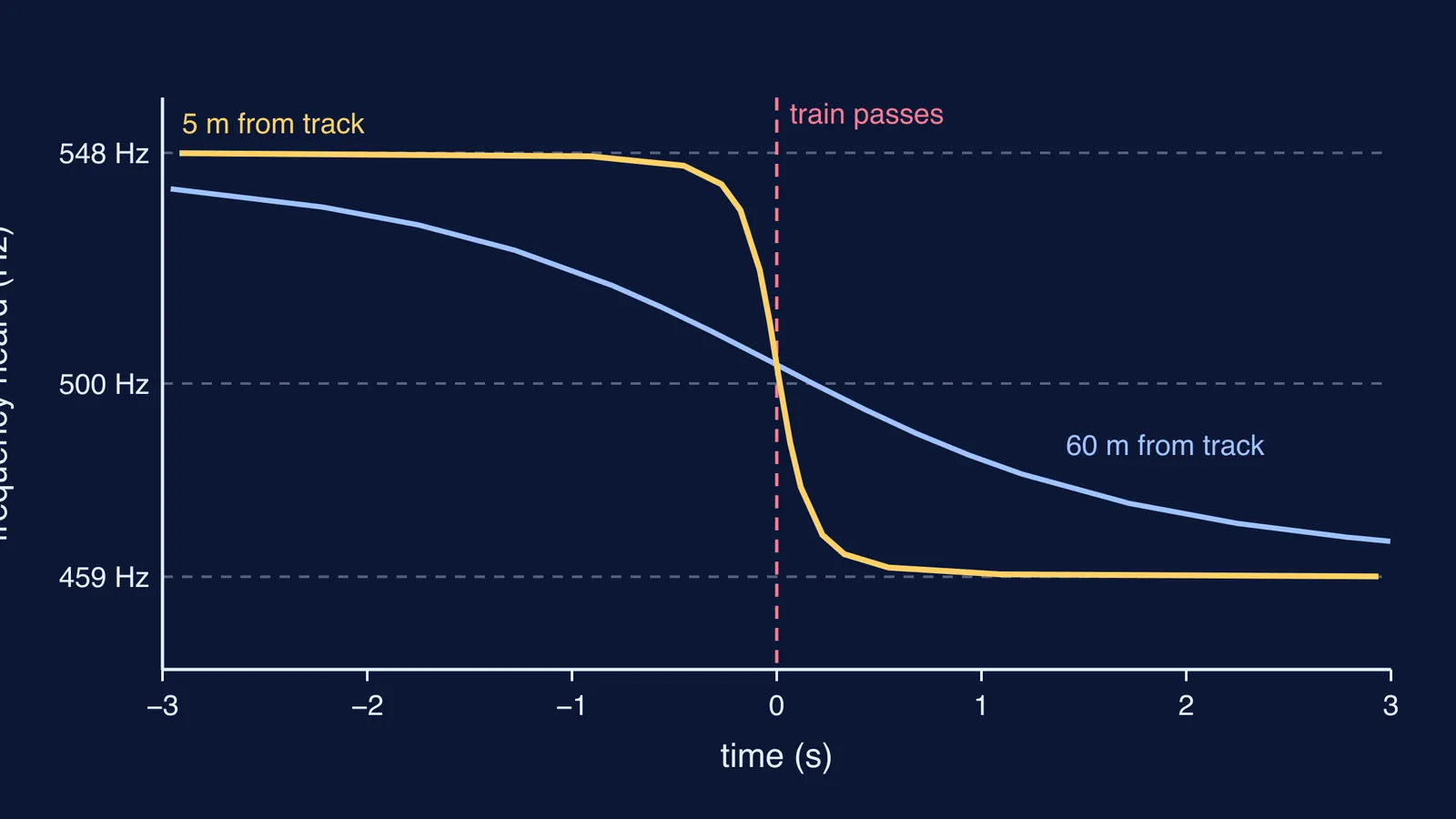
Textbook problems use only the two far-off values, as if the pitch jumped. HyperPhysics describes "a noticeable drop in the pitch" as a vehicle passes; in reality the drop is a slide whose speed depends on where you stand.
If you stand a distance d from the track, only the part of the train's velocity along the line to your ear counts. The formula becomes f = f0 × v / (v − vs cos θ), where θ is the angle between the train's direction and the line from the train to you when the sound left it. Far away and approaching, θ is near 0 and you hear about 548 Hz. When the train is level with you, θ is 90°, cos θ is 0, and the sound it sends then reaches you at exactly 500 Hz. Far past, θ is near 180° and you hear about 459 Hz.
Two details most solutions skip:
Sound takes time to reach you, so the 500 Hz note emitted when the engine is level with you arrives d/v later: 0.015 s if you stand 5 m away, 0.18 s at 60 m.
The closer you stand, the sharper the slide. Working the formula through at 5 m, the pitch falls from about 542 Hz to 464 Hz in roughly 0.6 seconds. At 60 m the same slide is spread over several seconds.
The diagram at the top of this post plots both cases.
How do you set up any train whistle problem?
Use this checklist before you write a number:
Convert speeds to m/s: divide km/h by 3.6.
Decide who moves relative to the air: the source, the listener, or both.
Pick the sign: approaching gives a higher frequency, receding a lower one.
Use the speed of sound the question gives; if none, say which value you assumed.
Sanity-check: the drop should be roughly 2 f0 vs / v.
The Doppler formula rests on v = fλ, so if that feels shaky, read how wave speed, frequency and wavelength fit together. The speed of sound also changes with temperature and medium: see how temperature changes an organ pipe's frequency and why sound through a rail track reaches you before sound in air.
Next time a train passes, listen for the slide, then work out its speed from the two pitches.