

On this page
Most students can recite v = fλ. Fewer can say which of the three quantities is in charge when one of them changes, and that is where many numericals go wrong. Here is the relation for sound, with real numbers and a short checklist for numericals.
What is the relation between wave speed, frequency and wavelength?
Wave speed equals frequency multiplied by wavelength, v = fλ, where v is in metres per second, f in hertz and λ in metres (OpenStax University Physics, Volume 1, section 17.2).
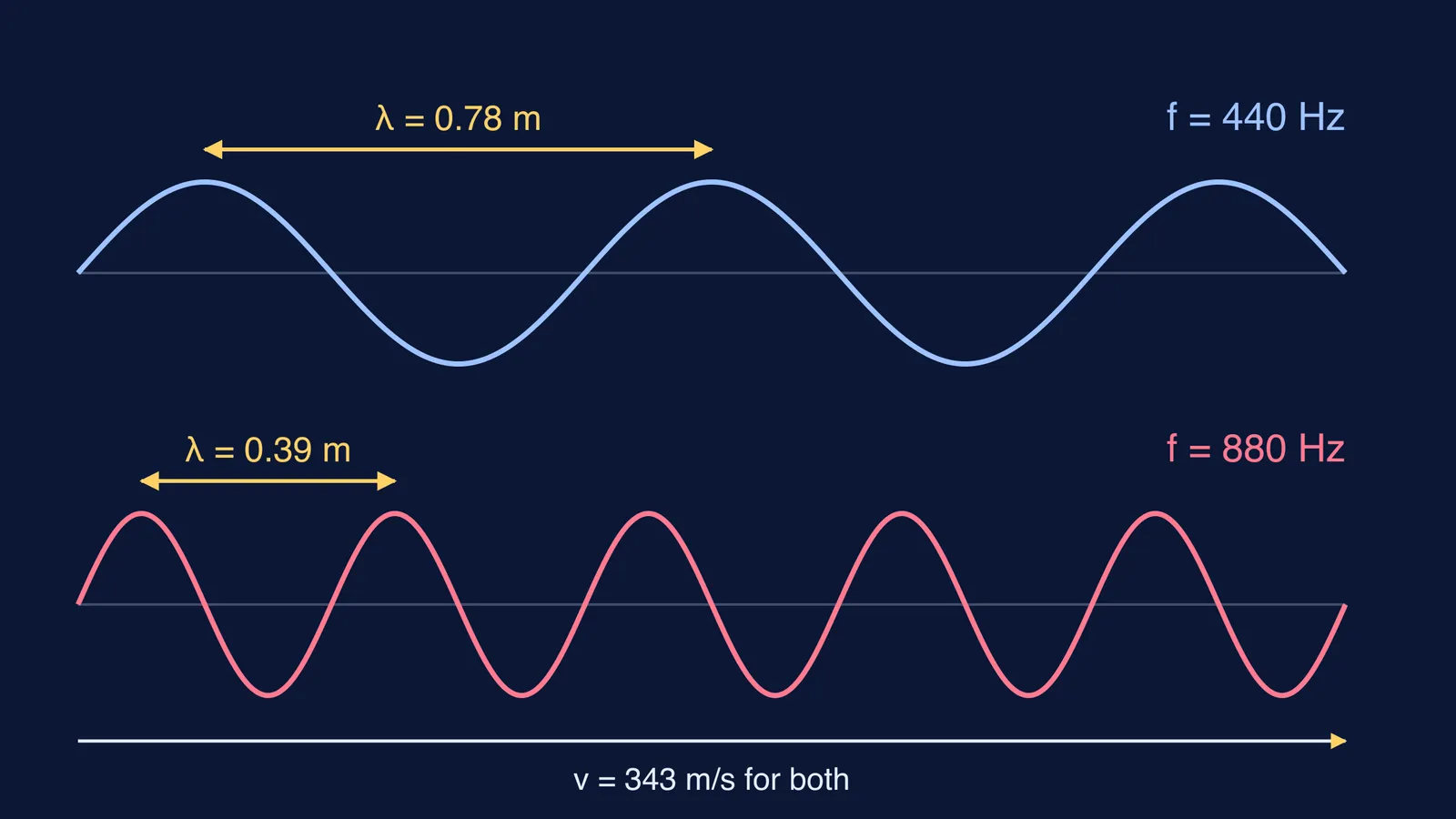
The reasoning is short. Frequency is how many wave crests pass a point each second. Wavelength is the distance between neighbouring crests. If 440 crests pass you every second and each is 0.78 m behind the one before, the wave front has moved 440 × 0.78 ≈ 343 m in that second. That is the speed.
The equation has three letters, but for sound they are not equal partners. The same OpenStax chapter says the frequency of a sound "is the same as that of the source", while the speed of sound "depends on the medium and on the state of the medium" (OpenStax, section 17.2). The source decides f. The air decides v. Wavelength is what is left over: λ = v ÷ f.
Why does wavelength get shorter as pitch rises?
Pitch is how we hear frequency, and in open air the speed of sound is nearly independent of frequency (OpenStax, section 17.2). OpenStax gives an everyday proof: music from a marching band arrives in step even at the far end of a stadium, so high and low notes must travel at nearly the same speed.
If v stays fixed and f goes up, λ must come down by the same factor. Double the frequency and the wavelength halves. Musicians call a doubling of frequency an octave: an octave is a 2:1 frequency ratio, and the A above middle C is often set at 440 Hz (UNSW Music Acoustics, note names and frequencies).
Worked example: how long is each note?
Take air at 20 °C, where sound travels at 343 m/s (OpenStax, section 17.2). Use λ = v ÷ f for each note, starting from A at 440 Hz and moving up and down in octaves (UNSW Music Acoustics).
A at 220 Hz: λ = 343 ÷ 220 ≈ 1.56 m, about the height of a short adult.
A at 440 Hz: λ = 343 ÷ 440 ≈ 0.78 m, roughly the width of a door.
A at 880 Hz: λ = 343 ÷ 880 ≈ 0.39 m, half the previous value.
A at 1760 Hz: λ = 343 ÷ 1760 ≈ 0.195 m, half again.
Now stretch it to the edges of human hearing. OpenStax uses 20 Hz and 20,000 Hz as the extremes of the audible range (OpenStax, section 17.2). At 343 m/s, a 20 Hz rumble has a wavelength of about 17 m, longer than most classrooms, and a 20,000 Hz whistle has a wavelength of about 1.7 cm, shorter than your thumb. Every note crossed the room at 343 m/s; only the spacing of the crests changed.
What changes when sound moves into water or a hotter room?
Here the medium changes, so v changes, and f stays fixed because the source has not changed. Wavelength follows v.
Water: sound in fresh water travels at about 1480 m/s (OpenStax, Table 17.1), so the same 440 Hz note has λ = 1480 ÷ 440 ≈ 3.4 m.
A hot afternoon: the speed of sound in air follows v = 331 m/s × √(T ÷ 273 K), with T in kelvin (OpenStax, section 17.2). On a 35 °C day in Delhi or Chennai, T ≈ 308 K, so v ≈ 352 m/s and the 440 Hz note stretches to about 0.80 m.
If the picture of crests bunching up and spreading out is hard to hold in your head, the Fermi Simulation Lab has interactive simulations for ideas that are easier to see than to read.
A three-question checklist for v = fλ numericals
Before you touch the calculator, answer these in the margin:
What is the source, and did it change? If not, frequency is fixed.
What is the medium, and did it change (including its temperature)? If not, speed is fixed.
So which quantity is left to change? That one is your answer, found from v = fλ.
Also convert kHz to Hz and cm to m before dividing.
For practice, the Fermi Problem Library has worked problems with a step-by-step solver that explains the reasoning rather than printing an answer, so you can see where each of the three questions fits.
Next time a note rises in pitch, picture the crests squeezing closer while the wave keeps the same speed.


