On this page
Your grandparent holds the newspaper at arm's length to read it, then looks over their glasses to watch the cricket. That is presbyopia, and it is why some spectacles have a line across the middle. Below: why one lens power is not enough, and a worked example that finds both powers of a bifocal.
What is presbyopia?
Presbyopia is the gradual loss of the eye's ability to focus on nearby objects with age, which NCERT's Class 10 chapter The Human Eye and the Colourful World traces to "the gradual weakening of the ciliary muscles and diminishing flexibility of the eye lens." The same chapter says the near point of a young adult with normal vision is about 25 cm and the far point is infinity; with presbyopia, the near point "gradually recedes away".
The US National Eye Institute says everyone gets presbyopia as they get older, usually after age 45, and that with age the lens in the eye gets harder and less flexible. The World Health Organization names presbyopia as the main condition causing near vision impairment, affecting 826 million people.
Why does presbyopia need two lens powers?
The key idea is accommodation: how much the eye lens can change its power between looking far and looking near. Power in dioptres is 1 divided by the distance in metres, so the change your eye makes is 1/near point − 1/far point. For the normal eye in the NCERT chapter, that is 1/0.25 − 0 = 4 D, which we work through in why the eye's power changes by 4 D from far to near.
A spectacle lens has one fixed power. It can slide your range of clear vision nearer or farther, but it cannot make the range wider. Once the eye's own range has shrunk to a sliver, one lens cannot cover both the road and the book.
NCERT notes that a person may suffer from both myopia and hypermetropia and then often needs bi-focal lenses: "The upper portion consists of a concave lens. It facilitates distant vision. The lower part is a convex lens. It facilitates near vision." The American Academy of Ophthalmology describes bifocals the same way: the bottom of the lens is for close-up vision and the top for distant objects.
How do you find the power of each part of a bifocal lens?
We use the sign convention and lens formula from the NCERT Class 10 chapter Light – Reflection and Refraction: distances are measured from the lens, an object in front of it has negative u, 1/v − 1/u = 1/f, and P = 1/f with f in metres. We treat the spectacles as sitting right at the eye.
Problem. A 55-year-old can see clearly only between 100 cm and 200 cm from their eyes. Find the power of the upper and lower parts of the bifocal lens that lets them see distant objects and read a book held at 25 cm.
Check the range. Their accommodation is 1/1.0 − 1/2.0 = 0.5 D, against 4 D for the normal eye. That is one-eighth of the normal range.
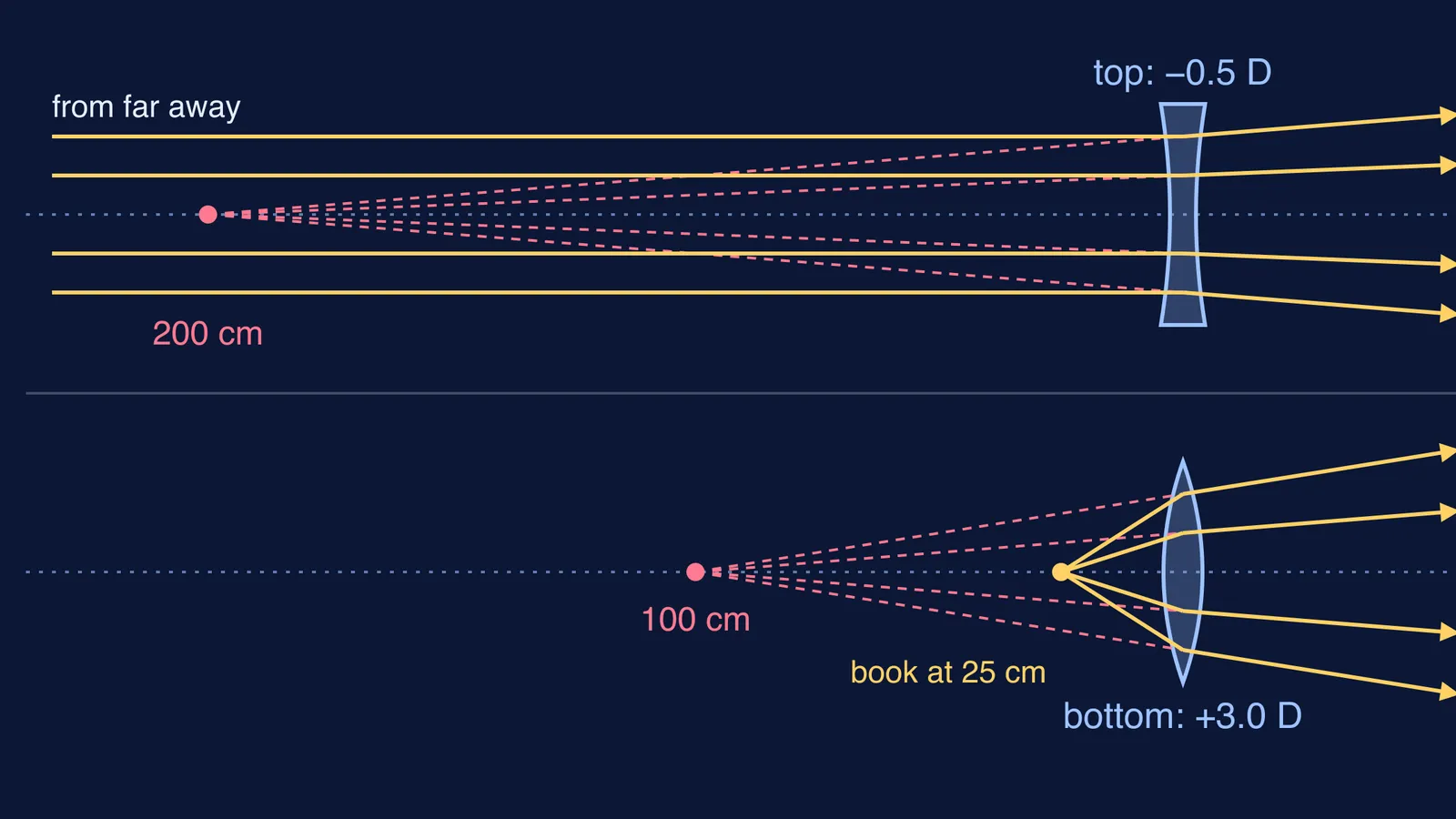
Upper part, for distance. A far object (u = −∞) must form a virtual image at their far point, v = −200 cm. So 1/f = 1/(−200) − 0, giving f = −200 cm = −2 m and P = −0.5 D, a concave lens.
Lower part, for reading. A book at u = −25 cm must form a virtual image at their near point, v = −100 cm. So 1/f = 1/(−100) − 1/(−25) = 3/100, giving f = 33.3 cm = 0.333 m and P = +3.0 D, a convex lens.
Check the coverage. Through the upper part, an object at 200 cm gives 1/v = 1/(−200) + 1/(−200), so v = −100 cm, the near point: the top shows everything from 2 m to infinity. Through the lower part, an image at the far point needs 1/u = 1/(−200) − 3/100, so u ≈ −28.6 cm: the bottom covers only about 25 cm to 29 cm.
Step 4 is often left out, yet it explains a real complaint. With these glasses on, anything between about 29 cm and 2 m, a laptop screen for instance, is not sharp through either part. Lens makers fill that gap: the American Academy of Ophthalmology says trifocals add a mid-range area, and in progressive lenses refraction changes gradually from the top of the lens to the bottom.
What mistakes cost marks in bifocal questions?
These four come up again and again with the NCERT sign convention:
Taking v = +100 cm. The image the eye looks at is virtual and on the same side as the book, so v is negative.
Forgetting units. P = 1/f needs f in metres; with f in cm, use P = 100/f.
Swapping the parts. Your eyes look down to read, so the bottom is the reading part.
Assuming every presbyopic eye needs a concave top. If the far point is still at infinity, only a reading power is needed; the top is for people who also need help with distance.
If a step trips you up, the Fermi Problem Library has worked problems with a step-by-step solver that explains the reasoning, so you can see where a sign went wrong rather than only the final answer. To practise each half on its own, try correcting short sight with a concave lens and the hypermetropia near point worked example.
One note for parents: this is the physics of a textbook question, not a prescription. If you or a grandparent find small print getting harder to read, an eye test with an optometrist or ophthalmologist will measure the actual powers needed.